Mino Masaaki, Kanno Keishi, Okimoto Kousuke, Sugiyama Akiko, Kishikawa Nobusuke, Kobayashi Tomoki, Ono Junya, Izuhara Kenji, Kobayashi Tsuyoshi, Ohigashi Toshikazu, Ohdan Hideki, Tazuma Susumu
Department of General Internal Medicine Hiroshima University Hospital Hiroshima Japan.
Central Institute Shino-Test Corporation Kanagawa Japan.
Hepatol Commun. 2017 Oct 25;1(10):1099-1109. doi: 10.1002/hep4.1114. eCollection 2017 Dec.
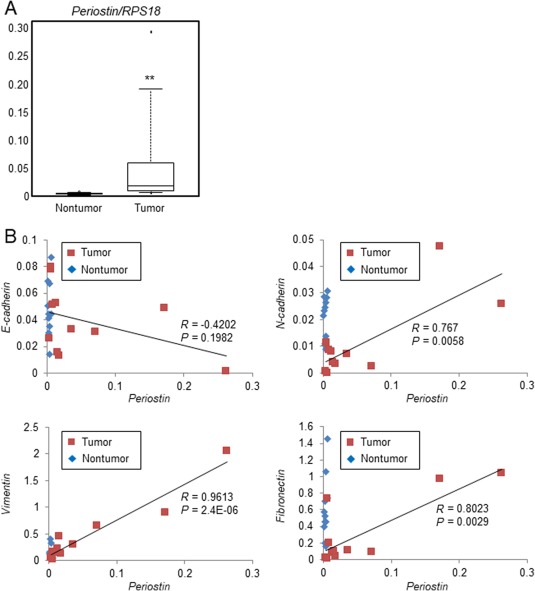
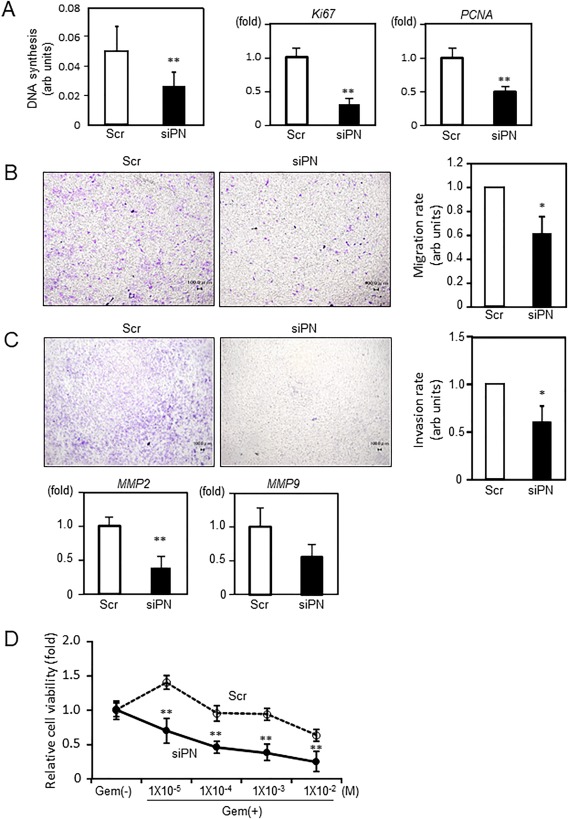
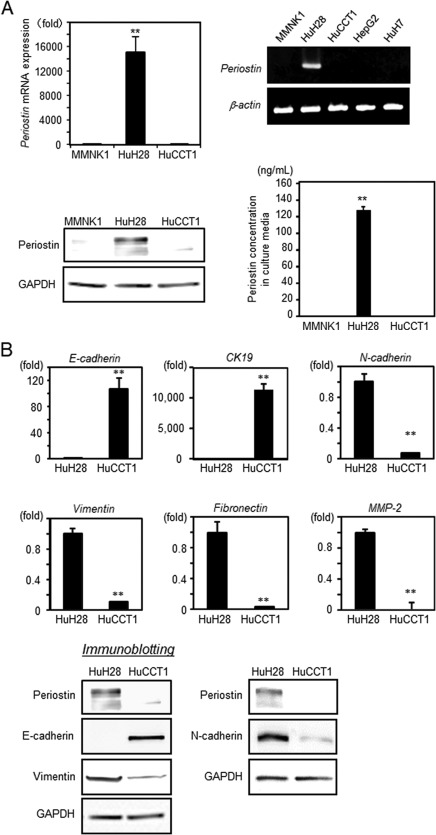
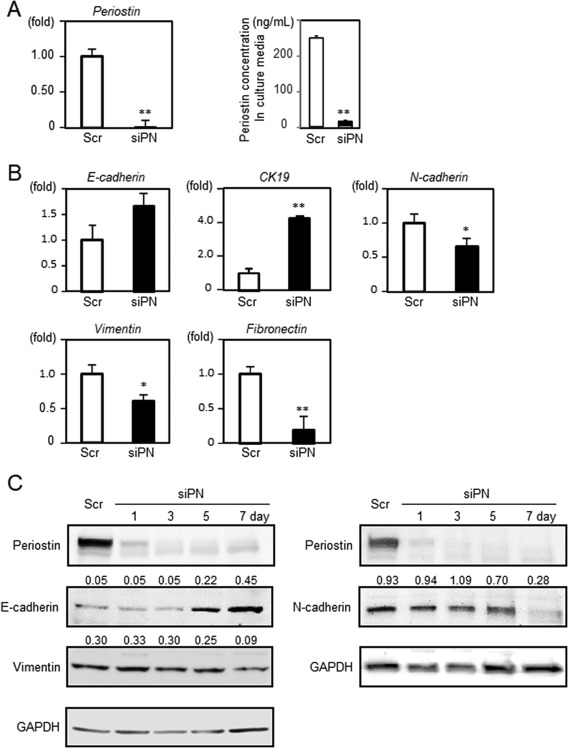
Periostin, a secreted matricellular protein, has been reported to induce epithelial-mesenchymal transition (EMT), which increases motility and invasiveness in various epithelial cancer cells. Periostin is also overexpressed in intrahepatic cholangiocarcinoma (ICC) and suggested to be a biomarker for tumor progression and poor prognosis; however, its functional role in ICC is not fully understood. Here, we investigated whether periostin influences malignant potential through the induction of EMT in ICC. Analyses of surgical resected ICC specimens revealed that the gene expression of periostin was significantly higher in ICC tumors than in adjacent nontumor liver tissues and was closely correlated with the expression of mesenchymal markers, including N-cadherin, vimentin, and fibronectin. However, the expression level of periostin varied in each case. Consistently, the expression of periostin in HuH28 (an undifferentiated ICC cell) was markedly higher than in HuCCT-1 (a moderately differentiated ICC cell). In addition, high-level secretion of periostin into culture media was observed in HuH28 but not in HuCCT-1. To identify the biological significance of periostin in EMT, gene silencing of periostin by small interfering RNA was performed in HuH28 cells. Periostin knockdown in HuH28 cells significantly down-regulated mesenchymal markers and up-regulated epithelial markers, suggesting the reversal of EMT, namely mesenchymal-epithelial transition. Along with these changes, cell proliferation was significantly suppressed by 52%. In addition, cell migration and invasion were significantly suppressed by 62% and 61%, respectively, with reduced gene expression of matrix metalloproteinase 2. Interestingly, chemosensitivity to gemcitabine was also significantly improved by periostin depletion. Periostin plays an important role in the regulation of malignant potential through EMT and is suggested to be a novel target for the treatment of ICC. ( 2017;1:1099-1109).
骨膜蛋白是一种分泌性基质细胞蛋白,据报道可诱导上皮-间质转化(EMT),从而增加多种上皮癌细胞的迁移能力和侵袭性。骨膜蛋白在肝内胆管癌(ICC)中也呈过表达,提示其为肿瘤进展和预后不良的生物标志物;然而,其在ICC中的功能作用尚未完全明确。在此,我们研究了骨膜蛋白是否通过诱导ICC中的EMT影响恶性潜能。对手术切除的ICC标本分析显示,骨膜蛋白的基因表达在ICC肿瘤中显著高于相邻的非肿瘤肝组织,且与包括N-钙黏蛋白、波形蛋白和纤连蛋白在内的间质标志物的表达密切相关。然而,骨膜蛋白的表达水平在每个病例中有所不同。同样,骨膜蛋白在HuH28(一种未分化的ICC细胞)中的表达明显高于HuCCT-1(一种中度分化的ICC细胞)。此外,在HuH28中观察到骨膜蛋白向培养基中的高水平分泌,而在HuCCT-1中未观察到。为了确定骨膜蛋白在EMT中的生物学意义,在HuH28细胞中通过小干扰RNA对骨膜蛋白进行基因沉默。HuH28细胞中骨膜蛋白的敲低显著下调了间质标志物并上调了上皮标志物,提示EMT的逆转,即间质-上皮转化。伴随这些变化,细胞增殖被显著抑制了52%。此外,细胞迁移和侵袭分别被显著抑制了62%和61%,同时基质金属蛋白酶2的基因表达降低。有趣的是,骨膜蛋白的缺失也显著提高了对吉西他滨的化疗敏感性。骨膜蛋白通过EMT在恶性潜能的调节中起重要作用,提示其为ICC治疗的新靶点。(2017;1:1099 - 1109)