Canini Laetitia, Koh Christopher, Cotler Scott J, Uprichard Susan L, Winters Mark A, Han Ma Ai Thanda, Kleiner David E, Idilman Ramazan, Yurdaydin Cihan, Glenn Jeffrey S, Heller Theo, Dahari Harel
Program for Experimental and Theoretical Modeling Division of Hepatology, Loyola University Medical Center Maywood IL.
Centre for Immunity Infection and Evolution, University of Edinburgh Edinburgh United Kingdom.
Hepatol Commun. 2017 May 19;1(4):288-292. doi: 10.1002/hep4.1043. eCollection 2017 Jun.
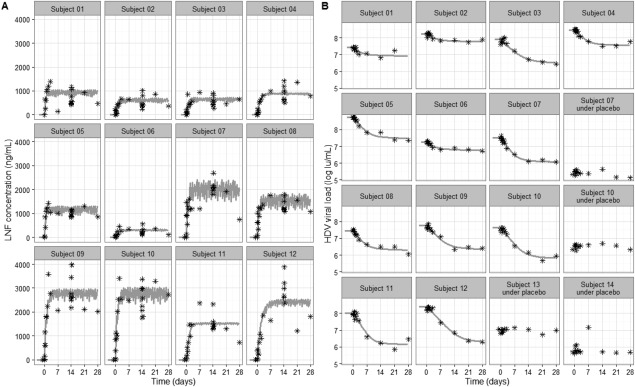
The prenylation inhibitor lonafarnib (LNF) is a potent antiviral agent providing a breakthrough for the treatment of hepatitis delta virus (HDV). The current study used a maximum likelihood approach to model LNF pharmacokinetic (PK) and pharmacodynamic (PD) parameters and predict the dose needed to achieve 99% efficacy using data from 12 patients chronically infected with HDV and treated with LNF 100 mg twice daily (bid) (group 1) or 200 mg bid (group 2) for 28 days. The LNF-PK model predicted average steady-state LNF concentrations of 860 ng/mL and 1,734 ng/mL in groups 1 and 2, respectively, with an LNF absorption rate k = 0.43/hour and elimination rate k = 0.045/hour. The PK/PD model identified an average delay of 0.56 hours and an LNF concentration that decreases HDV production by 50%, EC50 = 227 ng/mL, with a Hill factor = 1.48. The HDV half-life in blood was 1.87 days, and the average steady-state LNF efficacy in blocking HDV production was ɛ = 87.7% for group 1 and ɛ = 95.2% for group 2. A biphasic HDV decline with an average phase 1 decline (0.9 log IU/mL and 1.32 log IU/mL) was observed in groups 1 and 2, respectively. Phase 2 was not significantly ( 0.94) different between the two groups, with an average slope of -0.06 log IU/mL/day. The model suggests an LNF dose of ∼610 mg bid would achieve ɛ = 99%. : The first PK/PD modeling study in patients with chronic HDV indicates that a ∼3-fold increase in LNF dose (∼610 mg bid) would achieve 99% antiviral efficacy. A ritonavir-boosted LNF combination may provide a means to increase LNF efficacy with minimal side effects. The modeling findings provide an important advance in understanding HDV dynamics and the basis to optimize LNF therapy for hepatitis D. ( 2017;1:288-292).
异戊二烯化抑制剂洛那法尼(LNF)是一种有效的抗病毒药物,为丁型肝炎病毒(HDV)的治疗带来了突破。本研究采用最大似然法对LNF的药代动力学(PK)和药效学(PD)参数进行建模,并利用12例慢性HDV感染患者的数据预测达到99%疗效所需的剂量,这些患者接受每日两次(bid)100mg(第1组)或每日两次200mg(第2组)的LNF治疗28天。LNF-PK模型预测第1组和第2组的LNF平均稳态浓度分别为860ng/mL和1734ng/mL,LNF吸收速率k = 0.43/小时,消除速率k = 0.045/小时。PK/PD模型确定平均延迟为0.56小时,使HDV产生减少50%的LNF浓度,即EC50 = 227ng/mL,希尔系数 = 1.48。HDV在血液中的半衰期为1.87天,第1组阻断HDV产生的平均稳态LNF疗效为ɛ = 87.7%,第2组为ɛ = 95.2%。在第1组和第2组中分别观察到HDV呈双相下降,第1阶段平均下降(0.9 log IU/mL和1.32 log IU/mL)。两组之间的第2阶段差异不显著(0.94),平均斜率为-0.06 log IU/mL/天。该模型表明,每日两次约610mg的LNF剂量将达到ɛ = 99%。:第一项针对慢性HDV患者的PK/PD建模研究表明,LNF剂量增加约3倍(每日两次约610mg)将实现99%的抗病毒疗效。利托那韦增强的LNF联合用药可能提供一种以最小副作用提高LNF疗效的方法。建模结果为理解HDV动态提供了重要进展,并为优化丁型肝炎的LNF治疗奠定了基础。(2017;1:288 - 292)