Goh George Boon-Bee, Li James Weiquan, Chang Pik-Eu, Chow Khuan-Yew, Tan Chee-Kiat
Department of Gastroenterology and Hepatology Singapore General Hospital Singapore.
Duke-NUS Medical School Singapore.
Hepatol Commun. 2017 Jun 14;1(6):564-571. doi: 10.1002/hep4.1059. eCollection 2017 Aug.
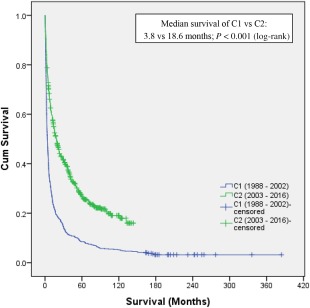
Hepatocellular carcinoma (HCC) is one of the most common and lethal cancers globally. With advances in therapy for chronic viral hepatitis, changing social circumstances, and increasing practice of HCC surveillance, the epidemiology of HCC is expected to change over time. We explored the temporal trends in HCC in Singapore, a multiethnic Asian country, over the last 3 decades. Patients with HCC were prospectively enrolled and stratified into two cohorts (C1, 1988-2002; C2, 2003-2016). Patient and tumor characteristics, management, and survival were compared between the two cohorts, and a survival census was performed on October 31, 2015. There were 1,401 patients, and the mean age at diagnosis of HCC for C1 and C2 was 60.1 and 63.5 years, respectively. Male patient preponderance decreased significantly, with the male to female ratio falling from 5.2:1 to 3.9:1 between C1 and C2. Hepatitis B, although still the predominant risk factor for HCC, showed a significant decline from C1 to C2 (76.5% to 68.2%), while the nonviral etiology increased significantly over the same period (14.4% versus 25.0%, respectively). Significantly more patients in C2 than C1 were diagnosed through surveillance (39.2% versus 11.3%, respectively) and had better physical performance (Eastern Cooperative Oncology Group 0, 62.1% versus 20.4%, respectively). While Child-Pugh status was comparable, significantly more patients in C2 than C1 had early stage disease (Barcelona Clinic Liver Cancer 0-A, 39.5% versus 7.4%, respectively), which translated into significantly higher median survival (18.6 months versus 3.8 months, respectively). : Over the past 3 decades, hepatitis B-related HCC has been decreasing while HCC due to nonviral etiology has been increasing significantly. Surveillance to diagnose early stage HCC is important in improving the outcome of HCC. ( 2017;1:564-571).
肝细胞癌(HCC)是全球最常见且致命的癌症之一。随着慢性病毒性肝炎治疗方法的进步、社会环境的变化以及HCC监测工作的日益普及,预计HCC的流行病学情况会随时间发生改变。我们探究了过去30年里新加坡这个多民族亚洲国家HCC的时间趋势。对HCC患者进行前瞻性登记,并分为两个队列(C1,1988 - 2002年;C2,2003 - 2016年)。比较了两个队列之间的患者和肿瘤特征、治疗情况及生存率,并于2015年10月31日进行了生存普查。共有1401例患者,C1和C2队列中HCC诊断时的平均年龄分别为60.1岁和63.5岁。男性患者占优势的情况显著下降,C1和C2队列之间的男女比例从5.2∶1降至3.9∶1。乙型肝炎虽然仍是HCC的主要危险因素,但从C1到C2显著下降(从76.5%降至68.2%),而同期非病毒病因显著增加(分别为14.4%和25.0%)。C2队列中通过监测诊断出的患者显著多于C1队列(分别为39.2%和11.3%),且身体状况更好(东部肿瘤协作组0级,分别为62.1%和20.4%)。虽然Child-Pugh分级情况相当,但C2队列中处于疾病早期(巴塞罗那临床肝癌0 - A期)的患者显著多于C1队列(分别为39.5%和7.4%),这使得C2队列的中位生存期显著更长(分别为18.6个月和3.8个月)。在过去30年里,乙型肝炎相关的HCC一直在减少,而非病毒病因导致的HCC则显著增加。监测以诊断早期HCC对改善HCC的预后很重要。(2017;1:564 - 571)