Nasr Patrik, Ignatova Simone, Kechagias Stergios, Ekstedt Mattias
Department of Gastroenterology and Hepatology, Department of Medical and Health Sciences Linköping University Linköping Sweden.
Department of Clinical Pathology and Clinical Genetics, Department of Clinical and Experimental Medicine Linköping University Linköping Sweden.
Hepatol Commun. 2017 Dec 27;2(2):199-210. doi: 10.1002/hep4.1134. eCollection 2018 Feb.
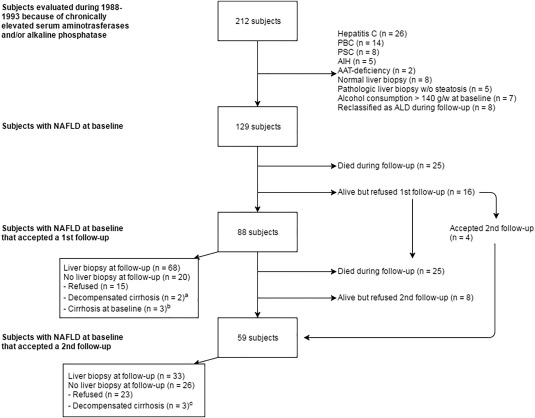
Nonalcoholic fatty liver disease (NAFLD) is the most prevalent chronic liver disease in the world. The complete natural history of NAFLD is unknown because few high-quality follow-up studies have been conducted. Our aim was to find variables predicting disease severity through an extended follow-up with serial biopsies. In a prospective cohort study, 129 patients who enrolled between 1988 and 1993 were asked to participate in a follow-up study on two occasions; biochemical, clinical, and histologic data were documented. The mean time between biopsies was 13.7 (±1.7) and 9.3 (±1.0) years, respectively. At the end of the study period, 12 patients (9.3%) had developed end-stage liver disease and 34% had advanced fibrosis. Out of the 113 patients with baseline low fibrosis (<3), 16% developed advanced fibrosis. Fibrosis progression did not differ among the different stages of baseline fibrosis ( = 0.374). Fifty-six patients (43%) had isolated steatosis, of whom 9% developed advanced fibrosis (3 patients with biopsy-proven fibrosis stage F3-F4 and 2 patients with end-stage liver disease). Fibrosis stage, ballooning, and diabetes were more common in patients who developed end-stage liver disease; however, there were no baseline clinical, histologic, or biochemical variables that predicted clinical significant disease progression. : NAFLD is a highly heterogeneous disease, and it is surprisingly hard to predict fibrosis progression. Given enough time, NAFLD seems to have a more dismal prognosis then previously reported, with 16% of patients with fibrosis stage <3 developing advanced fibrosis and 9.3% showing signs of end-stage liver disease. ( 2018;2:199-210).
非酒精性脂肪性肝病(NAFLD)是全球最常见的慢性肝病。由于很少进行高质量的随访研究,NAFLD的完整自然病程尚不清楚。我们的目的是通过连续活检的长期随访来寻找预测疾病严重程度的变量。在一项前瞻性队列研究中,邀请了1988年至1993年间入组的129名患者分两次参与随访研究;记录了生化、临床和组织学数据。两次活检之间的平均时间分别为13.7(±1.7)年和9.3(±1.0)年。在研究期结束时,12名患者(9.3%)发展为终末期肝病,34%有进展性肝纤维化。在113名基线肝纤维化程度低(<3)的患者中,16%发展为进展性肝纤维化。不同基线肝纤维化阶段的纤维化进展无差异(=0.374)。56名患者(43%)有单纯性脂肪变性,其中9%发展为进展性肝纤维化(活检证实纤维化分期为F3-F4的3名患者和2名终末期肝病患者)。肝纤维化分期、气球样变和糖尿病在发展为终末期肝病的患者中更常见;然而,没有基线临床、组织学或生化变量能够预测具有临床意义的疾病进展。:NAFLD是一种高度异质性疾病,令人惊讶的是很难预测纤维化进展。给予足够的时间,NAFLD的预后似乎比之前报道的更差,16%纤维化分期<3的患者发展为进展性肝纤维化,9.3%出现终末期肝病迹象。(2 : 199 - 210) (2018年)