UNC-Project Malawi, Lilongwe, Malawi.
Center for Biostatistics in AIDS Research, Harvard T. H. Chan School of Public Health, Boston, MA.
J Acquir Immune Defic Syndr. 2018 May 1;78(1):54-61. doi: 10.1097/QAI.0000000000001641.
Hepatotoxicity associated with isoniazid preventive therapy (IPT) and antiretroviral therapy (ART) has not been well studied in severely immunosuppressed people with HIV. Our objective was to determine risk factors for hepatotoxicity in severely immunosuppressed individuals taking IPT and ART.
Multicenter study in resource-limited settings with high burden of tuberculosis.
We conducted a secondary analysis of data from 1 randomized arm of the REMEMBER trial. The analysis includes participants with pre-ART CD4 cell counts of <50 cells/μL receiving IPT and ART for 24 weeks. Hepatotoxicity was defined as elevated aspartate aminotransferase (AST) or alanine aminotransferase (ALT) >5 × upper limit of normal or symptomatic hepatitis during IPT and ART. Logistic regression was used to identify baseline risk factors for hepatotoxicity. Time to occurrence of hepatotoxicity was estimated by the Kaplan-Meier method.
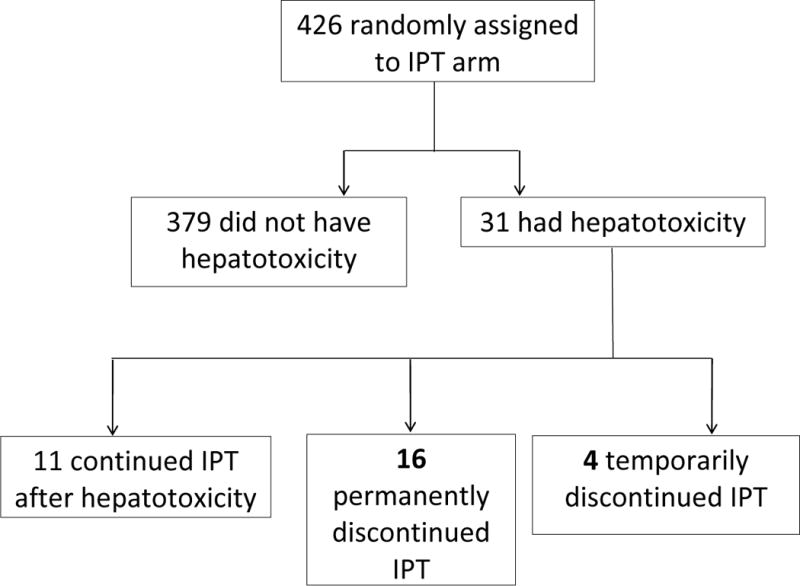
Among 426 participants (53% male, median age 35 years, median CD4 count 19 cells/µL), 31 developed hepatotoxicity (7.3%). Raised pretreatment AST/ALT (odds ratio [OR] 3.6, 95% confidence interval [CI]: 1.7 to 7.7) and hepatitis B surface antigen (HBsAg) seropositivity at baseline (OR 4.7, 95% CI: 1.7 to 12.9) were significantly associated with an increased risk of developing hepatotoxicity. Participants with both raised AST/ALT and positive HBsAg had a higher risk (OR 19.9, 95% CI: 5.3 to 74.3) and earlier onset of hepatotoxicity than participants who did not have these conditions at baseline.
The incidence of hepatotoxicity during IPT and ART was high. Severely immunosuppressed individuals with raised pretreatment AST/ALT or HBsAg seropositivity need closer monitoring for hepatotoxicity.
异烟肼预防性治疗(IPT)和抗逆转录病毒治疗(ART)相关的肝毒性在 HIV 感染且严重免疫抑制的人群中尚未得到充分研究。我们的目的是确定接受 IPT 和 ART 的严重免疫抑制个体发生肝毒性的相关危险因素。
在结核病负担高的资源有限环境中进行的多中心研究。
我们对 REMEMBER 试验的一个随机臂进行了二次分析。该分析包括接受 IPT 和 ART 治疗 24 周的 ART 前 CD4 细胞计数<50 个/μL 的参与者。肝毒性定义为 IPT 和 ART 期间天门冬氨酸氨基转移酶(AST)或丙氨酸氨基转移酶(ALT)升高>正常上限的 5 倍或有症状的肝炎。使用逻辑回归确定肝毒性的基线危险因素。通过 Kaplan-Meier 方法估计肝毒性发生的时间。
在 426 名参与者(53%为男性,中位年龄 35 岁,中位 CD4 计数 19 个/μL)中,有 31 名发生了肝毒性(7.3%)。基线时升高的预处理 AST/ALT(比值比 [OR] 3.6,95%置信区间 [CI]:1.7 至 7.7)和乙型肝炎表面抗原(HBsAg)阳性(OR 4.7,95%CI:1.7 至 12.9)与肝毒性风险增加显著相关。同时存在 AST/ALT 升高和 HBsAg 阳性的参与者发生肝毒性的风险更高(OR 19.9,95%CI:5.3 至 74.3),且肝毒性发生时间更早。
IPT 和 ART 期间肝毒性的发生率较高。接受 IPT 和 ART 治疗的严重免疫抑制个体,如果存在预处理 AST/ALT 升高或 HBsAg 血清阳性,需要更密切监测肝毒性。