Ooka Masato, Abe Takuya, Cho Kosai, Koike Kaoru, Takeda Shunichi, Hirota Kouji
Department of Chemistry, Graduate School of Science and Engineering, Tokyo Metropolitan University, 1-1 Minami-osawa, Hachioji, Tokyo, Japan.
Department of Radiation Genetics, Graduate School of Medicine, Kyoto University, Yoshidakonoe, Sakyo-ku, Kyoto, Japan.
PLoS One. 2018 Feb 6;13(2):e0192421. doi: 10.1371/journal.pone.0192421. eCollection 2018.
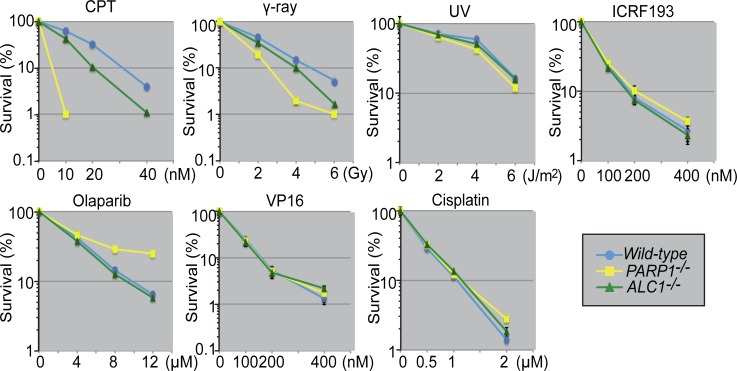
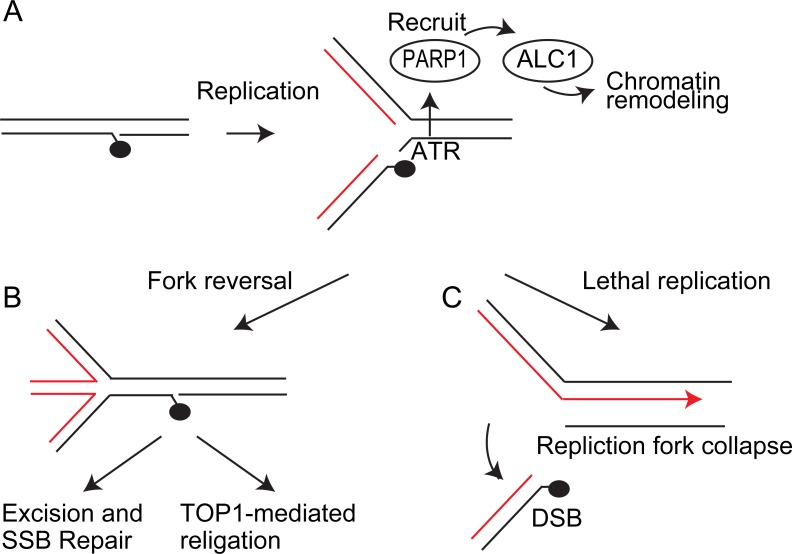
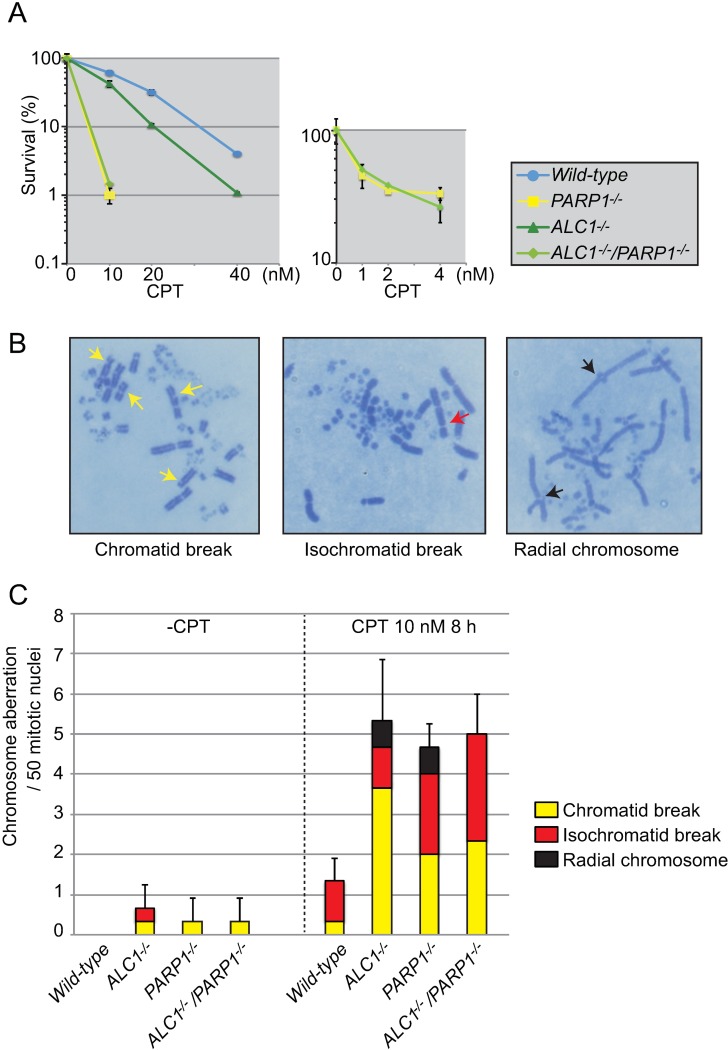
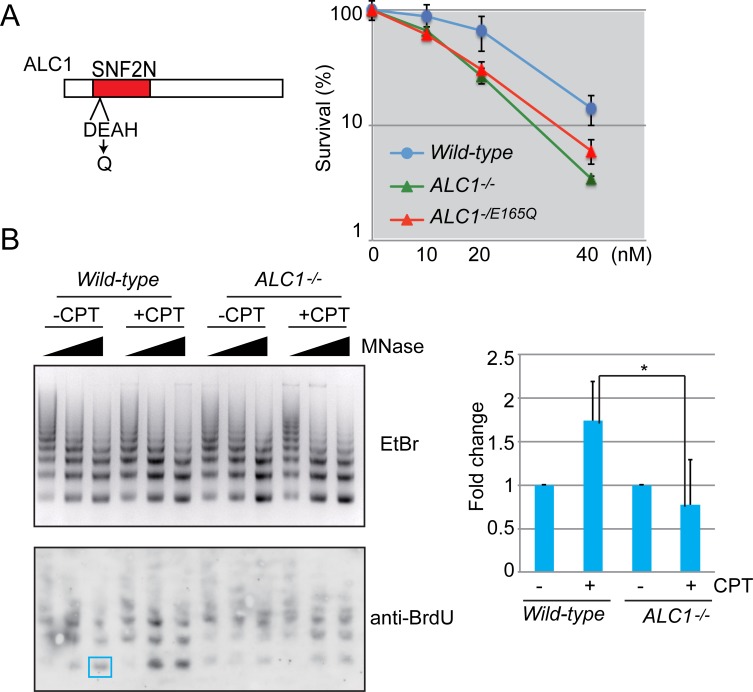
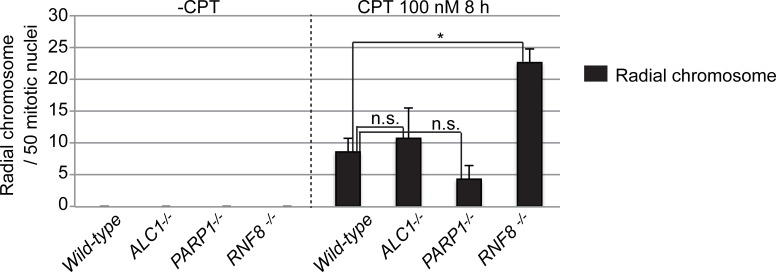
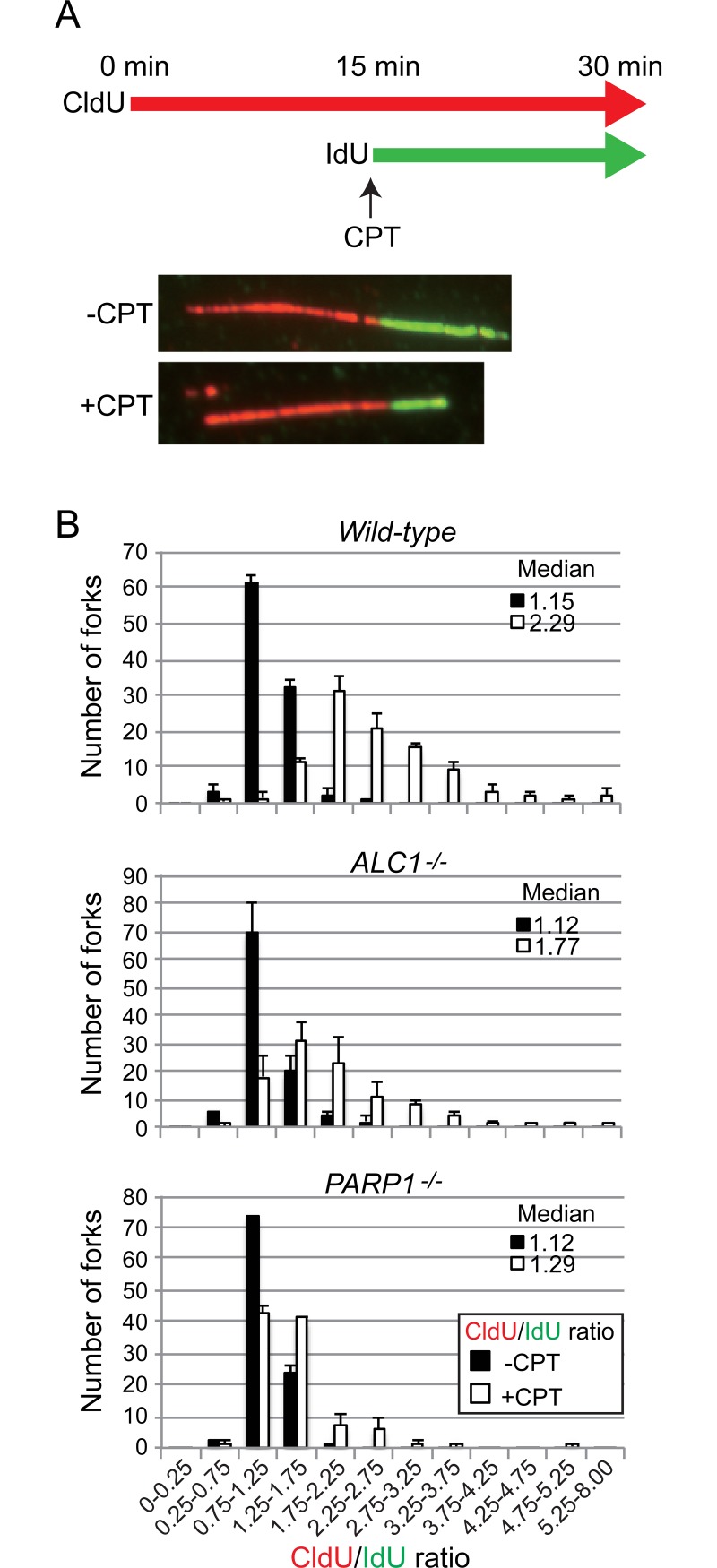
ALC1 (amplified in liver cancer 1), an SNF2 superfamily chromatin-remodeling factor also known as CHD1L (chromodomain helicase/ATPase DNA binding protein 1-like), is implicated in base-excision repair, where PARP (Poly(ADP-ribose) polymerase) mediated Poly(ADP-ribose) signaling facilitates the recruitment of this protein to damage sites. We here demonstrate the critical role played by ALC1 in the regulation of replication-fork progression in cleaved template strands. To analyze the role played by ALC1 as well as its functional relationship with PARP1, we generated ALC1-/-, PARP1-/-, and ALC1-/-/PARP1-/- cells from chicken DT40 cells. We then exposed these cells to camptothecin (CPT), a topoisomerase I poison that generates single-strand breaks and causes the collapse of replication forks. The ALC1-/- and PARP1-/- cells exhibited both higher sensitivity to CPT and an increased number of chromosome aberrations, compared with wild-type cells. Moreover, phenotypes were very similar across all three mutants, indicating that the role played by ALC1 in CPT tolerance is dependent upon the PARP pathway. Remarkably, inactivation of ALC1 resulted in a failure to slow replication-fork progression after CPT exposure, indicating that ALC1 regulates replication-fork progression at DNA-damage sites. We disrupted ATPase activity by inserting the E165Q mutation into the ALC1 gene, and found that the resulting ALC1-/E165Q cells displayed a CPT sensitivity indistinguishable from that of the null-mutant cells. This observation suggests that ALC1 contributes to cellular tolerance to CPT, possibly as a chromatin remodeler. This idea is supported by the fact that CPT exposure induced chromatin relaxation in the vicinity of newly synthesized DNA in wild-type but not in ALC1-/- cells. This implies a previously unappreciated role for ALC1 in DNA replication, in which ALC1 may regulate replication-fork slowing at CPT-induced DNA-damage sites.
ALC1(肝癌1中扩增基因)是一种SNF2超家族染色质重塑因子,也被称为CHD1L(染色质结构域解旋酶/ATP酶DNA结合蛋白1样蛋白),参与碱基切除修复,其中聚(ADP - 核糖)聚合酶(PARP)介导的聚(ADP - 核糖)信号传导促进该蛋白募集到损伤位点。我们在此证明了ALC1在调控切割模板链中的复制叉进展中所起的关键作用。为了分析ALC1所起的作用及其与PARP1的功能关系,我们从鸡DT40细胞中生成了ALC1 - / - 、PARP1 - / - 和ALC1 - / - /PARP1 - / - 细胞。然后我们将这些细胞暴露于喜树碱(CPT),一种拓扑异构酶I毒药,它会产生单链断裂并导致复制叉崩溃。与野生型细胞相比,ALC1 - / - 和PARP1 - / - 细胞对CPT均表现出更高的敏感性以及染色体畸变数量增加。此外,所有三个突变体的表型非常相似,表明ALC1在CPT耐受性中所起的作用依赖于PARP途径。值得注意的是,ALC1的失活导致CPT暴露后复制叉进展未能减缓,表明ALC1在DNA损伤位点调控复制叉进展。我们通过在ALC1基因中插入E165Q突变破坏了ATP酶活性,发现所得的ALC1 - /E165Q细胞表现出与无突变细胞难以区分的CPT敏感性。这一观察结果表明,ALC1可能作为一种染色质重塑因子,有助于细胞对CPT的耐受性。这一观点得到以下事实的支持:CPT暴露在野生型细胞而非ALC1 - / - 细胞中诱导了新合成DNA附近的染色质松弛。这意味着ALC1在DNA复制中具有先前未被认识到的作用,其中ALC1可能在CPT诱导的DNA损伤位点调控复制叉减慢。