Department of Electrical Engineering, Rice University, 6100 Main Street, Houston, TX, 77005, USA; Bioinformatics and Computational Biology, The University of Texas MD Anderson Cancer Center, 1515 Holcombe Boulevard, Houston, TX, 77030, USA.
Department of Radiation Oncology, The University of Texas MD Anderson Cancer Center, 1515 Holcombe Boulevard, Houston, TX, 77030, USA.
Lung Cancer. 2018 Mar;117:73-79. doi: 10.1016/j.lungcan.2018.01.022. Epub 2018 Feb 4.
To determine the prognostic significance of spatial proximity of lung cancer cells and specific immune cells in the tumor microenvironment.
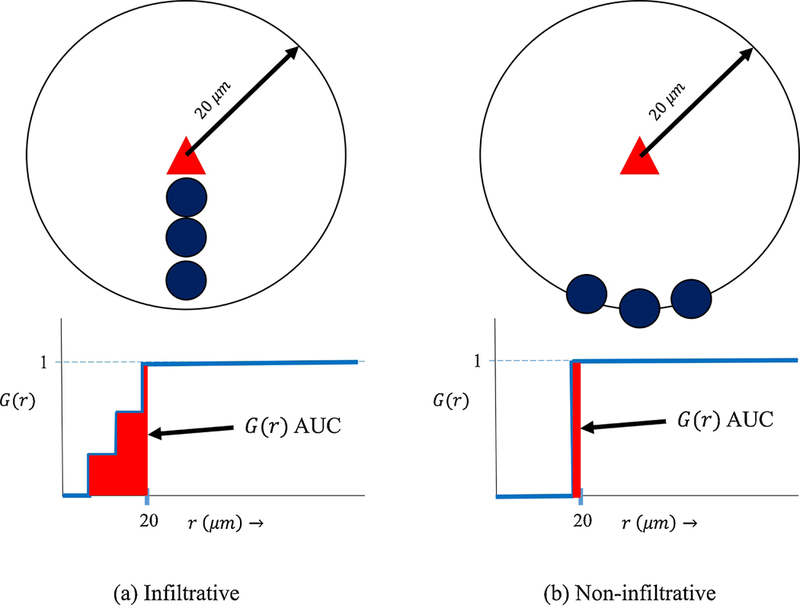
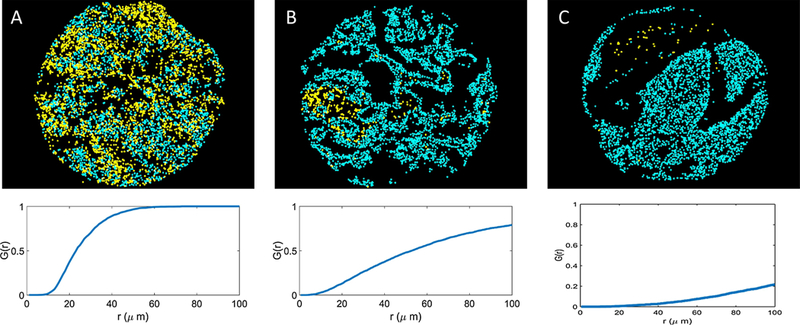
We probed formalin-fixed, paraffin-embedded (FFPE) tissue microarrays using a novel tyramide signal amplification multiplexing technique labelling CD8, CD4, Foxp3, and CD68+ cells. Each multiplex stained immunohistochemistry slide was digitally processed by Vectra INFORMS software, and an X- and Y-coordinate assigned to each labeled cell type. The abundance and spatial location of each cell type and their proximity to one another was analyzed using a novel application of the G-cross spatial distance distribution method which computes the probability of finding at least one immune cell of any given type within a rμm radius of a tumor cell. Cox proportional hazards multiple regression was used for multivariate analysis of the influence of proximity of lymphocyte types.
Pathologic tumor specimens from 120 NSCLC patients with pathologic tumor stage I-III disease were analyzed. On univariate analysis, age (P = .0007) and number of positive nodes (P = .0014) were associated with overall survival. Greater area under the curve (AUC) of the G-cross function for tumor cell-Treg interactions was significantly associated with worse survival adjusting for age and number of positive nodes (HR 1.52 (1.11-2.07), P = .009). Greater G-cross AUC for T-reg-CD8 was significantly associated with better survival adjusting for age and number of positive lymph nodes (HR 0.96 (0.92-0.99), P = .042).
Increased infiltration of regulatory T cells into core tumor regions is an independent predictor of worse overall survival in NSCLC. However, increased infiltration of CD8+ cytotoxic T cells among regulatory T cells seems to mitigate this effect and was significantly associated with better survival. Validation of the G-cross method of measuring spatial proximity between tumor and immune cell types and exploration of its use as a prognostic factor in lung cancer treatment is warranted.
确定肺癌细胞与肿瘤微环境中特定免疫细胞空间接近度的预后意义。
我们使用新型酪胺信号放大多重标记技术对福尔马林固定、石蜡包埋(FFPE)组织微阵列进行探测,标记 CD8、CD4、Foxp3 和 CD68+细胞。每张多重免疫组织化学载玻片均由 Vectra INFORMS 软件进行数字化处理,并为每个标记细胞类型分配 X 和 Y 坐标。使用 G 交叉空间距离分布方法的新应用程序分析每种细胞类型的丰度和空间位置及其彼此之间的接近程度,该方法计算在肿瘤细胞的 rμm 半径内找到任何给定类型的至少一个免疫细胞的概率。使用 Cox 比例风险多变量回归分析淋巴细胞类型接近度的多变量分析的影响。
分析了 120 例 NSCLC 患者的病理肿瘤标本,这些患者患有 I-III 期病理肿瘤疾病。在单变量分析中,年龄(P=0.0007)和阳性淋巴结数量(P=0.0014)与总生存期相关。肿瘤细胞-Treg 相互作用的 G 交叉函数的曲线下面积(AUC)越大,调整年龄和阳性淋巴结数量后,与生存预后越差相关(HR 1.52(1.11-2.07),P=0.009)。调整年龄和阳性淋巴结数量后,Treg-CD8 的 G 交叉 AUC 越大,与生存预后越好相关(HR 0.96(0.92-0.99),P=0.042)。
调节性 T 细胞向核心肿瘤区域的浸润增加是 NSCLC 总生存不良的独立预测因子。然而,CD8+细胞毒性 T 细胞在调节性 T 细胞中的浸润增加似乎减轻了这种影响,并且与更好的生存预后显著相关。验证 G 交叉方法测量肿瘤和免疫细胞类型之间的空间接近度并探索其作为肺癌治疗中的预后因素是有必要的。