Suzuki Yasuhiro, Yatoh Shigeru, Suzuki Hiroaki, Tanabe Yuuki, Shimizu Yukiyo, Hada Yasushi, Shimano Hitoshi
Department of Internal Medicine (Endocrinology and Metabolism), Faculty of Medicine, University of Tsukuba: 1-1-1 Tennodai, Tsukuba, Ibaraki 305-0031, Japan.
Department of Rehabilitation Medicine, University of Tsukuba Hospital, Japan.
J Phys Ther Sci. 2018 Jan;30(1):86-91. doi: 10.1589/jpts.30.86. Epub 2018 Jan 27.
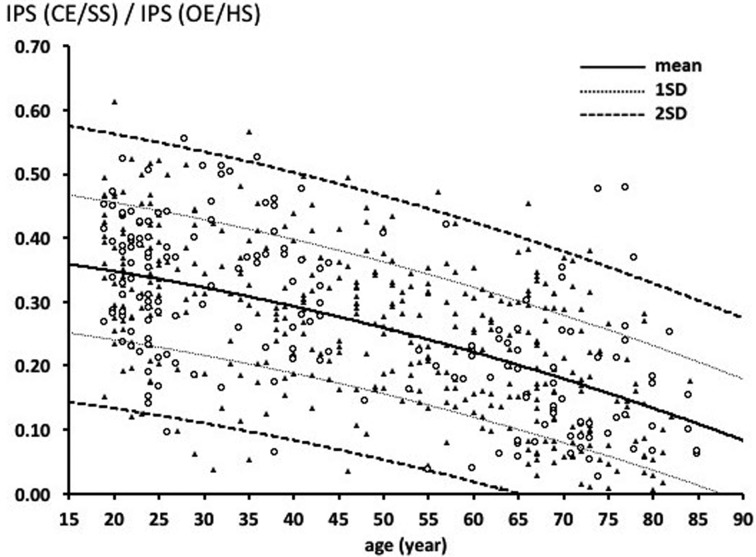
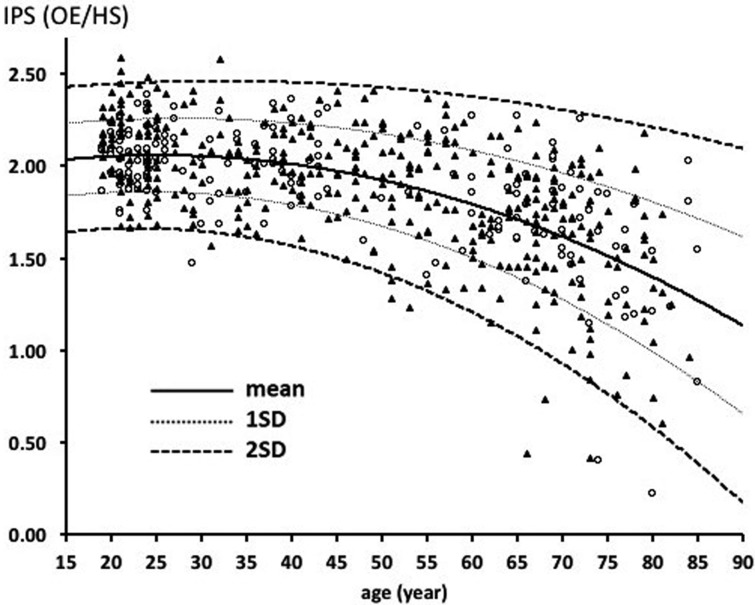
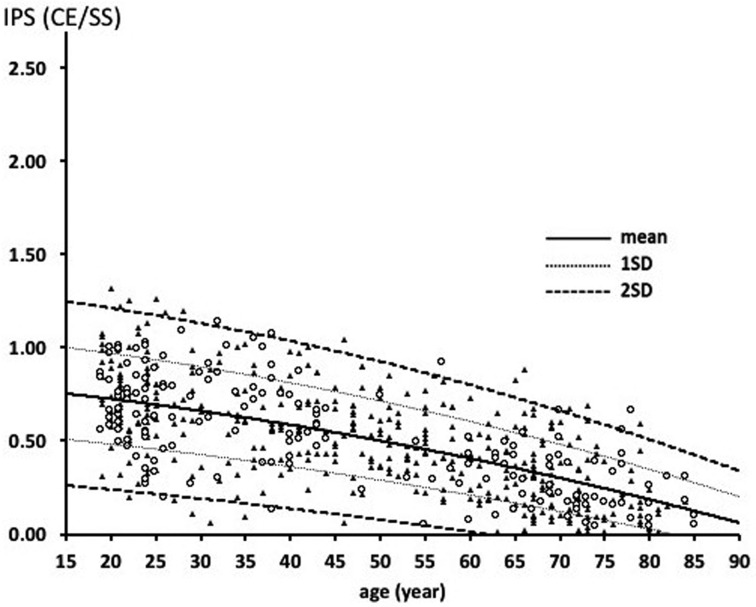
[Purpose] The efficacy of a stabilometer-based index of postural stability (IPS) as an indicator of dynamic balance ability was investigated. [Subjects and Methods] Using a stabilometer, we calculated the IPS in 583 healthy subjects (178 males, 405 females) under two conditions (open eyes/hard surface, OE/HS; closed eyes/soft surface, CE/SS). [Results] Results revealed a negative relation between IPS and age. IPS (OE/HS) began to decrease at middle-age (40-60 years old), and then decreased more rapidly during elderly ages (>60 years old). On the other hand, IPS (CE/SS) decreased linearly with increasing age. There was no gender difference between the two IPSs. [Conclusion] These results suggest that IPS can evaluate balance ability quantitatively and without a ceiling effect. It was concluded that IPS (OE/HS) indicates comprehensive balance ability, while IPS (CE/SS) reveals balance ability without compensation by visual acuity and plantar superficial sense.
[目的] 研究基于稳定仪的姿势稳定性指数(IPS)作为动态平衡能力指标的有效性。[对象与方法] 使用稳定仪,我们在两种条件下(睁眼/硬表面,OE/HS;闭眼/软表面,CE/SS)计算了583名健康受试者(178名男性,405名女性)的IPS。[结果] 结果显示IPS与年龄呈负相关。IPS(OE/HS)在中年(40 - 60岁)开始下降,然后在老年(>60岁)期间下降更快。另一方面,IPS(CE/SS)随年龄增长呈线性下降。两种IPS之间没有性别差异。[结论] 这些结果表明IPS可以定量评估平衡能力且无天花板效应。得出的结论是,IPS(OE/HS)表明综合平衡能力,而IPS(CE/SS)揭示了不受视力和足底浅感觉补偿的平衡能力。