Reeves Adam, Grayhem Rebecca, Hwang Alex D
Department of Psychology, Northeastern University, Boston, MA, United States.
John A. Volpe National Transportation Systems Center, Cambridge, MA, United States.
Front Psychol. 2018 Jan 23;9:8. doi: 10.3389/fpsyg.2018.00008. eCollection 2018.
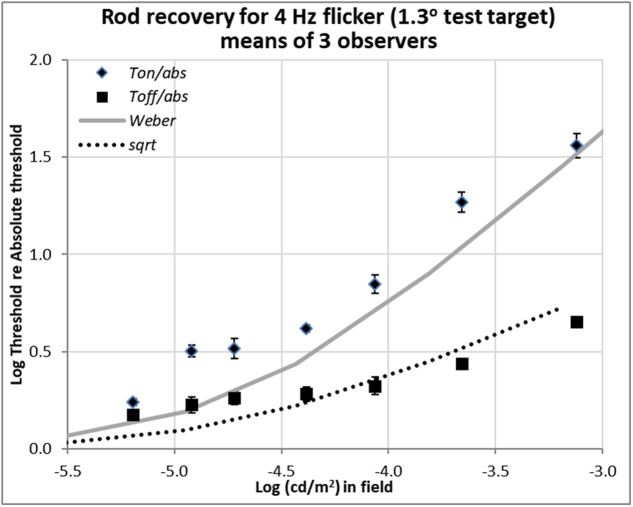
Apart from the well-known loss of color vision and of foveal acuity that characterizes human rod-mediated vision, it has also been thought that night vision is very slow (taking up to 40 min) to adapt to changes in light levels. Even cone-mediated, daylight, vision has been thought to take 2 min to recover from light adaptation. Here, we show that most, though not all adaptation is rapid, taking less than 0.6 s. Thus, monochrome (black-white-gray) images can be presented at mesopic light levels and be visible within a few 10th of a second, even if the overall light level, or level of glare (as with passing headlamps while driving), changes abruptly.
除了众所周知的人类视杆细胞介导的视觉所具有的色觉丧失和中央凹视力下降外,人们还认为夜视适应光照水平的变化非常缓慢(长达40分钟)。即使是视锥细胞介导的日光视觉,也被认为需要2分钟才能从光适应中恢复。在这里,我们表明,虽然并非所有适应都是快速的,但大多数适应都很快,不到0.6秒。因此,即使整体光照水平或眩光水平(如开车时迎面而来的前照灯)突然变化,单色(黑白灰)图像也可以在中间视觉光照水平下呈现,并在几十分之一秒内可见。