Eunice Kennedy Shriver National Institute of Child Health and Human Development, National Institutes of Health, Bethesda, Maryland, USA.
The Henry M. Jackson Foundation for the Advancement of Military Medicine, Inc., Bethesda, Maryland, USA.
Magn Reson Med. 2017 Nov;78(5):1767-1780. doi: 10.1002/mrm.26575. Epub 2017 Jan 16.
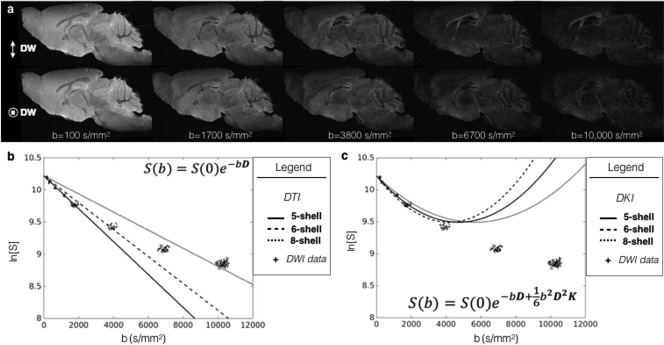
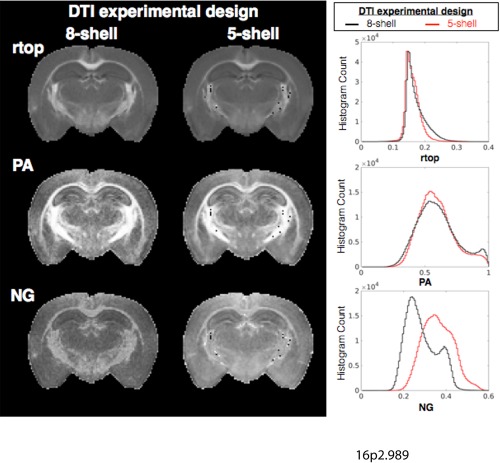
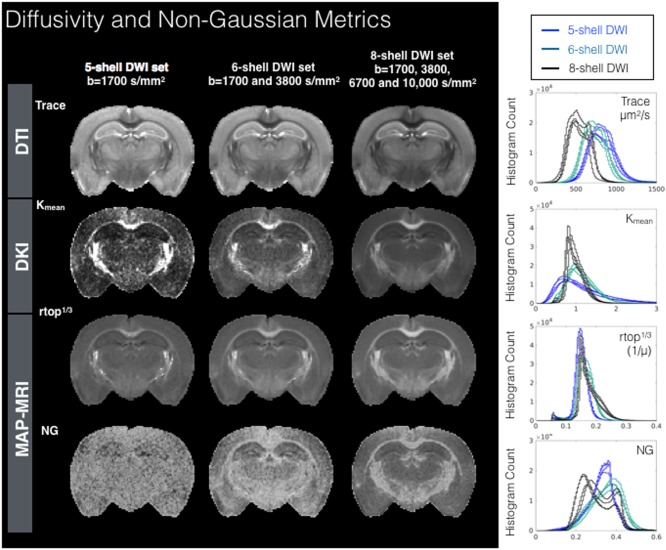
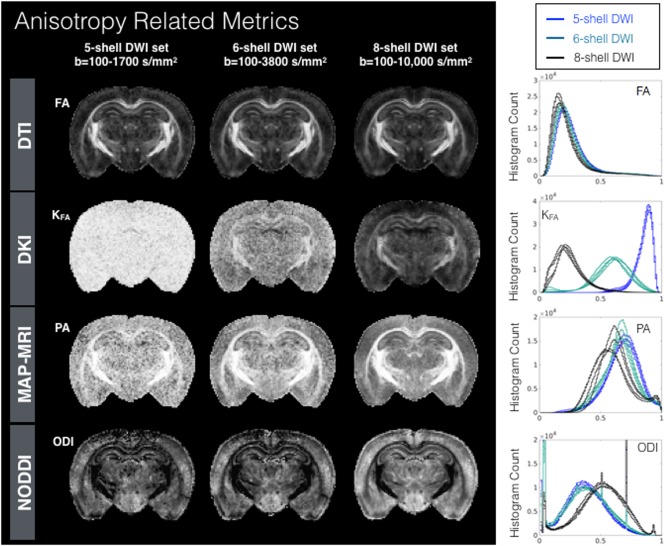
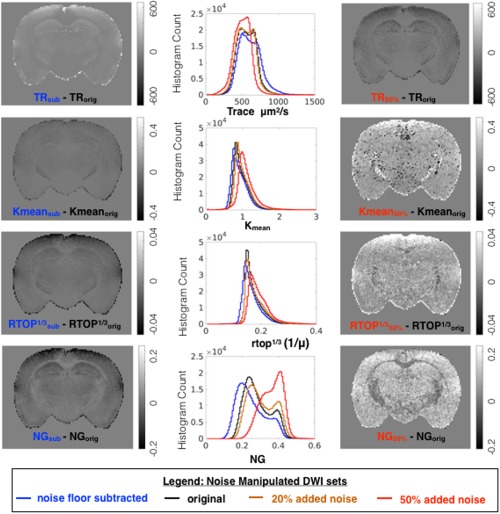
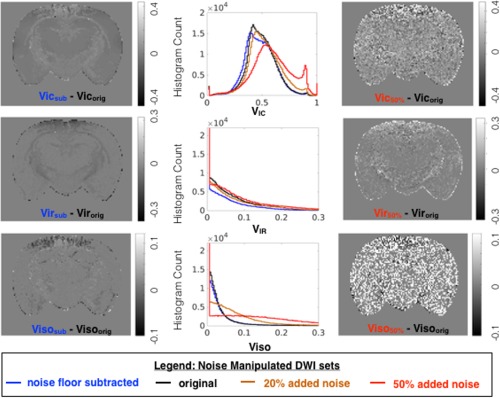
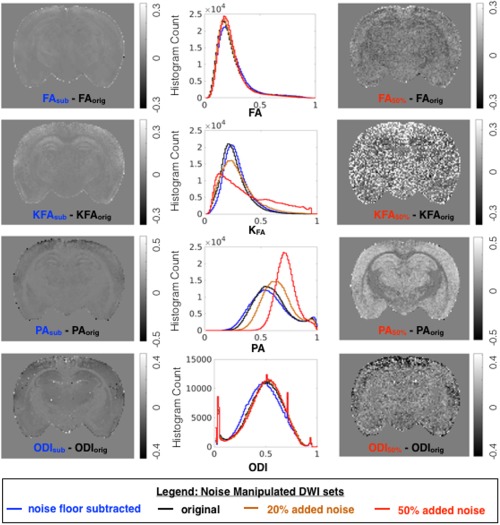
This study was a systematic evaluation across different and prominent diffusion MRI models to better understand the ways in which scalar metrics are influenced by experimental factors, including experimental design (diffusion-weighted imaging [DWI] sampling) and noise.
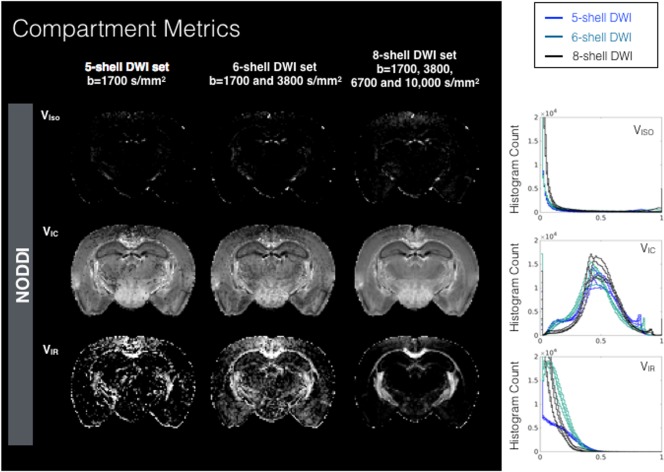
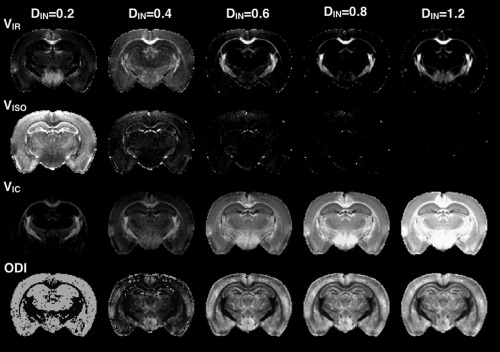
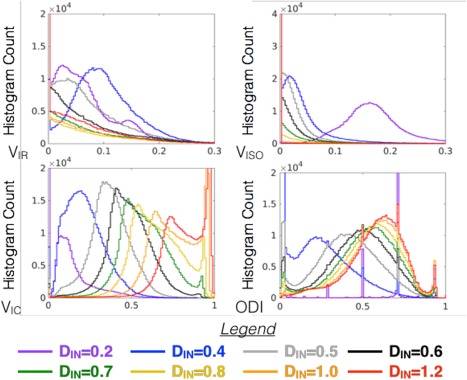
Four diffusion MRI models-diffusion tensor imaging (DTI), diffusion kurtosis imaging (DKI), mean apparent propagator MRI (MAP-MRI), and neurite orientation dispersion and density imaging (NODDI)-were evaluated by comparing maps and histogram values of the scalar metrics generated using DWI datasets obtained in fixed mouse brain with different noise levels and DWI sampling complexity. Additionally, models were fit with different input parameters or constraints to examine the consequences of model fitting procedures.
Experimental factors affected all models and metrics to varying degrees. Model complexity influenced sensitivity to DWI sampling and noise, especially for metrics reporting non-Gaussian information. DKI metrics were highly susceptible to noise and experimental design. The influence of fixed parameter selection for the NODDI model was found to be considerable, as was the impact of initial tensor fitting in the MAP-MRI model.
Across DTI, DKI, MAP-MRI, and NODDI, a wide range of dependence on experimental factors was observed that elucidate principles and practical implications for advanced diffusion MRI. Magn Reson Med 78:1767-1780, 2017. © 2017 International Society for Magnetic Resonance in Medicine.
本研究对不同突出的扩散磁共振成像模型进行了系统评估,以便更好地了解标量指标受实验因素影响的方式,包括实验设计(扩散加权成像[DWI]采样)和噪声。
通过比较使用不同噪声水平和 DWI 采样复杂性获得的固定小鼠脑 DWI 数据集生成的标量指标的图谱和直方图值,对扩散张量成像(DTI)、扩散峰度成像(DKI)、平均表观传播器 MRI(MAP-MRI)和神经丝取向分散和密度成像(NODDI)四种扩散磁共振成像模型进行了评估。此外,还通过使用不同的输入参数或约束条件对模型进行拟合,以检查模型拟合过程的后果。
实验因素以不同的程度影响所有模型和指标。模型复杂性会影响对 DWI 采样和噪声的敏感性,尤其是对于报告非高斯信息的指标。DKI 指标对噪声和实验设计高度敏感。发现 NODDI 模型的固定参数选择的影响相当大,MAP-MRI 模型中初始张量拟合的影响也很大。
在 DTI、DKI、MAP-MRI 和 NODDI 中,观察到对实验因素的广泛依赖性,阐明了高级扩散磁共振成像的原理和实际意义。磁共振医学 78:1767-1780,2017. © 2017 国际磁共振学会。