NORMENT, KG Jebsen Centre for Psychosis Research, Institute of Clinical Medicine, University of Oslo, Oslo, Norway and Division of Mental Health and Addiction, Oslo University Hospital, Oslo, Norway.
NORMENT, KG Jebsen Centre for Psychosis Research, Institute of Clinical Medicine, University of Oslo, Oslo, Norway and Division of Mental Health and Addiction, Oslo University Hospital, Oslo, Norway.
J Am Acad Child Adolesc Psychiatry. 2018 Feb;57(2):86-95. doi: 10.1016/j.jaac.2017.11.013. Epub 2017 Nov 26.
Attention-deficit/hyperactivity disorder (ADHD) is a common and highly heritable psychiatric condition. By exploiting the reported relationship between ADHD and educational attainment (EA), we aimed to improve discovery of ADHD-associated genetic variants and to investigate genetic overlap between these phenotypes.
A conditional/conjunctional false discovery rate (condFDR/conjFDR) method was applied to genome-wide association study (GWAS) data on ADHD (2,064 trios, 896 cases, and 2,455 controls) and EA (n=328,917) to identify ADHD-associated loci and loci overlapping between ADHD and EA. Identified single nucleotide polymorphisms (SNPs) were tested for association in an independent population-based study of ADHD symptoms (n=17,666). Genetic correlation between ADHD and EA was estimated using LD score regression and Pearson correlation.
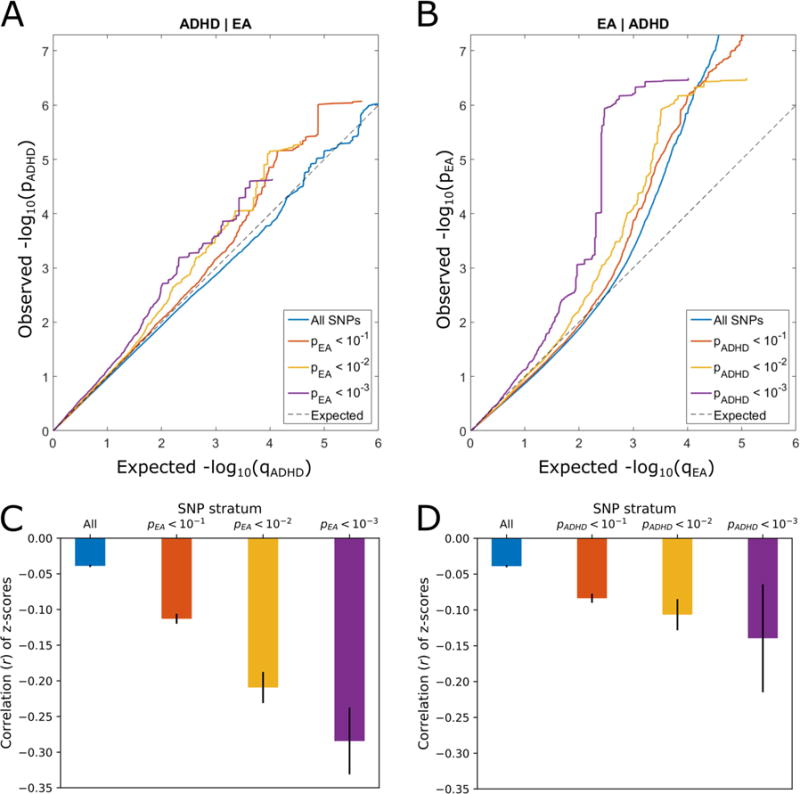
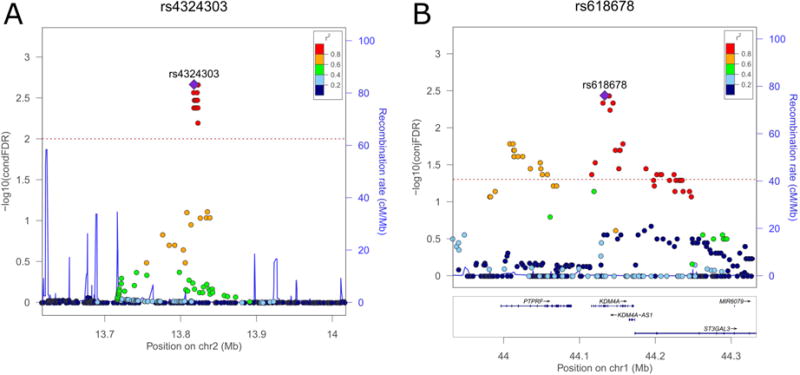
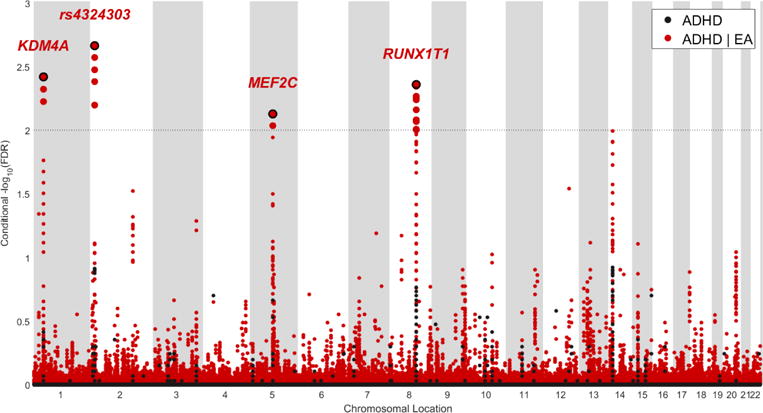
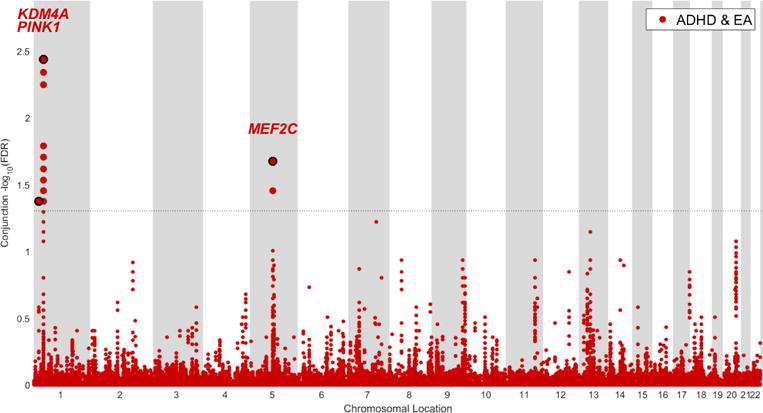
At levels of condFDR<0.01 and conjFDR<0.05, we identified 5 ADHD-associated loci, 3 of these being shared between ADHD and EA. None of these loci had been identified in the primary ADHD GWAS, demonstrating the increased power provided by the condFDR/conjFDR analysis. Leading SNPs for 4 of 5 identified regions are in introns of protein coding genes (KDM4A, MEF2C, PINK1, RUNX1T1), whereas the remaining one is an intergenic SNP on chromosome 2 at 2p24. Consistent direction of effects in the independent study of ADHD symptoms was shown for 4 of 5 identified loci. A polygenic overlap between ADHD and EA was supported by significant genetic correlation (r=-0.403, p=7.90×10) and >10-fold mutual enrichment of SNPs associated with both traits.
We identified 5 novel loci associated with ADHD and provided evidence for a shared genetic basis between ADHD and EA. These findings could aid understanding of the genetic risk architecture of ADHD and its relation to EA.
注意力缺陷多动障碍(ADHD)是一种常见且高度遗传的精神疾病。通过利用 ADHD 与教育程度(EA)之间的已知关系,我们旨在提高与 ADHD 相关的遗传变异的发现,并研究这些表型之间的遗传重叠。
应用条件/联合虚假发现率(condFDR/conjFDR)方法对 ADHD(2064 个三胞胎,896 例病例和 2455 个对照)和 EA(n=328917)的全基因组关联研究(GWAS)数据进行分析,以鉴定与 ADHD 相关的基因座和 ADHD 与 EA 之间重叠的基因座。在一项针对 ADHD 症状的基于人群的独立研究(n=17666)中,对鉴定出的单核苷酸多态性(SNP)进行了关联测试。使用 LD 得分回归和 Pearson 相关估计 ADHD 和 EA 之间的遗传相关性。
在 condFDR<0.01 和 conjFDR<0.05 的水平下,我们鉴定出了 5 个与 ADHD 相关的基因座,其中 3 个在 ADHD 和 EA 之间共享。这些基因座中没有一个在原发性 ADHD GWAS 中被鉴定出来,这表明 condFDR/conjFDR 分析提供了更高的检测能力。5 个鉴定出的区域中的 4 个的主要 SNP 位于蛋白质编码基因的内含子中(KDM4A、MEF2C、PINK1、RUNX1T1),而另一个位于 2 号染色体上的 2p24 上的基因间 SNP。在 ADHD 症状的独立研究中,5 个鉴定出的基因座中的 4 个显示出一致的作用方向。ADHD 和 EA 之间存在显著的遗传相关性(r=-0.403,p=7.90×10)和超过 10 倍的与两种性状相关的 SNP 的相互富集,支持了 ADHD 和 EA 之间存在多基因重叠。
我们鉴定出了 5 个与 ADHD 相关的新基因座,并提供了 ADHD 和 EA 之间存在共同遗传基础的证据。这些发现可以帮助理解 ADHD 的遗传风险结构及其与 EA 的关系。