Torgersen Kristin, Rahman Zillur, Bahrami Shahram, Hindley Guy Frederick Lanyon, Parker Nadine, Frei Oleksandr, Shadrin Alexey, O'Connell Kevin S, Tesli Martin, Smeland Olav B, Munkhaugen John, Djurovic Srdjan, Dammen Toril, Andreassen Ole A
Department of Behavioral Medicine and Faculty of Medicine, University of Oslo, Norway.
NORMENT: Norwegian Centre for Mental Disorders Research, University of Oslo and Oslo University Hospital, Oslo, Norway.
PLoS Genet. 2022 May 13;18(5):e1010161. doi: 10.1371/journal.pgen.1010161. eCollection 2022 May.
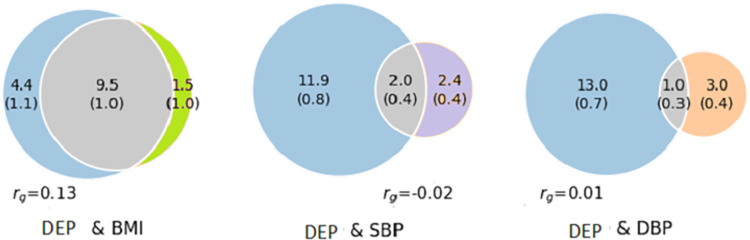
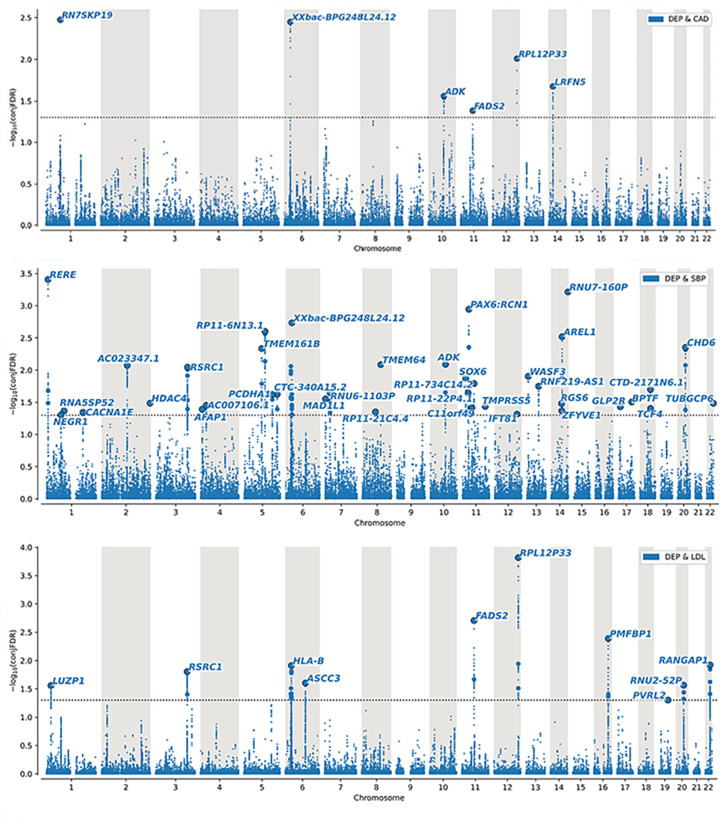
Epidemiological and clinical studies have found associations between depression and cardiovascular disease risk factors, and coronary artery disease patients with depression have worse prognosis. The genetic relationship between depression and these cardiovascular phenotypes is not known. We here investigated overlap at the genome-wide level and in individual loci between depression, coronary artery disease and cardiovascular risk factors. We used the bivariate causal mixture model (MiXeR) to quantify genome-wide polygenic overlap and the conditional/conjunctional false discovery rate (pleioFDR) method to identify shared loci, based on genome-wide association study summary statistics on depression (n = 450,619), coronary artery disease (n = 502,713) and nine cardiovascular risk factors (n = 204,402-776,078). Genetic loci were functionally annotated using FUnctional Mapping and Annotation (FUMA). Of 13.9K variants influencing depression, 9.5K (SD 1.0K) were shared with body-mass index. Of 4.4K variants influencing systolic blood pressure, 2K were shared with depression. ConjFDR identified 79 unique loci associated with depression and coronary artery disease or cardiovascular risk factors. Six genomic loci were associated jointly with depression and coronary artery disease, 69 with blood pressure, 49 with lipids, 9 with type 2 diabetes and 8 with c-reactive protein at conjFDR < 0.05. Loci associated with increased risk for depression were also associated with increased risk of coronary artery disease and higher total cholesterol, low-density lipoprotein and c-reactive protein levels, while there was a mixed pattern of effect direction for the other risk factors. Functional analyses of the shared loci implicated metabolism of alpha-linolenic acid pathway for type 2 diabetes. Our results showed polygenic overlap between depression, coronary artery disease and several cardiovascular risk factors and suggest molecular mechanisms underlying the association between depression and increased cardiovascular disease risk.
流行病学和临床研究发现抑郁症与心血管疾病风险因素之间存在关联,且患有抑郁症的冠状动脉疾病患者预后更差。抑郁症与这些心血管表型之间的遗传关系尚不清楚。我们在此研究了抑郁症、冠状动脉疾病和心血管风险因素在全基因组水平以及个别基因座上的重叠情况。我们基于抑郁症(n = 450,619)、冠状动脉疾病(n = 502,713)和九种心血管风险因素(n = 204,402 - 776,078)的全基因组关联研究汇总统计数据,使用双变量因果混合模型(MiXeR)来量化全基因组多基因重叠,并使用条件/联合错误发现率(pleioFDR)方法来识别共享基因座。基因座使用功能映射与注释(FUMA)进行功能注释。在影响抑郁症的13,900个变异中,9500个(标准差1000)与体重指数共享。在影响收缩压的4400个变异中,2000个与抑郁症共享。联合错误发现率(ConjFDR)确定了79个与抑郁症、冠状动脉疾病或心血管风险因素相关的独特基因座。在联合错误发现率(ConjFDR)< 0.05时,六个基因组基因座与抑郁症和冠状动脉疾病共同相关,69个与血压相关,49个与血脂相关,9个与2型糖尿病相关,8个与C反应蛋白相关。与抑郁症风险增加相关的基因座也与冠状动脉疾病风险增加以及总胆固醇、低密度脂蛋白和C反应蛋白水平升高相关,而其他风险因素的效应方向则呈现混合模式。对共享基因座的功能分析表明,α-亚麻酸途径的代谢与2型糖尿病有关。我们的研究结果显示了抑郁症、冠状动脉疾病和几种心血管风险因素之间的多基因重叠,并提示了抑郁症与心血管疾病风险增加之间关联的分子机制。