Cancer Research Centre, Department of Molecular and Clinical Cancer Medicine, University of Liverpool, United Kingdom.
Gray Laboratories, Cancer Research UK/Medical Research Council Oxford Institute for Radiation Oncology, University of Oxford, Oxford, United Kingdom.
Int J Radiat Oncol Biol Phys. 2018 Mar 1;100(3):776-784. doi: 10.1016/j.ijrobp.2017.11.012. Epub 2017 Nov 14.
To investigate the precise mechanism of recognition and processing of ionizing radiation (IR)-induced complex DNA damage (CDD), where two or more DNA lesions are in close proximity, in cellular DNA which is packaged with histones to form chromatin.
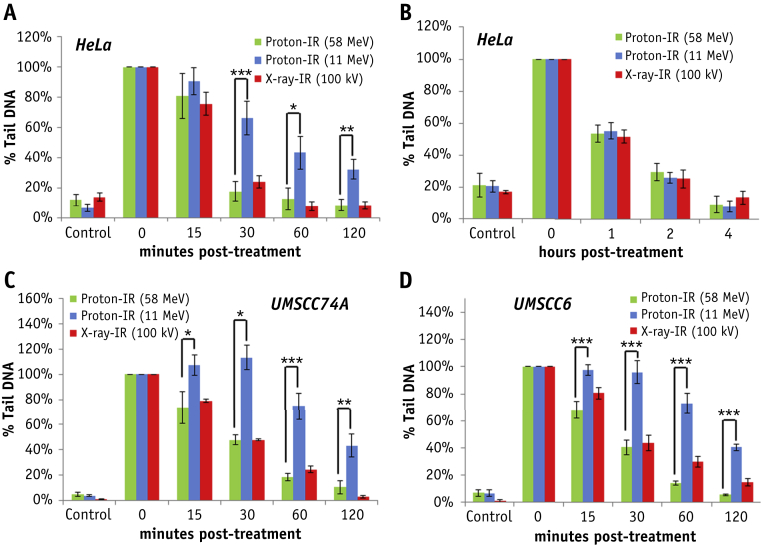
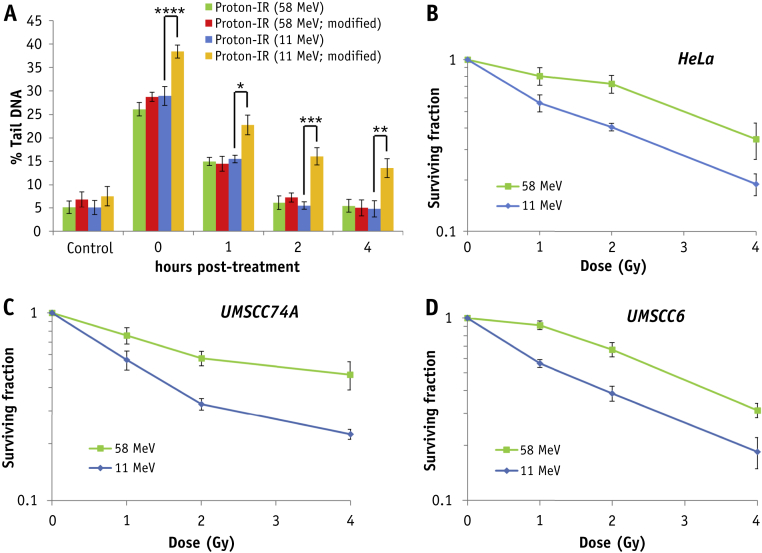
HeLa and oropharyngeal squamous cell carcinoma (UMSCC74A and UMSCC6) cells were irradiated with high linear energy transfer (LET) α-particles or protons, versus low-LET protons and X rays. At various time points after irradiation, site-specific histone post-translational modifications were analyzed by quantitative Western blotting; DNA damage and repair were measured by different versions of the comet assay; and cell survival was determined using clonogenic assays.
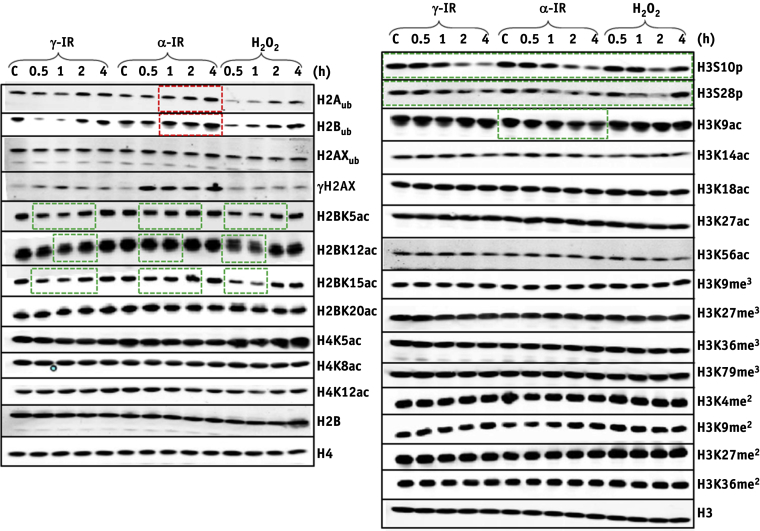
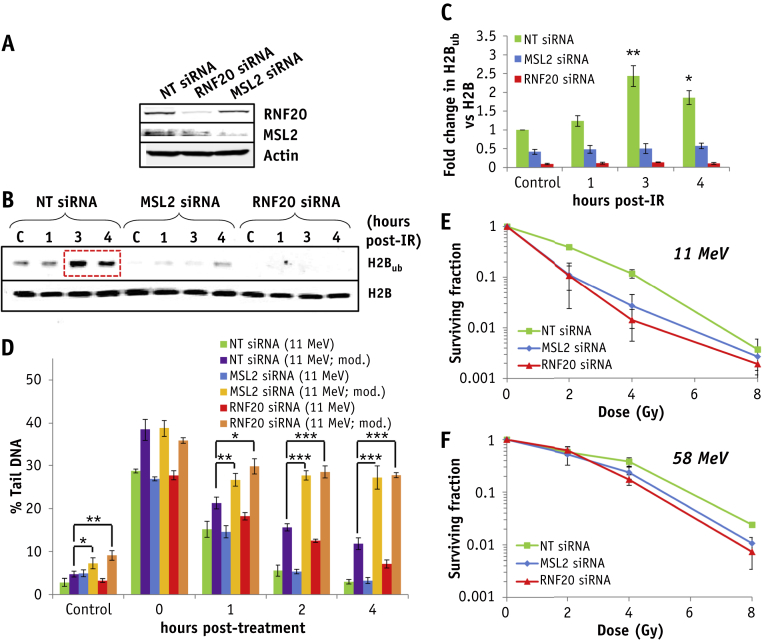
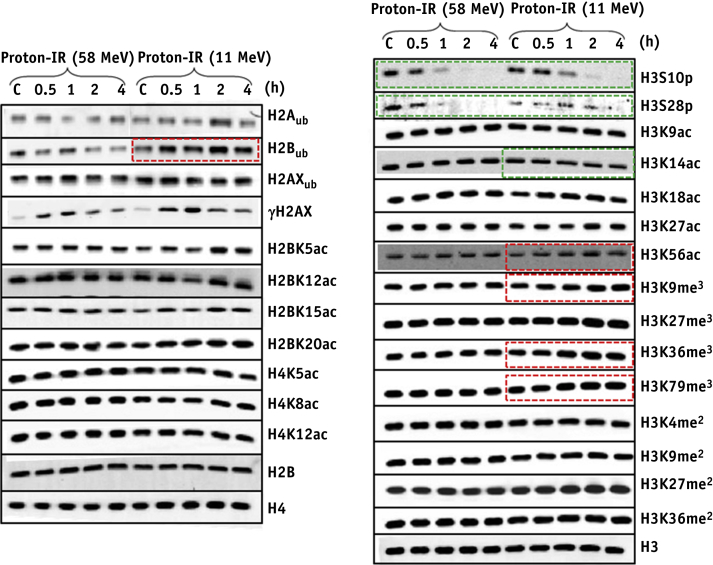
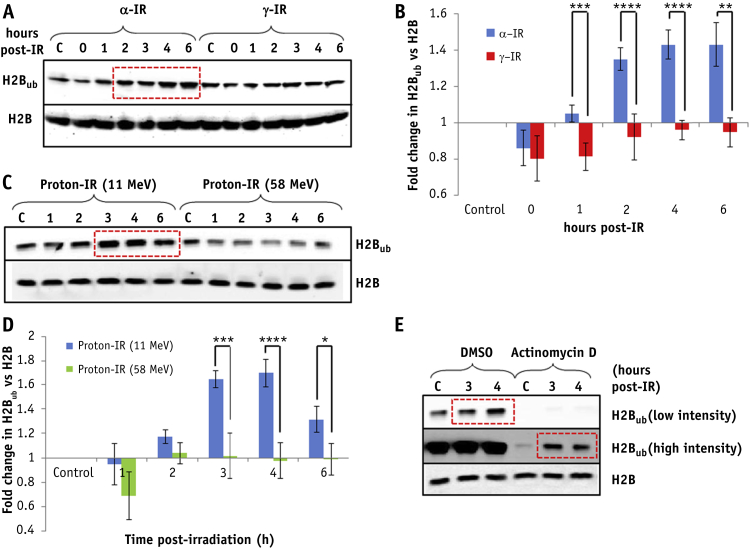
Site-specific histone post-translational modifications after low- and high-LET radiation, particularly proton irradiation, were screened, aiming to identify those responsive to CDD. We demonstrate that histone H2B ubiquitylated on lysine 120 (H2B) is specifically induced several hours after irradiation in response to high-LET α-particles and protons but not by low-LET protons or X rays/γ-radiation. This is associated with increased levels of CDD, which contributes to decreased cell survival. We further discovered that modulation of H2B is under the control of two E3 ubiquitin ligases, MSL2 and RNF20/RNF40 complex, whose depletion leads to defective processing and further persistence of CDD, and to additional decreased cell survival after irradiation.
This study demonstrates that the signaling and repair of CDD, particularly induced by high-LET IR is co-ordinated through the specific induction of H2B catalyzed by MSL2 and RNF20/40, a mechanism that contributes significantly to cell survival after irradiation.
研究在与组蛋白包装形成染色质的细胞 DNA 中,两个或更多 DNA 损伤近距离接近时,对电离辐射(IR)诱导的复杂 DNA 损伤(CDD)的精确识别和处理机制。
用高传能线密度(LET)α-粒子或质子,而非低 LET 质子和 X 射线照射 HeLa 和口咽鳞癌细胞(UMSCC74A 和 UMSCC6)。在照射后不同时间点,通过定量 Western 印迹分析特定部位的组蛋白翻译后修饰;通过不同版本的彗星试验测量 DNA 损伤和修复;通过集落形成试验测定细胞存活。
筛选了低和高 LET 辐射,特别是质子照射后特定部位的组蛋白翻译后修饰,旨在鉴定那些对 CDD 有反应的修饰。我们证明,赖氨酸 120 上泛素化的组蛋白 H2B(H2B)在受到高 LET α-粒子和质子照射数小时后特异性诱导,但不受低 LET 质子或 X 射线/γ 射线的影响。这与 CDD 水平的增加有关,从而导致细胞存活减少。我们进一步发现,H2B 的调节受两个 E3 泛素连接酶 MSL2 和 RNF20/RNF40 复合物的控制,其耗竭导致 CDD 的处理缺陷和进一步持续存在,并导致照射后细胞存活的进一步减少。
本研究表明,CDD 的信号转导和修复,特别是由高 LET IR 诱导的 CDD,通过 MSL2 和 RNF20/40 催化的特定诱导 H2B 来协调,这一机制对照射后细胞存活有重要贡献。