Joddar Binata, Tasnim Nishat, Thakur Vikram, Kumar Alok, McCallum Richard W, Chattopadhyay Munmun
Inspired Materials & Stem-Cell Based Tissue Engineering Laboratory (IMSTEL), Department of Metallurgical, Materials and Biomedical Engineering, University of Texas at El Paso, 500 W University Avenue, El Paso, TX 79968, USA.
Border Biomedical Research Center, University of Texas at El Paso, 500 W University Avenue, El Paso, TX 79968, USA.
Bioengineering (Basel). 2018 Feb 7;5(1):12. doi: 10.3390/bioengineering5010012.
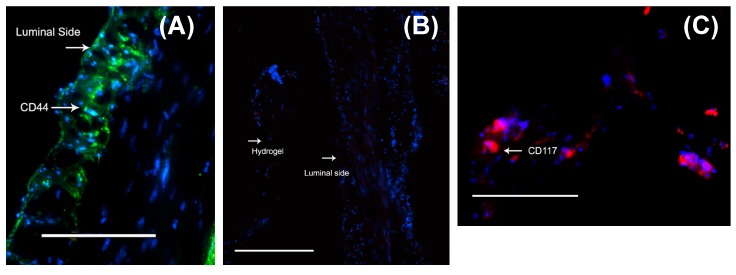
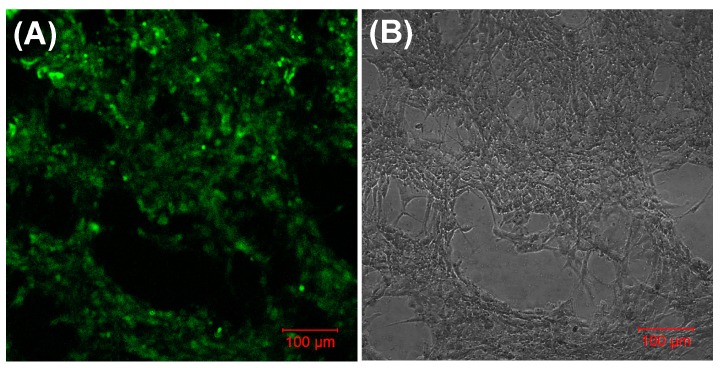
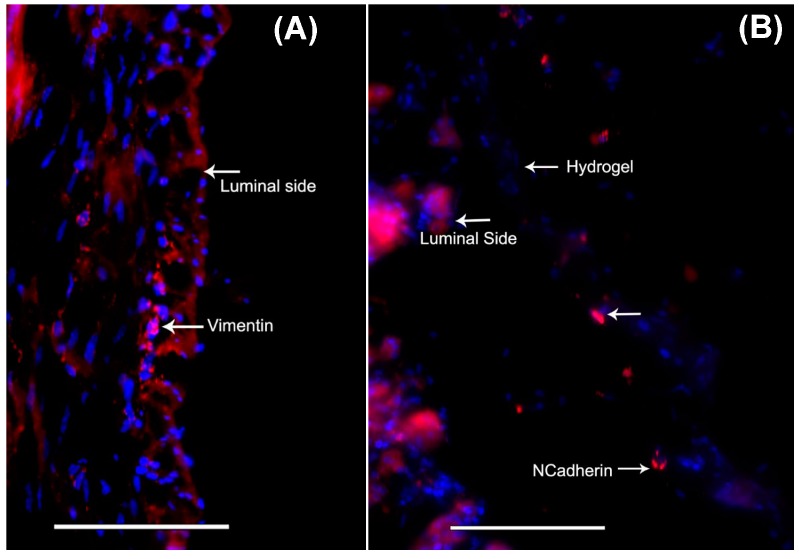
Gastroparesis (GP) is associated with depletion of interstitial cells of Cajal (ICCs) and enteric neurons, which leads to pyloric dysfunction followed by severe nausea, vomiting and delayed gastric emptying. Regenerating these fundamental structures with mesenchymal stem cell (MSC) therapy would be helpful to restore gastric function in GP. MSCs have been successfully used in animal models of other gastrointestinal (GI) diseases, including colitis. However, no study has been performed with these cells on GP animals. In this study, we explored whether mouse MSCs can be delivered from a hydrogel scaffold to the luminal surfaces of mice stomach explants. Mouse MSCs were seeded atop alginate-gelatin, coated with poly-l-lysine. These cell-gel constructs were placed atop stomach explants facing the luminal side. MSCs grew uniformly all across the gel surface within 48 h. When placed atop the lumen of the stomach, MSCs migrated from the gels to the tissues, as confirmed by positive staining with vimentin and -cadherin. Thus, the feasibility of transplanting a cell-gel construct to deliver stem cells in the stomach wall was successfully shown in a mice stomach explant model, thereby making a significant advance towards envisioning the transplantation of an entire tissue-engineered 'gastric patch' or 'microgels' with cells and growth factors.
胃轻瘫(GP)与 Cajal 间质细胞(ICC)和肠神经元的耗竭有关,这会导致幽门功能障碍,进而引发严重的恶心、呕吐和胃排空延迟。用间充质干细胞(MSC)疗法再生这些基本结构将有助于恢复 GP 患者的胃功能。MSC 已成功应用于包括结肠炎在内的其他胃肠道(GI)疾病的动物模型。然而,尚未对 GP 动物进行过这些细胞的研究。在本研究中,我们探讨了小鼠 MSC 是否可以从水凝胶支架递送至小鼠胃外植体的腔表面。将小鼠 MSC 接种在涂有聚-L-赖氨酸的藻酸盐-明胶上。将这些细胞-凝胶构建体置于面向腔侧的胃外植体上。48 小时内,MSC 在凝胶表面均匀生长。当置于胃腔上方时,如波形蛋白和 E-钙黏蛋白阳性染色所证实,MSC 从凝胶迁移至组织。因此,在小鼠胃外植体模型中成功证明了移植细胞-凝胶构建体以在胃壁中递送干细胞的可行性,从而朝着设想移植带有细胞和生长因子的整个组织工程化“胃贴片”或“微凝胶”迈出了重要一步。