Department of Health Services Research, Carl von Ossietzky University Oldenburg, 26129 Oldenburg, Germany.
Leibniz Institute for Prevention Research and Epidemiology-BIPS, 28359 Bremen, Germany.
Int J Environ Res Public Health. 2018 Feb 7;15(2):289. doi: 10.3390/ijerph15020289.
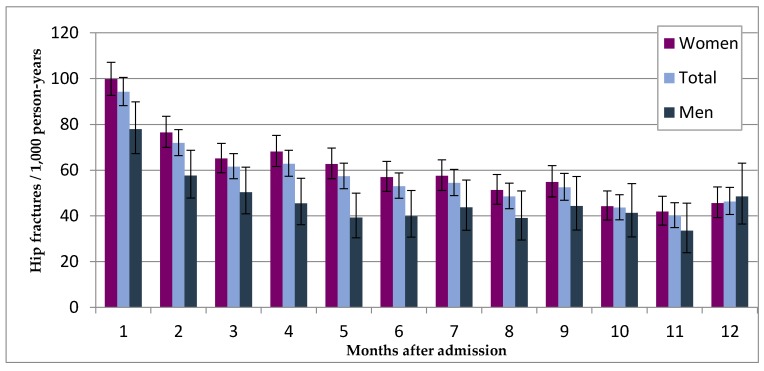
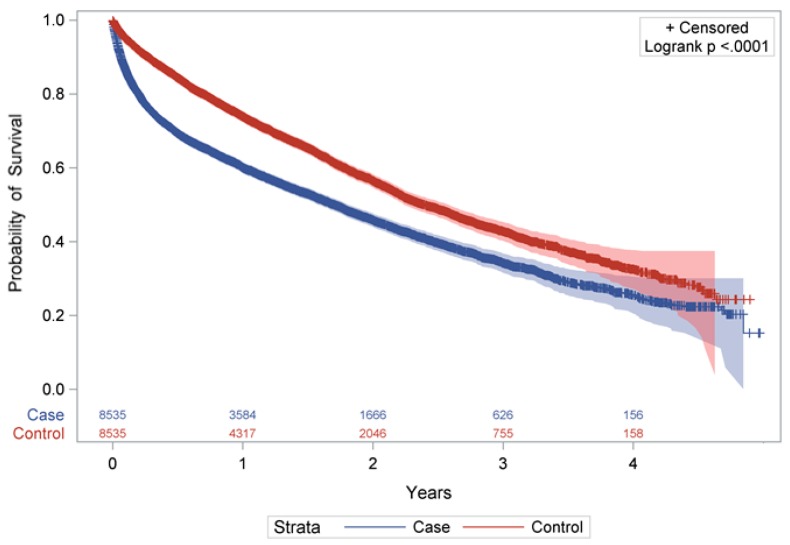
Little is known about hip fracture rates and post-fracture mortality among nursing home residents. This retrospective cohort study examined incidence rates (IR) of and mortality after hip fracture in this population focusing on sex differences. A cohort of >127,000 residents ≥65 years, newly admitted to German nursing homes between 2010 and 2014 were used to calculate age-, sex-, care-need- and time after admission-specific IR. To determine mortality, the Kaplan-Meier-method was applied. Using Cox regression, we studied mortality and estimated time-dependent hazard ratios (HRs). For this purpose, to each person with a hip fracture, one resident without a hip fracture was matched by sex, age and care-need using risk-set sampling. 75% were women (mean age: 84.0 years). During 168,588 person-years (PY), 8537 residents with at least one hip fracture were observed. The IR for women and men were 52.9 and 42.5/1000 PY. For both sexes, IR increased with rising age and decreased with increasing care-level. IR were highest in the first months after admission and subsequently declined afterwards. The impact of hip fractures on mortality was time-dependent. Mortality of residents with hip fracture was highest in the first two months after fracture compared to those without (HR): 2.82; 95% CI 2.57-3.11) and after six months, no differences were found (HR: 1.10; 95% CI 0.98-1.22) Further research should always include analyses stratified by sex, age and time period after admission.
关于养老院居民的髋部骨折发生率和骨折后死亡率知之甚少。本回顾性队列研究调查了该人群中髋部骨折的发生率(IR)和死亡率,重点关注性别差异。使用了一个 >127,000 名年龄≥65 岁、2010 年至 2014 年新入住德国养老院的居民队列,以计算按年龄、性别、护理需求和入院后时间划分的特定 IR。为了确定死亡率,应用了 Kaplan-Meier 方法。使用 Cox 回归,我们研究了死亡率并估计了时变危险比(HRs)。为此,对于每个髋部骨折患者,通过风险集抽样,按性别、年龄和护理需求与一名没有髋部骨折的居民进行匹配。75%为女性(平均年龄:84.0 岁)。在 168,588 人年(PY)中,观察到 8537 名至少有一次髋部骨折的居民。女性和男性的 IR 分别为 52.9 和 42.5/1000 PY。对于两性,IR 随年龄的增加而增加,随护理水平的增加而降低。IR 在入院后最初几个月最高,随后下降。髋部骨折对死亡率的影响具有时间依赖性。与没有髋部骨折的居民相比,骨折后前两个月髋部骨折居民的死亡率最高(HR:2.82;95%CI 2.57-3.11),而在 6 个月后,没有发现差异(HR:1.10;95%CI 0.98-1.22)。进一步的研究应始终包括按性别、年龄和入院后时间分层的分析。