Nemati Mahdieh, Santos Abel, Losic Dusan
School of Chemical Engineering, The University of Adelaide, Engineering North Building, Adelaide 5005, Australia.
Institute for Photonics and Advanced Sensing (IPAS), The University of Adelaide, Adelaide 5005, Australia.
Sensors (Basel). 2018 Feb 6;18(2):470. doi: 10.3390/s18020470.
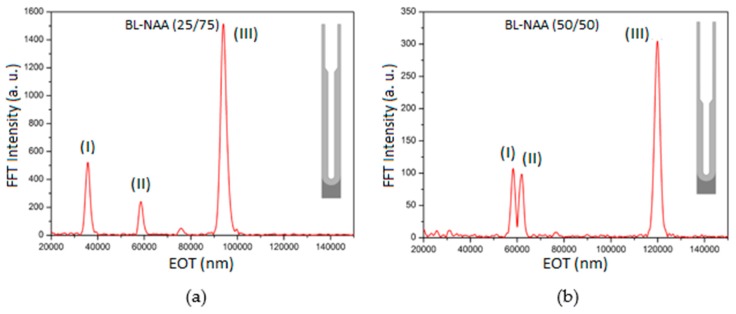
Herein, we present an innovative strategy for optimizing hierarchical structures of nanoporous anodic alumina (NAA) to advance their optical sensing performance toward multi-analyte biosensing. This approach is based on the fabrication of multilayered NAA and the formation of differential effective medium of their structure by controlling three fabrication parameters (i.e., anodization steps, anodization time, and pore widening time). The rationale of the proposed concept is that interferometric bilayered NAA (BL-NAA), which features two layers of different pore diameters, can provide distinct reflectometric interference spectroscopy (RIfS) signatures for each layer within the NAA structure and can therefore potentially be used for multi-point biosensing. This paper presents the structural fabrication of layered NAA structures, and the optimization and evaluation of their RIfS optical sensing performance through changes in the effective optical thickness (EOT) using quercetin as a model molecule. The bilayered or funnel-like NAA structures were designed with the aim of characterizing the sensitivity of both layers of quercetin molecules using RIfS and exploring the potential of these photonic structures, featuring different pore diameters, for simultaneous size-exclusion and multi-analyte optical biosensing. The sensing performance of the prepared NAA platforms was examined by real-time screening of binding reactions between human serum albumin (HSA)-modified NAA (i.e., sensing element) and quercetin (i.e., analyte). BL-NAAs display a complex optical interference spectrum, which can be resolved by fast Fourier transform (FFT) to monitor the EOT changes, where three distinctive peaks were revealed corresponding to the top, bottom, and total layer within the BL-NAA structures. The spectral shifts of these three characteristic peaks were used as sensing signals to monitor the binding events in each NAA pore in real-time upon exposure to different concentrations of quercetin. The multi-point sensing performance of BL-NAAs was determined for each pore layer, with an average sensitivity and low limit of detection of 600 nm (mg mL) and 0.14 mg mL, respectively. BL-NAAs photonic structures have the capability to be used as platforms for multi-point RIfS sensing of biomolecules that can be further extended for simultaneous size-exclusion separation and multi-analyte sensing using these bilayered nanostructures.
在此,我们提出了一种创新策略,用于优化纳米多孔阳极氧化铝(NAA)的层级结构,以提升其对多种分析物进行生物传感的光学传感性能。该方法基于多层NAA的制备以及通过控制三个制备参数(即阳极氧化步骤、阳极氧化时间和扩孔时间)来形成其结构的差分有效介质。所提出概念的基本原理是,具有两层不同孔径的干涉式双层NAA(BL-NAA)能够为NAA结构内的每一层提供独特的反射干涉光谱(RIfS)特征,因此有可能用于多点生物传感。本文介绍了分层NAA结构的构建,以及通过使用槲皮素作为模型分子改变有效光学厚度(EOT)来优化和评估其RIfS光学传感性能。设计双层或漏斗状NAA结构的目的是利用RIfS表征槲皮素分子两层的灵敏度,并探索这些具有不同孔径的光子结构用于同时进行尺寸排阻和多分析物光学生物传感的潜力。通过实时筛选人血清白蛋白(HSA)修饰的NAA(即传感元件)与槲皮素(即分析物)之间的结合反应,来检测所制备的NAA平台的传感性能。BL-NAA呈现出复杂的光学干涉光谱,可通过快速傅里叶变换(FFT)进行解析以监测EOT变化,其中揭示了对应于BL-NAA结构顶部、底部和总层的三个独特峰。这三个特征峰的光谱位移被用作传感信号,以实时监测在暴露于不同浓度槲皮素时每个NAA孔中的结合事件。确定了BL-NAA每个孔层的多点传感性能,平均灵敏度和检测下限分别为600 nm/(mg/mL)和0.14 mg/mL。BL-NAA光子结构有能力用作生物分子多点RIfS传感的平台,利用这些双层纳米结构可进一步扩展用于同时进行尺寸排阻分离和多分析物传感。