Xu Libo, Wang Jinguo, Guo Baofeng, Zhang Haixia, Wang Kaichen, Wang Ding, Dai Chang, Zhang Ling, Zhao Xuejian
Department of Pathophysiology, College of Basic Medical Science, Jilin University, Changchun, China.
Department of Urology, The First Hospital of Jilin University, Changchun, China.
Oncotarget. 2017 Sep 8;9(1):428-441. doi: 10.18632/oncotarget.20787. eCollection 2018 Jan 2.
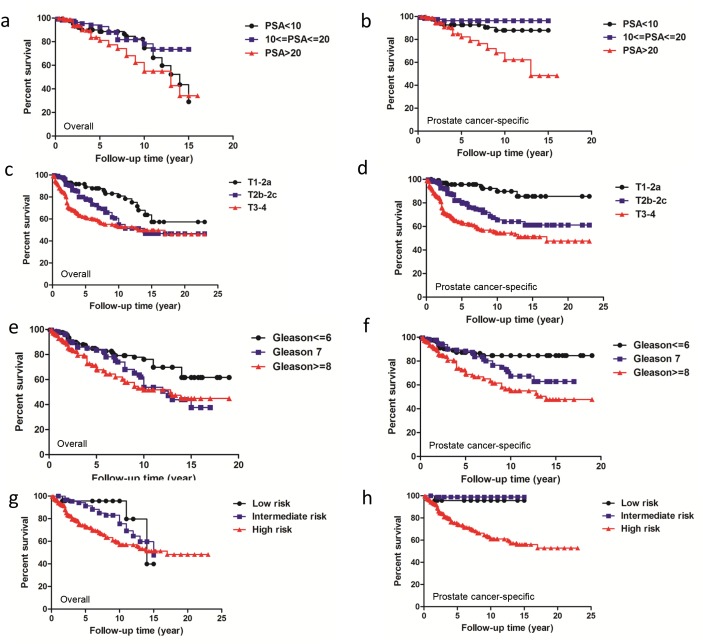
Prostate-specific antigen (PSA)-based mass screening remains the most controversial topic in prostate cancer. PSA-based mass screening has not been widely used in China yet. The aim of our study was to evaluate the effect of the PSA-based screening in China. The cohort consisted of 1,012 prostate cancer patients. Data were retrospectively collected and clinical characteristics of the cohorts were investigated. Survival was analyzed for prostatic carcinoma of both PSA screened and clinically diagnosed patients according to clinical characteristics and the National Comprehensive Cancer Network (NCCN) risk classification. Cox Proportional Hazards Model analysis was done for risk predictor identification. The median age was 71 years old. Five-year overall and prostate-cancer-specific survival in prostatic adenocarcinoma patients were 77.52% and 79.65%; 10-year survivals were 62.57% and 68.60%, respectively. Survival was significantly poorer in patients with metastases and non-curative management. T staging and Gleason score by NCCN classification effectively stratified prostatic adenocarcinoma patients into different risk groups. T staging was a significant predictor of survival by COX Proportional Hazard Model. PSA screened patients had a significantly higher percentage diagnosed in early stage. PSA screened prostatic adenocarcinoma patients had a better prognosis in both overall and prostate cancer-specific survivals. This Chinese cohort had a lower overall and prostate cancer survival rate than it is reported in western countries. The incidence of early-stage prostate cancer found in PSA-based mass screening was high and there were significant differences in both overall and prostate cancer-specific survival between the PSA-screened and clinically diagnosed patients.
基于前列腺特异性抗原(PSA)的大规模筛查仍是前列腺癌领域最具争议的话题。基于PSA的大规模筛查在中国尚未广泛应用。我们研究的目的是评估在中国进行基于PSA筛查的效果。该队列由1012例前列腺癌患者组成。回顾性收集数据并调查队列的临床特征。根据临床特征和美国国立综合癌症网络(NCCN)风险分类,分析PSA筛查患者和临床诊断患者前列腺癌的生存率。采用Cox比例风险模型分析来识别风险预测因素。中位年龄为71岁。前列腺腺癌患者的5年总生存率和前列腺癌特异性生存率分别为77.52%和79.65%;10年生存率分别为62.57%和68.60%。有转移和非根治性治疗的患者生存率明显较差。根据NCCN分类的T分期和 Gleason评分有效地将前列腺腺癌患者分为不同风险组。通过COX比例风险模型,T分期是生存率的显著预测因素。PSA筛查患者早期诊断的比例显著更高。PSA筛查的前列腺腺癌患者在总生存率和前列腺癌特异性生存率方面预后更好。这个中国队列的总生存率和前列腺癌生存率低于西方国家报道的水平。基于PSA的大规模筛查发现的早期前列腺癌发病率较高,PSA筛查患者和临床诊断患者在总生存率和前列腺癌特异性生存率方面均存在显著差异。