Department of Tropical Medicine and Parasitology, Dokkyo Medical University, Mibu, Tochigi, Japan.
Graduate School of Health Sciences, Niigata University, Niigata, Niigata, Japan.
PLoS Negl Trop Dis. 2018 Feb 8;12(2):e0006260. doi: 10.1371/journal.pntd.0006260. eCollection 2018 Feb.
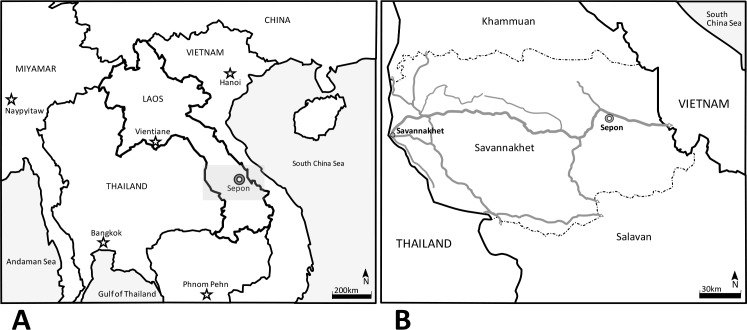
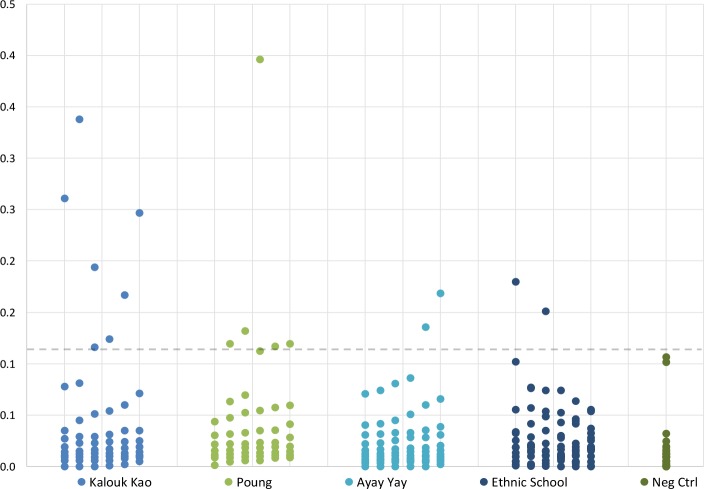
Most part of Southeast Asia is considered endemic for human-infecting Taenia tapeworms; Taenia solium, T. saginata, and T. asiatica. However, until now there was no report of the occurrence of human cases of T. asiatica in Lao PDR. This study, conducted in Savannakhet Province, Lao PDR, microscopically examined a total of 470 fecal samples by Kato Katz method and found 86% of people harboring at least one helminth. Hookworms were detected in 56% of the samples besides Opisthorchis like eggs (42%), Trichuris trichiura (27%), Ascaris spp. (14%), and Taenia spp. (4%) eggs. Serology for cysticercosis showed 6.8% positives with results varying from 3% to 14.3% in Ethnic School students and Kalouk Kao village respectively. Species-specific PCR targeting mitochondrial DNA (mtDNA) of 28 tapeworms, recovered from 16 patients, revealed T. solium (n = 2), T. saginata (n = 21), and T. asiatica (n = 5). Two patients were confirmed to be coinfected with T. saginata and T. asiatica, indicating the endemicity of the 3 human Taenia in Lao PDR. However, nucleotide sequencing of a nuclear DNA gene, DNA polymerase delta (pold) revealed that all the tapeworms identified as T. asiatica using mtDNA had T. saginata type allele at pold locus, demonstrating that they are not "pure T. asiatica" but the hybrid descendants between the two species, confirming the wide distribution of hybrids of T. saginata/ T. asiatica in Southeast Asia. The high prevalence of several helminthic NTDs in east Savannakhet area even with conventional control measures indicates the importance to establish wide and multifaceted health programs to sustainably improve the quality of life of the populations living in these communities.
东南亚大部分地区被认为是感染人类的带绦虫(绦虫)的地方病疫区,包括猪带绦虫、牛带绦虫和亚洲带绦虫。然而,迄今为止,老挝人民民主共和国(老挝)还没有报告过亚洲带绦虫感染人类病例。本研究在老挝沙拉湾省进行,通过加藤厚涂片法共检查了 470 份粪便样本,发现 86%的人至少携带一种寄生虫。除了华支睾吸虫卵(42%)、鞭虫(27%)、蛔虫(14%)和带绦虫卵(4%)外,还在 56%的样本中检测到钩虫。囊尾蚴病的血清学检查结果显示,阳性率为 6.8%,其中民族学校学生和卡卢克考村的阳性率分别为 3%至 14.3%。从 16 名患者中回收的 28 条带绦虫的种特异性聚合酶链反应(PCR)显示,猪带绦虫(n=2)、牛带绦虫(n=21)和亚洲带绦虫(n=5)。有两名患者被确诊为同时感染牛带绦虫和亚洲带绦虫,表明这三种人类带绦虫在老挝的地方病流行。然而,使用 mtDNA 鉴定为亚洲带绦虫的所有带绦虫在 DNA 聚合酶 delta(pold)的核 DNA 基因测序中均显示出牛带绦虫型等位基因,表明它们不是“纯亚洲带绦虫”,而是这两个物种的杂交后代,证实了牛带绦虫/亚洲带绦虫杂交种在东南亚的广泛分布。在沙拉湾东部地区,即使采用常规控制措施,几种蠕虫性 NTD 的高流行率表明,必须建立广泛和多方面的卫生保健计划,以可持续地提高生活在这些社区的人群的生活质量。