Seguin Philippe, Perrichet Harmonie, Pabic Estelle Le, Launey Yoann, Tiercin Marie, Corre Romain, Brinchault Graziella, Laviolle Bruno
Department of Critical Care Medicine, CHU de Rennes and Université Rennes 1, Rennes Cedex 9, France.
Center of Clinical Investigation, CHU de Rennes and Université Rennes 1, Rennes Cedex 9, France.
Indian J Crit Care Med. 2018 Jan;22(1):1-4. doi: 10.4103/ijccm.IJCCM_350_17.
A risk of tracheal mucosa injury induced by subglottic suctioning has been raised. Therefore, this prospective randomized study aims to compare the effect of continuous suctioning of subglottic secretions versus intermittent suctioning of subglottic secretions (CSSS vs. ISSS) secretions on tracheal mucosa in front of the suctioning port of the endotracheal tube.
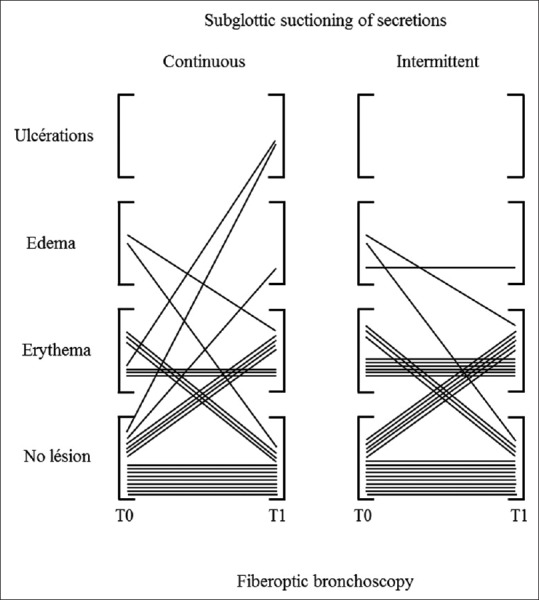
Patients requiring intubation or reintubation in Intensive Care Unit with an expected ventilation duration > 24 h were eligible. Participants received CSSS at -20 mmHg or ISSS at -100 mmHg during 15 s and no suction during 8 s. The effect on tracheal mucosa in front of the suction port was assessed after intubation (T0) and before extubation (T1) using bronchoscopy. Tracheal mucosa damages were graded into five categories (no injury, erythema, edema, ulceration, or necrosis). The occurrence (no injury observed at T0 but present at T1) or the worsening (injury observed at T0 exacerbating at T1) was studied.
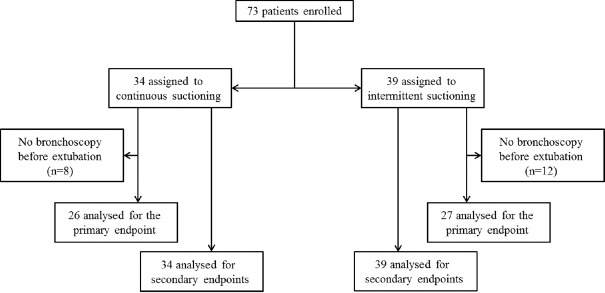
Seventy-three patients were included and 53 patients (CSSS, = 26 and ISSS, = 27) were evaluable on the primary endpoint. The occurrence or worsening of tracheal mucosal damages did not differ between the two groups (CSSS, = 7 [27%] vs. ISSS, = 5 [17%], = 0.465). Daily average volume of suctioned secretion was higher with ISSS (74 ± 100 ml vs. 20 ± 25 ml, < 0.001). Impossibility to aspirate was higher with CSSS (0.14 ± 0.16 per day vs. 0.03 ± 0.07 per day, < 0.001).
Our results suggest that tracheal mucosal damages did not differ between CSSS and ISSS. The aspirated volume was higher and impossibility to aspirate was lower with ISSS.
ClinicalTrials.gov Identifier: NCT01555229.
声门下吸引导致气管黏膜损伤的风险已引起关注。因此,本前瞻性随机研究旨在比较持续声门下分泌物吸引与间歇性声门下分泌物吸引(CSSS与ISSS)对气管插管吸引口前方气管黏膜的影响。
入住重症监护病房且预计通气时间>24小时、需要插管或再次插管的患者符合条件。参与者在15秒内接受-20 mmHg的CSSS或-100 mmHg的ISSS,8秒内不进行吸引。使用支气管镜在插管后(T0)和拔管前(T1)评估对吸引口前方气管黏膜的影响。气管黏膜损伤分为五类(无损伤、红斑、水肿、溃疡或坏死)。研究损伤的发生情况(T0时未观察到损伤但T1时出现)或加重情况(T0时观察到的损伤在T1时加重)。
纳入73例患者,53例患者(CSSS组26例,ISSS组27例)可用于主要终点评估。两组气管黏膜损伤的发生或加重情况无差异(CSSS组7例[27%] vs. ISSS组5例[17%],P = 0.465)。ISSS组每日平均吸出分泌物量更高(74±100 ml vs. 20±25 ml,P<0.001)。CSSS组吸痰失败率更高(0.14±0.16次/天 vs. 0.03±0.07次/天,P<0.001)。
我们的结果表明,CSSS和ISSS对气管黏膜损伤的影响无差异。ISSS组吸出量更高,吸痰失败率更低。
ClinicalTrials.gov标识符:NCT01555229。