Ebrahimian Abbasali, Tourdeh Maedeh, Paknazar Fatemeh, Davari Hossein
Nursing Care Research Center, Semnan University of Medical Sciences, Semnan, Iran.
School of Paramedicine, Qom University of Medical Sciences, Qom, Iran.
Turk J Anaesthesiol Reanim. 2020 Jun;48(3):202-207. doi: 10.5152/TJAR.2019.03342. Epub 2019 Oct 17.
Tracheal suctioning can cause pain and physiological indicator variations in patients with traumatic brain injury (TBI). The aim of the present study was to compare pain severity and physiological indicator variations during the closed tracheal suction system (CTSS) and open tracheal suction system (OTSS) in patients with TBI.
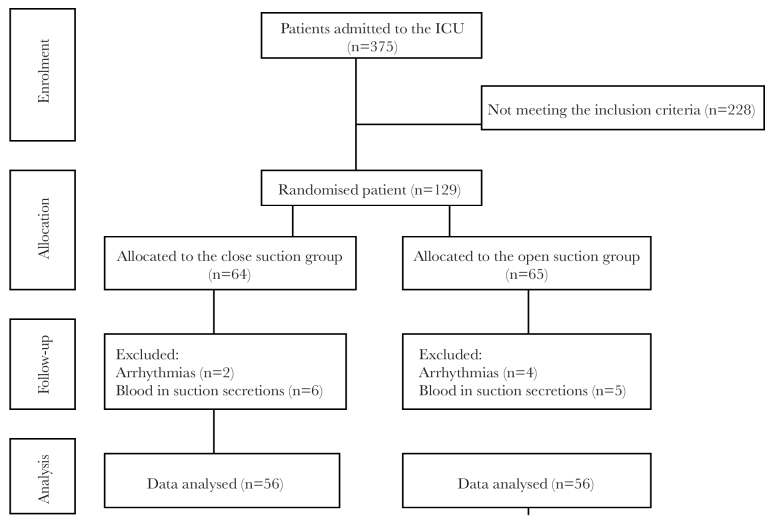
This study was a clinical trial. Samples included all ventilated patients with TBI. The patients were randomly divided into the OTSS and CTSS groups. In both groups, the Critical Care Pain Observation Tool (CPOT) and physiological indicators were recorded by three nurses prior to suctioning, the end of suctioning and 5 min after suction completion. Data were analysed using the independent t-test and repeated measurement tests.
A total of 112 patients participated in the present study. Before the interventions, the mean value of the Glasgow Coma Scale was 6.45±1.13, blood pressure 128.33±20.54, saturated oxygen in arterial blood (SpO) 96.74±2.76, respiratory rate (RR) 15.06±3.98, end-tidal CO2 (EtCO) 36.2±21.98, heart rate 82.18±42.33 and CPOT-based pain 0.43±0.94 in the patients. Independent t-test was used to compare CTSS and OTSS, suggesting significant differences with respect to the mean values of SpO, RR and EtCO immediately after suctioning. This test showed significant differences between the two groups with respect to pain intensity at all three points of measurement. The two groups were also found to be significantly different with respect to RR measured 5 min after suctioning (p<0.05).
Compared to OTSS, CTSS can cause higher reductions in pain levels during and after suctioning in patients with head traumas and can also cause higher improvements in physiological indicators, such as RR, O saturation and EtCO.
气管抽吸可导致创伤性脑损伤(TBI)患者疼痛及生理指标变化。本研究旨在比较TBI患者在使用密闭式气管抽吸系统(CTSS)和开放式气管抽吸系统(OTSS)时的疼痛严重程度及生理指标变化。
本研究为一项临床试验。样本包括所有接受机械通气的TBI患者。将患者随机分为OTSS组和CTSS组。两组患者在抽吸前、抽吸结束时及抽吸完成后5分钟,由三名护士记录重症监护疼痛观察工具(CPOT)及生理指标。采用独立样本t检验和重复测量检验对数据进行分析。
共有112例患者参与本研究。干预前,患者格拉斯哥昏迷量表平均值为6.45±1.13,血压128.33±20.54,动脉血氧饱和度(SpO)96.74±2.76,呼吸频率(RR)15.06±3.98,呼气末二氧化碳分压(EtCO)36.2±21.98,心率82.18±42.33,基于CPOT的疼痛评分为0.43±0.94。采用独立样本t检验比较CTSS组和OTSS组,结果显示抽吸后即刻SpO、RR和EtCO平均值存在显著差异。该检验还显示两组在所有三个测量点的疼痛强度均存在显著差异。两组在抽吸后5分钟测量的RR也存在显著差异(p<0.05)。
与OTSS相比,CTSS可使颅脑外伤患者在抽吸期间及抽吸后疼痛水平降低更多,还可使RR、血氧饱和度和EtCO等生理指标得到更大改善。