Sudhanshu Archika, Sharma Urvi, Vadiraja H S, Rana Rakesh Kumar, Singhal Richa
Department of Dental, Karuna Sindhu Hospital, New Delhi, India.
Central Council for Research in Yoga and Naturopathy, Ministry of AYUSH, Government of India, New Delhi, India.
Int J Yoga. 2017 Sep-Dec;10(3):121-127. doi: 10.4103/0973-6131.213468.
Yoga is considered to be one of the most important, effective, and valuable tools available for man to overcome various physical and psychological problems. Stress contributes significantly to the pathogenesis of periodontal diseases; hence, it becomes important to reduce the level of stress for prevention and management of diseases.
The present study was aimed: (1) To understand and analyze the possibilities of employing yogic practices in the treatment of periodontal disease along with conventional dental therapy, (2) to understand the effect of stress on periodontal treatment outcome, (3) to evaluate the efficacy of yoga in the management of periodontal disease with reference to stress.
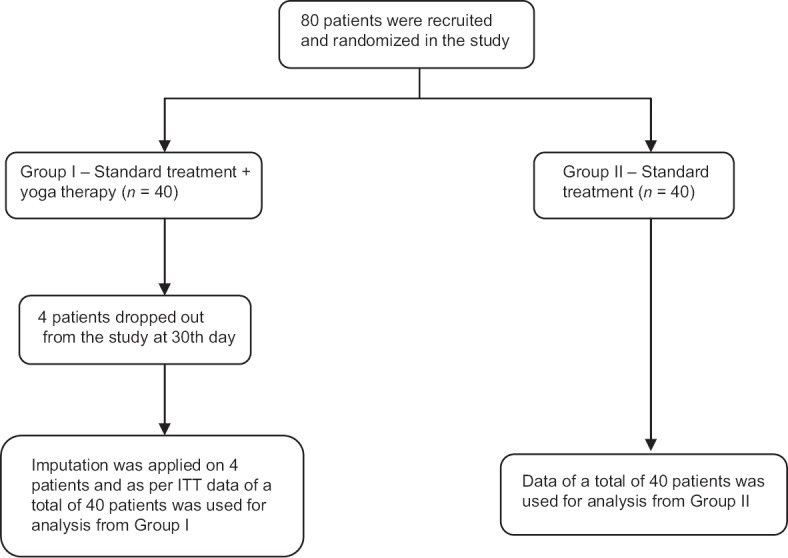
An outpatient department-based parallel group randomized study was performed with standard treatment for periodontal disease yoga therapy as Group II and only standard treatment as Group I. Periodontal health status was recorded using indices of modified plaque index (PI), bleeding on probing (BOP), probing depth, and clinical attachment loss (CAL). The Cohen's perceived stress questionnaire was also used to determine stress severity. The yogic intervention consists of lectures and practical sessions on asanas, pranayama, kriyas, and meditation.
Repeated measure analysis of variance revealed a significant difference ( < 0.001) in all the outcome variables with respect to time in both groups. It was observed that mean PI score reduced by 1.35 in Group II as compared to 0.54 in Group I, mean probing pocket depth reduced by 1.60 in Group II as compared to only 0.68 in Group I, and mean CAL score reduced by 1.60 in Group II as compared to 0.68 in Group I. Similarly, Cohen's perceived stress scale score also reduced by 18.76 points in Group II as compared to only 2.58 points in Group I, BOP also shows better improvement in Group II with a reduction of 0.68 as compared to reduction of only 0.08 in Group I. The results obtained ascertained the role of yoga in stress reduction in periodontal disease.
Although yoga does not play a direct role in improving periodontal disease, it accelerates the treatment outcomes by combating the stress which is a major factor affecting the treatment of periodontal disease.
瑜伽被认为是人类克服各种身体和心理问题最重要、最有效且最具价值的工具之一。压力在牙周疾病的发病机制中起重要作用;因此,降低压力水平对于疾病的预防和管理变得至关重要。
本研究旨在:(1)了解并分析在传统牙科治疗的同时采用瑜伽练习治疗牙周疾病的可能性,(2)了解压力对牙周治疗结果的影响,(3)参照压力评估瑜伽在牙周疾病管理中的疗效。
进行了一项基于门诊部的平行组随机研究,将牙周疾病的标准治疗加瑜伽疗法设为第二组,仅标准治疗设为第一组。使用改良菌斑指数(PI)、探诊出血(BOP)、探诊深度和临床附着丧失(CAL)指数记录牙周健康状况。还使用科恩感知压力问卷来确定压力严重程度。瑜伽干预包括关于体式、呼吸控制法、清洁法和冥想的讲座及实践课程。
重复测量方差分析显示,两组中所有结果变量随时间均存在显著差异(<0.001)。观察到,第二组的平均PI评分降低了1.35,而第一组仅降低了0.54;第二组的平均探诊袋深度降低了1.60,而第一组仅降低了0.68;第二组的平均CAL评分降低了1.60,而第一组降低了0.68。同样,第二组的科恩感知压力量表评分降低了18.76分,而第一组仅降低了2.58分,BOP在第二组也显示出更好的改善,降低了0.68,而第一组仅降低了0.08。所得结果确定了瑜伽在减轻牙周疾病压力方面的作用。
虽然瑜伽在改善牙周疾病方面不发挥直接作用,但它通过对抗作为影响牙周疾病治疗的主要因素的压力来加速治疗结果。