D'Ambrosio Francesco, Caggiano Mario, Schiavo Luigi, Savarese Giulia, Carpinelli Luna, Amato Alessandra, Iandolo Alfredo
Department of Medicine, Surgery and Dentistry "Schola Medica Salernitana", University of Salerno, Via S. Allende, 84081 Baronissi, Italy.
Dent J (Basel). 2022 Mar 18;10(3):49. doi: 10.3390/dj10030049.
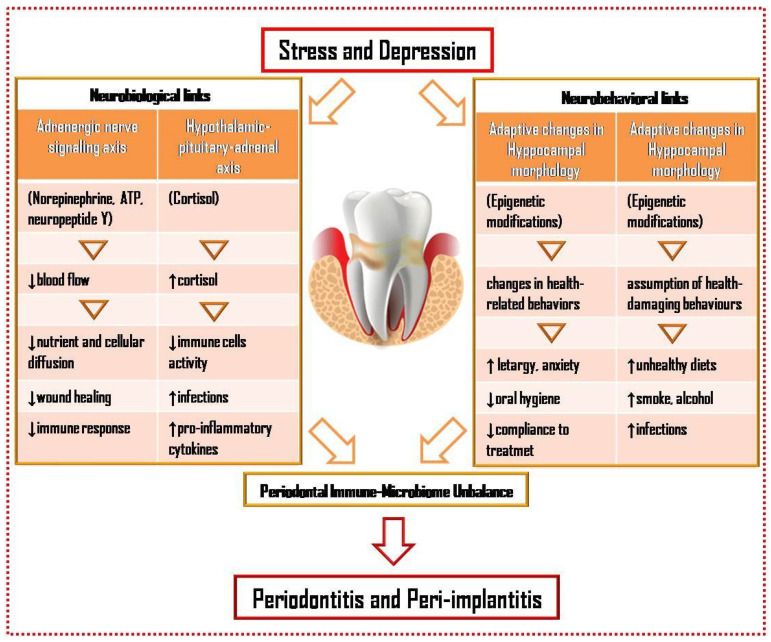
Besides the well-known systemic factors for periodontal and peri-implant diseases, additional co-factors, such as chronic stress and depression, may also affect disease onset and progression as well as treatment responsiveness. Neurobiological and neurobehavioral pathogenic links between chronic stress and depression, on the one side, and periodontitis and peri-implantitis, on the other side, which have been little investigated and principally related to necrotizing periodontal disease, have been reviewed, along with their putative interconnections with periodontal immune-microbiome balance. Rising evidence suggest that dysregulated neurobiological and neurobehavioral factors, as well as periodontal immune-microbiome unbalance, all related to chronic stress and depression, may crucially interact and thus represent contributing factors in the genesis and worsening not only of necrotizing periodontal lesions, but also of chronic periodontitis and peri-implantitis. Such potential interconnections may be even more relevant in recurrent and aggressive cases of periodontal and peri-implant disease, which are frequently refractory to therapy, and may, if corroborated, coherently pave the way for personalized prevention and treatment strategies, possibly targeting immune-microbiome unbalance and neurobehavioral factors and focusing on neurobiological ones, especially in chronically stressed and depressed subjects with periodontitis and peri-implantitis.
除了众所周知的导致牙周病和种植体周围疾病的全身因素外,其他共同因素,如慢性应激和抑郁症,也可能影响疾病的发生、发展以及治疗反应。本文综述了慢性应激和抑郁症与牙周炎和种植体周围炎之间的神经生物学和神经行为致病联系,这些联系此前研究较少,主要与坏死性牙周病有关,同时还探讨了它们与牙周免疫-微生物群平衡之间的潜在联系。越来越多的证据表明,与慢性应激和抑郁症相关的神经生物学和神经行为因素失调,以及牙周免疫-微生物群失衡,可能会产生关键的相互作用,从而不仅是坏死性牙周病变,也是慢性牙周炎和种植体周围炎发生和恶化的促成因素。这种潜在联系在复发性和侵袭性牙周病及种植体周围疾病中可能更为重要,这些疾病往往对治疗具有抗性,如果得到证实,可能会为个性化的预防和治疗策略铺平道路,这些策略可能针对免疫-微生物群失衡和神经行为因素,并侧重于神经生物学因素,特别是在患有牙周炎和种植体周围炎的慢性应激和抑郁患者中。