Oral Medicine and Periodontology Department, Faculty of Dentistry, Cairo University, Al Saraya Str. 11, Manial, Cairo, Egypt.
Clinic for Conservative Dentistry and Periodontology, School of Dental Medicine, Christian Albrechts University, Kiel, Germany.
Clin Oral Investig. 2021 Sep;25(9):5127-5138. doi: 10.1007/s00784-021-04056-7. Epub 2021 Jul 20.
The present study aimed to systematically assess current evidence on effects of locally delivered antibiotics during periodontal surgery compared to periodontal surgery alone on clinical attachment level (CAL) gain, probing pocket depth (PPD) reduction, recession depth (RD) changes, gingival index (GI), bleeding on probing (BOP), and plaque index (PI).
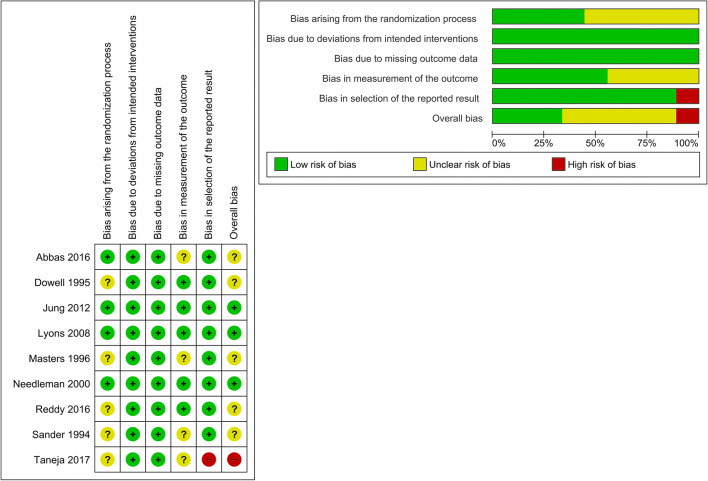
MEDLINE-PubMed, Cochrane-CENTRAL and Scopus databases were searched up to April 2021 for randomized clinical trials (RCT), evaluating effects of locally delivered antibiotics during periodontal surgery. CAL gain served as primary, while PPD reduction, RD changes, GI and PI as secondary outcomes. The Cochrane Risk of Bias Tool was used to assess possible bias. Data were extracted, and meta-analysis was performed where appropriate.
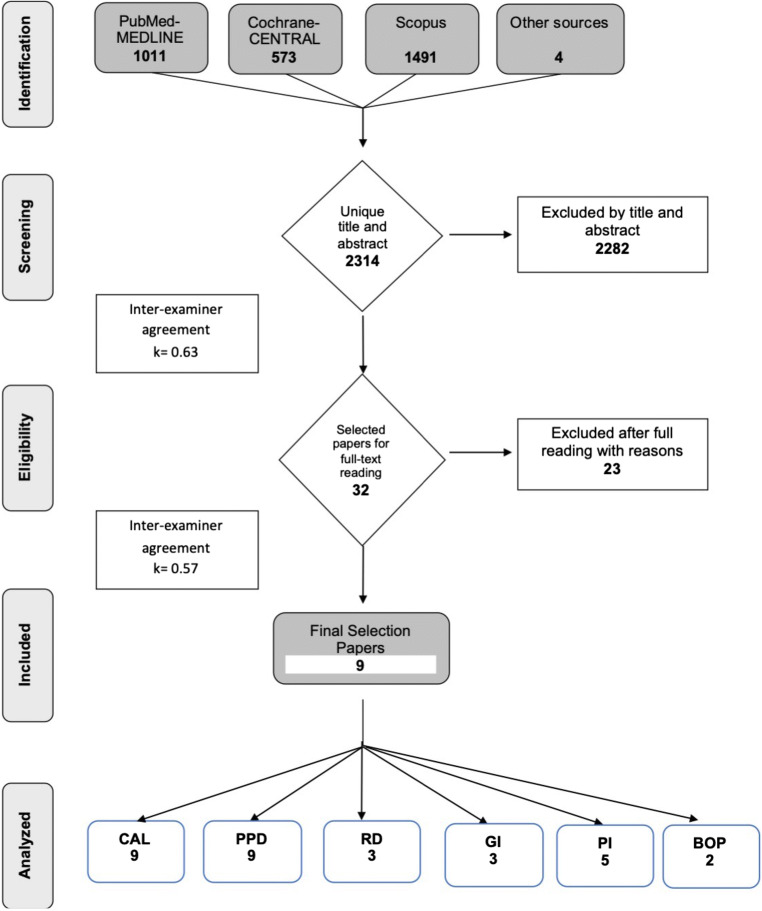
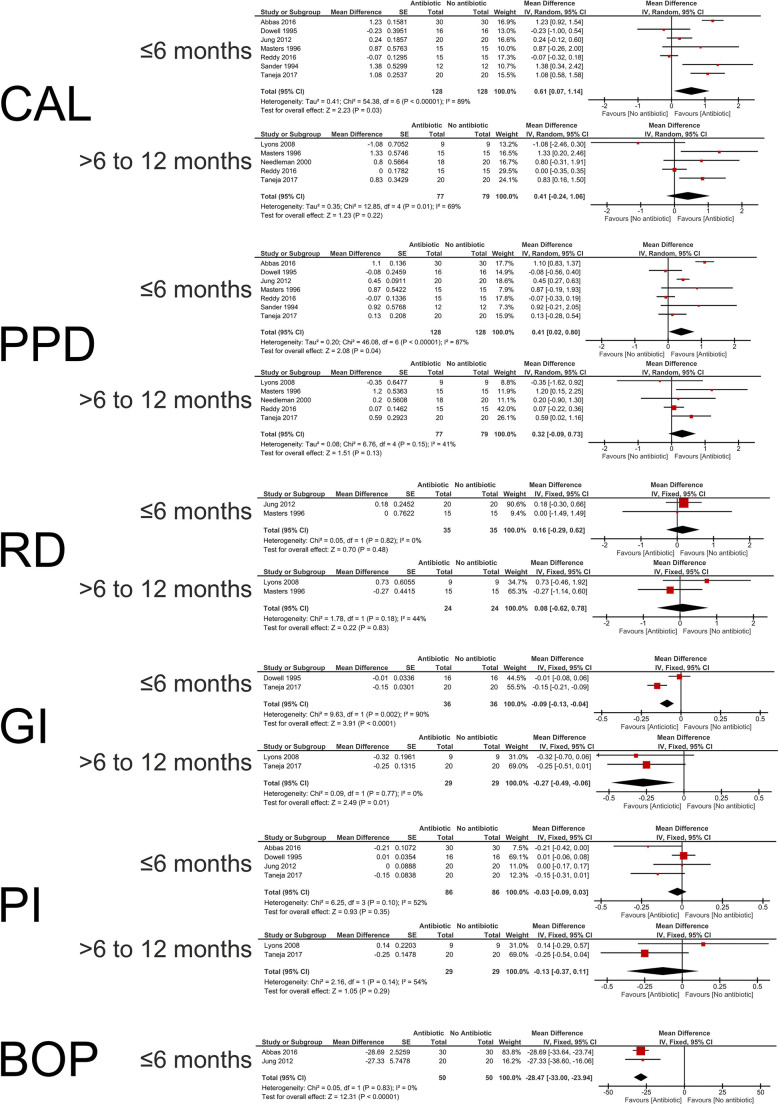
Screening of 2314 papers resulted in nine eligible studies. No adverse events were reported. Data on outcome variables were pooled and analyzed using generic inverse variance model and presented as weighted mean difference (WMD) and 95% confidence interval (95% CI). Statistically significant improvements in favor of antibiotics' delivery were observed in studies with follow-up of ≤6 months for CAL gain (WMD = 0.61 mm (95% CI [0.07, 1.14]; p = 0.03), PPD reduction (WMD = 0.41 mm (95% CI [0.02, 0.80]; p = 0.04)) and BOP (WMD = -28.47% (95% CI [-33.00, -23.94]); p < 0.001), while for GI improvements were notable for >6 to 12 months (WMD = -0.27 (95% CI [-0.49, -0.06]; p = 0.01)).
Within the current review's limitations, locally delivered antibiotics during surgical periodontal therapy results in post-surgical improvements for CAL, PPD, and BOP (≤6 months) with a longer-lasting GI improvement. Further randomized controlled trials are needed with true periodontal end-points to assess the ideal antibiotic agent, dosage, and delivery methods.
Local delivery of antibiotics during periodontal surgery improved clinical parameters for up to 6-month follow-up, with beneficial longer effects on gingival inflammation. Within the current study's limitation, the presented evidence could support the elective usage of locally delivered antibiotics during surgical periodontal therapy.
本研究旨在系统评估牙周手术中局部应用抗生素与单纯牙周手术相比对临床附着水平(CAL)获得、探诊袋深度(PPD)减少、退缩深度(RD)变化、牙龈指数(GI)、探诊出血(BOP)和菌斑指数(PI)的影响。
截至 2021 年 4 月,通过 MEDLINE-PubMed、Cochrane-CENTRAL 和 Scopus 数据库检索随机临床试验(RCT),评估牙周手术中局部应用抗生素的效果。CAL 获得作为主要结果,而 PPD 减少、RD 变化、GI 和 PI 作为次要结果。使用 Cochrane 偏倚风险工具评估可能的偏倚。提取数据,并在适当的情况下进行荟萃分析。
筛选出 2314 篇论文后,有 9 项符合条件的研究。未报告不良事件。对结局变量的数据进行汇总分析,使用通用逆方差模型,并以加权均数差(WMD)和 95%置信区间(95%CI)表示。在随访时间≤6 个月的研究中,观察到抗生素给药有统计学意义的改善,CAL 获得(WMD=0.61mm(95%CI[0.07,1.14];p=0.03)、PPD 减少(WMD=0.41mm(95%CI[0.02,0.80];p=0.04)和 BOP(WMD=-28.47%(95%CI[-33.00,-23.94]);p<0.001)。而 GI 改善则在>6 至 12 个月时更为显著(WMD=-0.27(95%CI[-0.49,-0.06];p=0.01))。
在当前综述的局限性内,牙周手术中局部应用抗生素可改善术后 CAL、PPD 和 BOP(≤6 个月),且 GI 改善持续时间更长。需要进一步进行随机对照试验,以评估理想的抗生素药物、剂量和给药方法。
牙周手术中局部应用抗生素可改善临床参数,随访时间最长可达 6 个月,对牙龈炎症有更长时间的有益作用。在当前研究的局限性内,所提供的证据可以支持在牙周手术中选择性使用局部应用抗生素。