Narang Vikram, Kaur Ravneet, Garg Bhavna, Mahajan Ramit, Midha Vandana, Sood Neena, Sood Ajit
Department of Pathology, Dayanand Medical College and Hospital, Ludhiana, India.
Department of Gastroentrology, Dayanand Medical College and Hospital, Ludhiana, India.
Intest Res. 2018 Jan;16(1):55-61. doi: 10.5217/ir.2018.16.1.55. Epub 2018 Jan 18.
BACKGROUND/AIMS: The therapeutic goal for treating ulcerative colitis (UC) patients has shifted to achieving mucosal healing over the past few years. However, at present, limited data is available on the correlation between endoscopic findings and histological remission in patients with endoscopic mucosal healing.
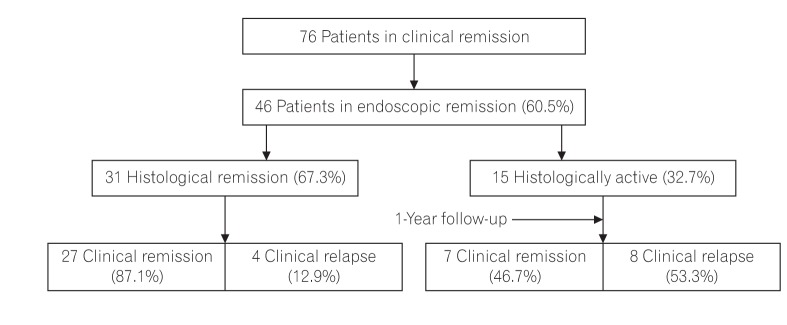
This was a prospective observational study conducted over a period of 18 months (January 2014 to June 2015) at Dayanand Medical College and Hospital, Ludhiana, Punjab, India. Patients diagnosed with UC who had been in clinical remission (n=76) for at least 6 months were evaluated for endoscopic remission. Those in endoscopic remission (Mayo score ≤1; 46/76, 60.5%) were subjected to multiple biopsies from the rectosigmoid region and histological remission, which was then defined as grade 0/1 as per the Geboes criteria.
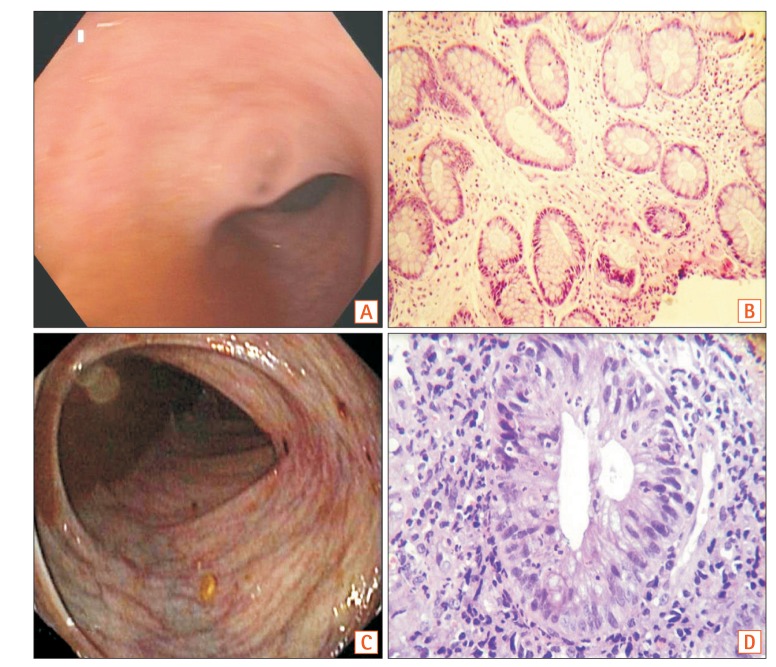
Of the 46 patients in endoscopic remission (age, 18-73 years; male:female=1.5:1.0), majority had E1 (proctitis) disease (21/46, 45.6%) followed by E2 (left sided colitis) (18/46, 39.1%) and E3 disease (pancolitis) (7/46, 15.2%) at baseline. Histological remission was noted in 67.3% (31/46) of the patients, while 32.7% (15/46) still retained the histologically active disease in the form of infiltration of the lamina propria by eosinophils and neutrophils (13/15, 86.6%), cryptitis (14/15, 93.3%), and crypt abscesses (8/15, 53.3%). On follow-up, after 1 year, 87.1% (27/31) of the patients who had been in histological remission remained clinically asymptomatic, while 12.9% (4/31) had relapsed. Among the 15 histologically active patients, 46.6% (7/15) remained in clinical remission, while 53.3% (8/15) had relapsed.
Histological remission, rather than endoscopic remission, predicts a sustained clinical remission and allows monitoring of therapy for the subsequent disease course in patients with UC.
背景/目的:在过去几年中,溃疡性结肠炎(UC)患者的治疗目标已转向实现黏膜愈合。然而,目前关于内镜下黏膜愈合患者内镜检查结果与组织学缓解之间相关性的数据有限。
这是一项在印度旁遮普邦卢迪亚纳市戴亚南德医学院及医院进行的为期18个月(2014年1月至2015年6月)的前瞻性观察研究。对诊断为UC且临床缓解至少6个月(n = 76)的患者进行内镜缓解评估。内镜缓解的患者(梅奥评分≤1;46/76,60.5%)接受来自直肠乙状结肠区域的多次活检,并根据格博斯标准将组织学缓解定义为0/1级。
46例内镜缓解患者(年龄18 - 73岁;男女比例 = 1.5:1.0)中,大多数患者基线时患有E1(直肠炎)疾病(21/46,45.6%),其次是E2(左侧结肠炎)(18/46,39.1%)和E3疾病(全结肠炎)(7/46,15.2%)。67.3%(31/46)的患者出现组织学缓解,而32.7%(15/46)的患者仍存在组织学活动性疾病,表现为嗜酸性粒细胞和中性粒细胞浸润固有层(13/15,86.6%)、隐窝炎(14/15,93.3%)和隐窝脓肿(8/15,53.3%)。随访1年后,组织学缓解的患者中有87.1%(27/31)仍无临床症状,而12.9%(4/31)复发。在15例组织学活动性患者中,46.6%(7/15)仍处于临床缓解状态,而53.3%(8/15)复发。
组织学缓解而非内镜缓解可预测UC患者持续的临床缓解,并有助于监测后续病程的治疗情况。