Ha Hojin, Ziegler Magnus, Welander Martin, Bjarnegård Niclas, Carlhäll Carl-Johan, Lindenberger Marcus, Länne Toste, Ebbers Tino, Dyverfeldt Petter
Department of Mechanical and Biomedical Engineering, Kangwon National University, Chuncheon, South Korea.
Division of Cardiovascular Medicine, Department of Medical and Health Sciences, Linköping University, Linköping, Sweden.
Front Physiol. 2018 Jan 25;9:36. doi: 10.3389/fphys.2018.00036. eCollection 2018.
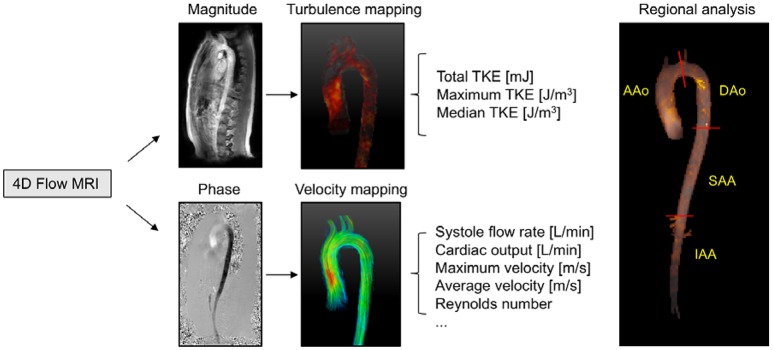
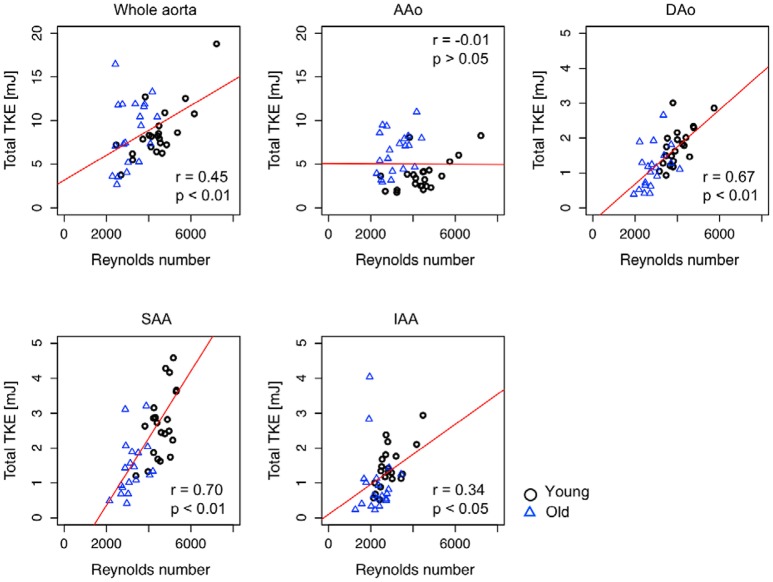
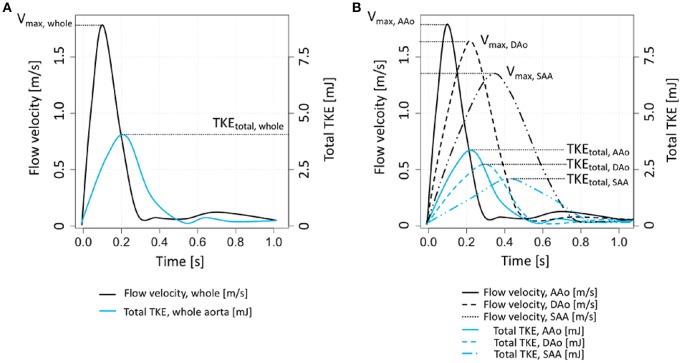
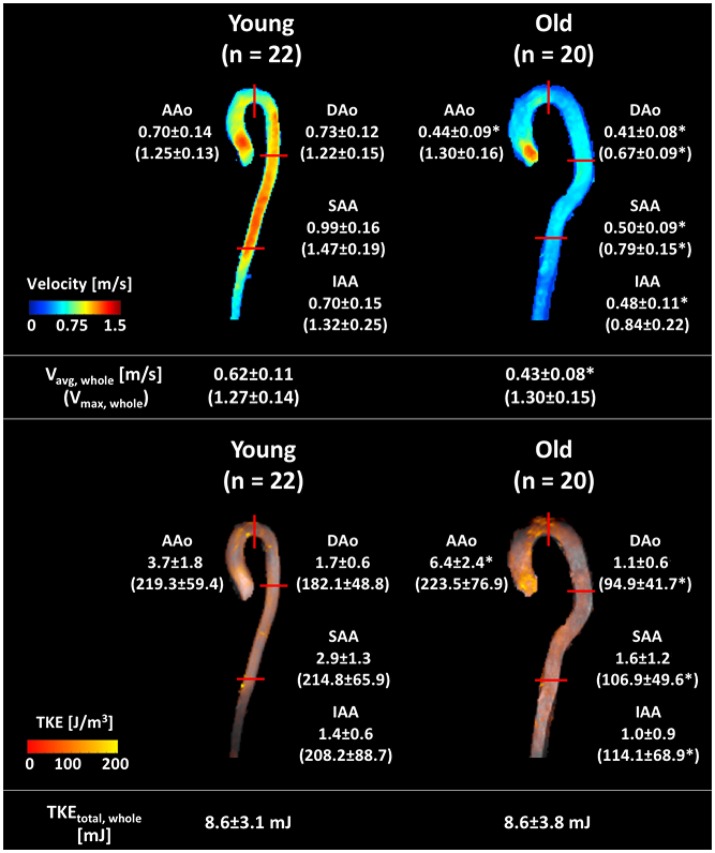
Turbulent blood flow is implicated in the pathogenesis of several aortic diseases but the extent and degree of turbulent blood flow in the normal aorta is unknown. We aimed to quantify the extent and degree of turbulece in the normal aorta and to assess whether age impacts the degree of turbulence. 22 young normal males (23.7 ± 3.0 y.o.) and 20 old normal males (70.9 ± 3.5 y.o.) were examined using four dimensional flow magnetic resonance imaging (4D Flow MRI) to quantify the turbulent kinetic energy (TKE), a measure of the intensity of turbulence, in the aorta. All healthy subjects developed turbulent flow in the aorta, with total TKE of 3-19 mJ. The overall degree of turbulence in the entire aorta was similar between the groups, although the old subjects had about 73% more total TKE in the ascending aorta compared to the young subjects (young = 3.7 ± 1.8 mJ, old = 6.4 ± 2.4 mJ, < 0.001). This increase in ascending aorta TKE in old subjects was associated with age-related dilation of the ascending aorta which increases the volume available for turbulence development. Conversely, age-related dilation of the descending and abdominal aorta decreased the average flow velocity and suppressed the development of turbulence. In conclusion, turbulent blood flow develops in the aorta of normal subjects and is impacted by age-related geometric changes. Non-invasive assessment enables the determination of normal levels of turbulent flow in the aorta which is a prerequisite for understanding the role of turbulence in the pathophysiology of cardiovascular disease.
湍流与几种主动脉疾病的发病机制有关,但正常主动脉中湍流的范围和程度尚不清楚。我们旨在量化正常主动脉中湍流的范围和程度,并评估年龄是否会影响湍流程度。使用四维流动磁共振成像(4D Flow MRI)对22名年轻正常男性(23.7±3.0岁)和20名老年正常男性(70.9±3.5岁)进行检查,以量化主动脉中湍流动能(TKE),这是一种衡量湍流强度的指标。所有健康受试者的主动脉中均出现了湍流,总TKE为3 - 19 mJ。两组之间整个主动脉的总体湍流程度相似,尽管老年受试者升主动脉的总TKE比年轻受试者多约73%(年轻组 = 3.7±1.8 mJ,老年组 = 6.4±2.4 mJ,<0.001)。老年受试者升主动脉TKE的增加与升主动脉的年龄相关扩张有关,这种扩张增加了可用于湍流发展的容积。相反,降主动脉和腹主动脉的年龄相关扩张降低了平均流速并抑制了湍流的发展。总之,正常受试者的主动脉中会出现湍流,并且受到年龄相关几何变化的影响。非侵入性评估能够确定主动脉中湍流的正常水平,这是理解湍流在心血管疾病病理生理学中作用的先决条件。