Division of Maternal-Fetal Medicine, Department of Gynecology and Obstetrics, Johns Hopkins School of Medicine, 500 North Wolfe Street, Phipps 222, Baltimore, MD 21218, USA.
Division of Maternal-Fetal Medicine, Department of Obstetrics and Gynecology, University of North Carolina at Chapel Hill, 3010 Old Clinic Building/Cb# 7516, Chapel Hill, NC 27599, USA.
Obstet Gynecol Clin North Am. 2018 Mar;45(1):69-81. doi: 10.1016/j.ogc.2017.10.003.
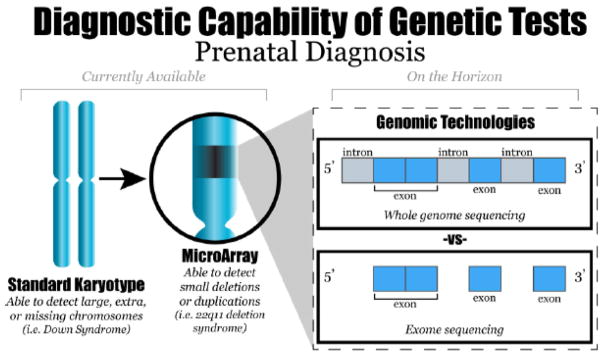
Prenatal whole exome sequencing (WES) has the potential to increase the ability to provide more diagnostic capabilities in fetuses with sonographic abnormalities, which would then improve the ability to counsel families. It is also often the first step in improving the path toward informed diagnosis and treatment, which is especially important in the era of advancing in utero fetal therapy. This article discusses the current literature regarding prenatal WES, clinical indications for WES, challenges with interpretation/counseling (variants of unknown significance), research priorities, ethical issues, and potential future advances.
产前全外显子组测序 (WES) 有可能提高对超声异常胎儿提供更多诊断能力的能力,从而提高对家庭进行咨询的能力。它通常也是改善知情诊断和治疗途径的第一步,这在胎儿宫内治疗不断发展的时代尤为重要。本文讨论了关于产前 WES 的现有文献,WES 的临床适应证,解释/咨询方面的挑战(意义不明的变异),研究重点,伦理问题以及潜在的未来进展。