Alcock Lisa, Galna Brook, Perkins Ruth, Lord Sue, Rochester Lynn
Institute of Neuroscience, Newcastle University, Newcastle upon Tyne, United Kingdom; Newcastle University Institute for Ageing, Newcastle University, Newcastle upon Tyne, United Kingdom.
Institute of Neuroscience, Newcastle University, Newcastle upon Tyne, United Kingdom; Newcastle University Institute for Ageing, Newcastle University, Newcastle upon Tyne, United Kingdom; School of Biomedical Sciences, Newcastle University, Newcastle upon Tyne, United Kingdom.
J Biomech. 2018 Apr 11;71:30-36. doi: 10.1016/j.jbiomech.2017.12.002. Epub 2017 Dec 13.
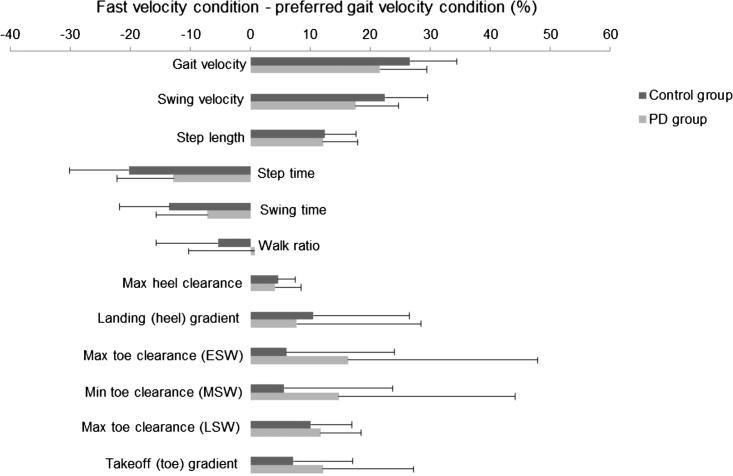
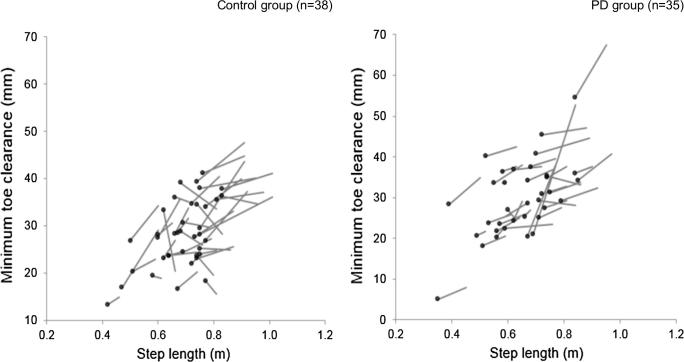
Reduced foot clearance when walking may increase the risk of trips and falls in people with Parkinson's disease (PD). Changes in foot clearance in people with PD are likely to be associated with temporal-spatial characteristics of gait such as walking slowly which evokes alterations in the temporal-spatial control of stepping patterns. Enhancing our understanding of the temporal-spatial determinants of foot clearance may inform the design of falls prevention therapies. Thirty-six people with PD and 38 age-matched controls completed four intermittent walks under two conditions: self-selected and fast gait velocity. Temporal-spatial characteristics of gait and foot (heel and toe) clearance outcomes were obtained using an instrumented walkway and 3D motion capture, respectively. A general linear model was used to quantify the effect of PD and gait velocity on gait and foot clearance. Regression evaluated the temporal and spatial gait predictors of minimum toe clearance (MTC). PD walked slower regardless of condition (p = .016) and tended to increase their step length to achieve a faster gait velocity. Step length and the walk ratio consistently explained the greatest proportion of variance in MTC (>28% and >33%, respectively) regardless of group or walking condition (p < .001). Our results suggest step length is the primary determinant of MTC regardless of pathology. Interventions that focus on increasing step length may help to reduce the risk of trips and falls during gait, however, clinical trials are required for robust evaluation.
帕金森病(PD)患者行走时足部离地间隙减小可能会增加绊倒和跌倒的风险。PD患者足部离地间隙的变化可能与步态的时空特征有关,比如行走缓慢会引起步行动作模式的时空控制改变。加强我们对足部离地间隙时空决定因素的理解可能会为预防跌倒疗法的设计提供依据。36名PD患者和38名年龄匹配的对照者在两种条件下完成了四次间歇性行走:自选步速和快速步速。分别使用仪器化步道和三维运动捕捉技术获取步态的时空特征以及足部(足跟和足尖)离地间隙结果。使用一般线性模型来量化PD和步速对步态和足部离地间隙的影响。回归分析评估了最小足尖离地间隙(MTC)的时间和空间步态预测因素。无论在哪种条件下,PD患者都走得较慢(p = 0.016),并且倾向于增加步长以达到更快的步速。无论组别或行走条件如何,步长和步幅比始终能解释MTC中最大比例的方差(分别>28%和>33%,p < 0.001)。我们的结果表明,无论病理情况如何,步长都是MTC的主要决定因素。专注于增加步长的干预措施可能有助于降低步态期间绊倒和跌倒的风险,然而,需要进行临床试验以进行有力评估。