Department of Endocrinology, Cleveland Clinic, Cleveland, Ohio.
Eli Lilly and Company, Indianapolis, Indiana.
Diabetes Obes Metab. 2018 Jun;20(6):1461-1469. doi: 10.1111/dom.13252. Epub 2018 Mar 23.
To assess efficacy and safety of dulaglutide 1.5 mg combined with insulin, categorized by subgroups of baseline glycated haemoglobin (HbA1c; ≤9% and >9% [≤74.9 and >74.9 mmol/mol]), age (<65 and ≥65 years), and duration of diabetes (<10 and ≥10 years) at 6 months in patients with type 2 diabetes (T2D).
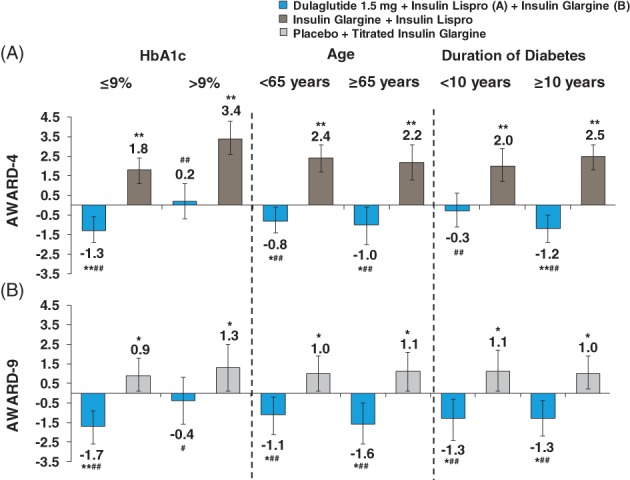
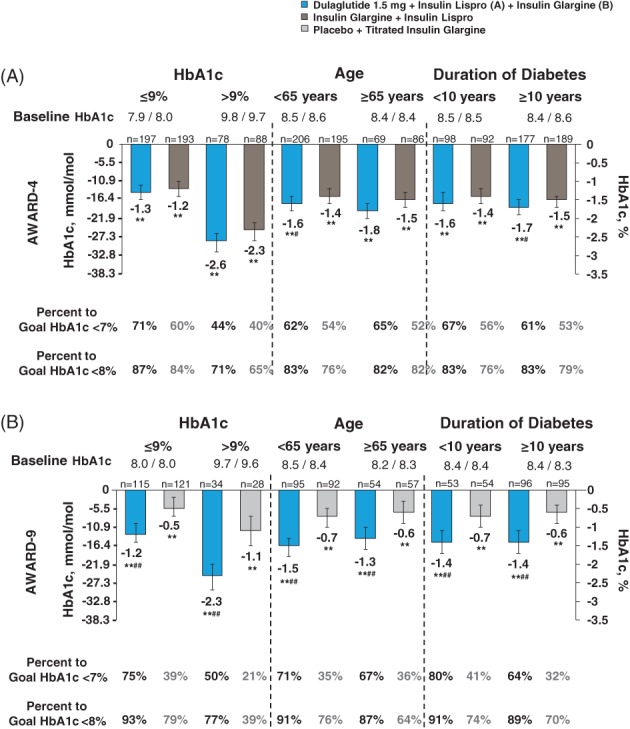
This pooled analysis was conducted in a population of patients with T2D with similar baseline characteristics who were included in the AWARD-4 and AWARD-9 clinical trials and randomized to dulaglutide 1.5 mg (pooled mean baseline age 59 years, duration of diabetes 13 years, HbA1c 8.4% [68.3 mmol/mol]). Weight and hypoglycaemia were analysed by individual trial. In AWARD-4, dulaglutide plus lispro three times daily was assessed against glargine plus lispro three times daily. In AWARD-9, dulaglutide added to glargine was assessed against placebo added to glargine. Insulins were titrated to target in both trials.
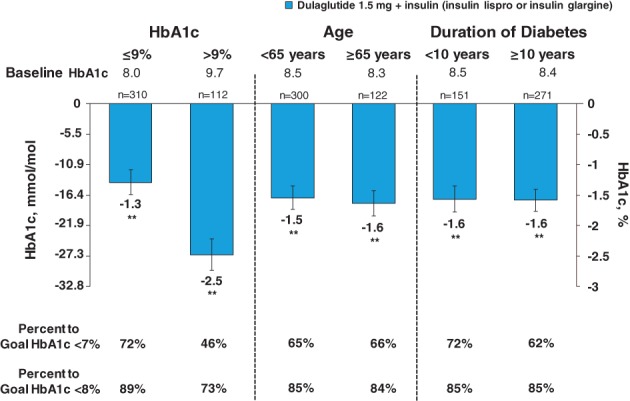
A total of 445 patients were included in this analysis (73% with HbA1c ≤9%, 27% [≤74.9 mmol/mol] with HbA1c >9% [>74.9 mmol/mol]; 70% aged <65 years, 30% aged ≥65 years; 36% with duration of diabetes <10 years, 64% with duration of diabetes ≥10 years). At 6 months, dulaglutide 1.5 mg significantly reduced HbA1c in all subgroups (P < .001), with the highest reduction observed in patients with baseline HbA1c >9% (>74.9 mmol/mol) (range - 1.3% to -2.5% [-14.2 to -27.3 mmol/mol]). The incidence rates of documented symptomatic and severe hypoglycaemia were similar in all subgroups in both trials. The most common adverse events observed in each trial were gastrointestinal in nature.
Dulaglutide 1.5 mg combined with basal or prandial insulin is efficacious for patients with T2D irrespective of age, duration of diabetes or baseline HbA1c.
评估在 6 个月时,糖化血红蛋白(HbA1c;≤9% 和>9%[≤74.9 和>74.9mmol/mol])、年龄(<65 岁和≥65 岁)和糖尿病病程(<10 年和≥10 年)的亚组中,利司那肽联合基础胰岛素或餐时胰岛素治疗 2 型糖尿病(T2D)患者的疗效和安全性。
这是一项在 AWARD-4 和 AWARD-9 临床试验中具有相似基线特征的 T2D 患者群体中进行的汇总分析,这些患者被随机分配至利司那肽 1.5mg 组(汇总平均基线年龄为 59 岁,糖尿病病程为 13 年,HbA1c 为 8.4%[68.3mmol/mol])。体重和低血糖情况按个例试验进行分析。在 AWARD-4 试验中,评估了利司那肽联合赖脯胰岛素每日 3 次与甘精胰岛素联合赖脯胰岛素每日 3 次的疗效。在 AWARD-9 试验中,评估了利司那肽联合甘精胰岛素与安慰剂联合甘精胰岛素的疗效。在两项试验中,胰岛素均滴定至目标剂量。
本分析共纳入 445 例患者(73%的患者 HbA1c≤9%,27%[≤74.9mmol/mol]的患者 HbA1c>9%[>74.9mmol/mol];70%的患者年龄<65 岁,30%的患者年龄≥65 岁;36%的患者糖尿病病程<10 年,64%的患者糖尿病病程≥10 年)。在 6 个月时,利司那肽 1.5mg 在所有亚组中均显著降低 HbA1c(P<.001),在基线 HbA1c>9%(>74.9mmol/mol)的患者中降幅最大(范围为-1.3%至-2.5%[-14.2 至-27.3mmol/mol])。在两项试验的所有亚组中,有记录的症状性和严重低血糖的发生率相似。在每个试验中观察到的最常见不良事件均为胃肠道性质。
利司那肽 1.5mg 联合基础胰岛素或餐时胰岛素治疗 T2D 患者有效,无论患者的年龄、糖尿病病程或基线 HbA1c 如何。