Environmental and Life Sciences, Faculty of Science, Universiti Brunei Darussalam, Gadong BE1410, Brunei Darussalam;
Department of Botany and Plant Sciences, University of California, Riverside, CA 92521;
Proc Natl Acad Sci U S A. 2018 Feb 20;115(8):1837-1842. doi: 10.1073/pnas.1714977115. Epub 2018 Feb 5.
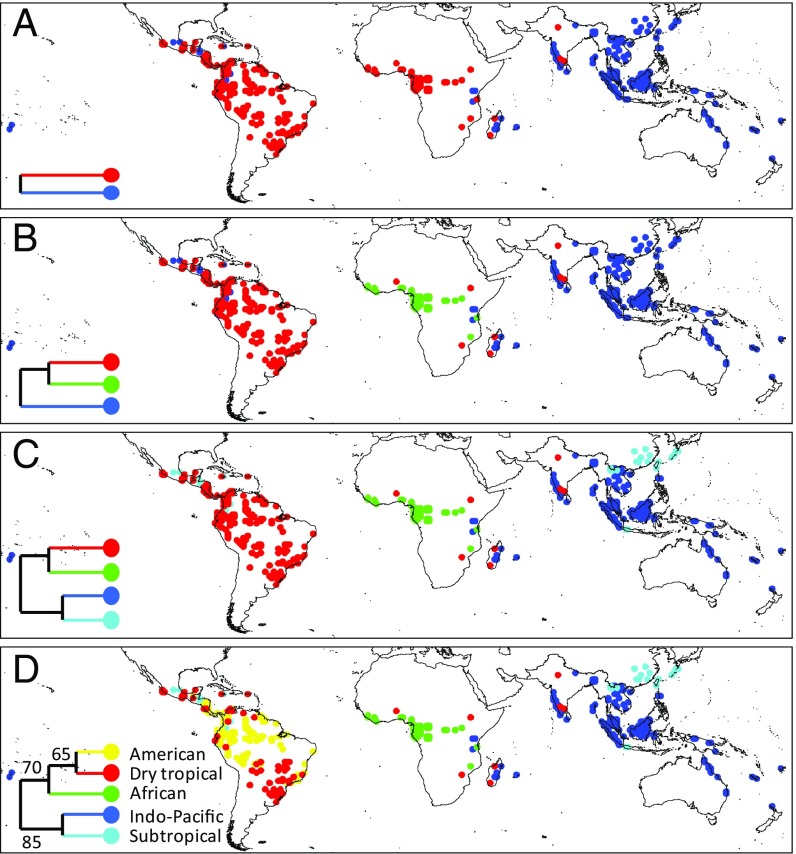
Knowledge about the biogeographic affinities of the world's tropical forests helps to better understand regional differences in forest structure, diversity, composition, and dynamics. Such understanding will enable anticipation of region-specific responses to global environmental change. Modern phylogenies, in combination with broad coverage of species inventory data, now allow for global biogeographic analyses that take species evolutionary distance into account. Here we present a classification of the world's tropical forests based on their phylogenetic similarity. We identify five principal floristic regions and their floristic relationships: () Indo-Pacific, () Subtropical, () African, () American, and () Dry forests. Our results do not support the traditional neo- versus paleotropical forest division but instead separate the combined American and African forests from their Indo-Pacific counterparts. We also find indications for the existence of a global dry forest region, with representatives in America, Africa, Madagascar, and India. Additionally, a northern-hemisphere Subtropical forest region was identified with representatives in Asia and America, providing support for a link between Asian and American northern-hemisphere forests.
关于世界热带森林生物地理亲缘关系的知识有助于更好地理解森林结构、多样性、组成和动态在区域上的差异。这种理解将使我们能够预测特定区域对全球环境变化的反应。现代系统发育学,结合广泛的物种清单数据,现在允许进行全球生物地理分析,考虑到物种进化距离。在这里,我们根据系统发育相似性对世界热带森林进行分类。我们确定了五个主要的植物区系区域及其植物区系关系:()印度-太平洋,()亚热带,()非洲,()美洲和()旱地森林。我们的结果不支持传统的新热带与古热带森林划分,而是将合并的美洲和非洲森林与其印度-太平洋对应物分开。我们还发现了存在一个全球旱地森林区域的迹象,其代表分布在美洲、非洲、马达加斯加和印度。此外,还确定了一个北半球亚热带森林区域,其代表分布在亚洲和美洲,为亚洲和美洲北半球森林之间的联系提供了支持。