Jakovac Catarina C, Meave Jorge A, Bongers Frans, Letcher Susan G, Dupuy Juan Manuel, Piotto Daniel, Rozendaal Danaë M A, Peña-Claros Marielos, Craven Dylan, Santos Braulio A, Siminski Alexandre, Fantini Alfredo C, Rodrigues Alice C, Hernández-Jaramillo Alma, Idárraga Alvaro, Junqueira André B, Zambrano Angelica María Almeyda, de Jong Ben H J, Pinho Bruno Ximenes, Finegan Bryan, Castellano-Castro Carolina, Zambiazi Daisy Christiane, Dent Daisy H, García Daniel Hernán, Kennard Deborah, Delgado Diego, Broadbent Eben N, Ortiz-Malavassi Edgar, Pérez-García Eduardo A, Lebrija-Trejos Edwin, Berenguer Erika, Marín-Spiotta Erika, Alvarez-Davila Esteban, de Sá Sampaio Everardo Valadares, Melo Felipe, Elias Fernando, França Filipe, Oberleitner Florian, Mora Francisco, Williamson G Bruce, Colletta Gabriel Dalla, Cabral George A L, Derroire Géraldine, Fernandes Geraldo Wilson, van der Wal Hans, Teixeira Heitor Mancini, Vester Henricus F M, García Hernando, Vieira Ima C G, Jiménez-Montoya Jaider, de Almeida-Cortez Jarcilene S, Hall Jefferson S, Chave Jerome, Zimmerman Jess K, Nieto Jhon Edison, Ferreira Joice, Rodríguez-Velázquez Jorge, Ruíz Jorge, Barlow Jos, Aguilar-Cano José, Hernández-Stefanoni José Luis, Engel Julien, Becknell Justin M, Zanini Kátia, Lohbeck Madelon, Tabarelli Marcelo, Romero-Romero Marco Antonio, Uriarte Maria, Veloso Maria D M, Espírito-Santo Mário M, van der Sande Masha T, van Breugel Michiel, Martínez-Ramos Miguel, Schwartz Naomi B, Norden Natalia, Pérez-Cárdenas Nathalia, González-Valdivia Noel, Petronelli Pascal, Balvanera Patricia, Massoca Paulo, Brancalion Pedro H S, Villa Pedro M, Hietz Peter, Ostertag Rebecca, López-Camacho René, César Ricardo G, Mesquita Rita, Chazdon Robin L, Muñoz Rodrigo, DeWalt Saara J, Müller Sandra C, Durán Sandra M, Martins Sebastião Venâncio, Ochoa-Gaona Susana, Rodríguez-Buritica Susana, Aide T Mitchell, Bentos Tony Vizcarra, de S Moreno Vanessa, Granda Vanessa, Thomas Wayt, Silver Whendee L, Nunes Yule R F, Poorter Lourens
Departamento de Fitotecnia, Centro de Ciências Agrárias, Universidade Federal de Santa Catarina, Rod. Admar Gonzaga, 1346, 88034-000 Florianópolis, Brazil.
Forest Ecology and Forest Management Group, Wageningen University & Research, P.O. Box 47, 6700 AA Wageningen, Netherlands.
Sci Adv. 2022 Jul;8(26):eabn1767. doi: 10.1126/sciadv.abn1767. Epub 2022 Jul 1.
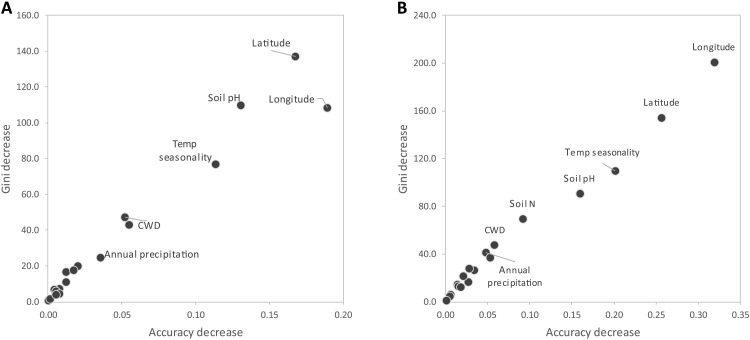
Forests that regrow naturally on abandoned fields are important for restoring biodiversity and ecosystem services, but can they also preserve the distinct regional tree floras? Using the floristic composition of 1215 early successional forests (≤20 years) in 75 human-modified landscapes across the Neotropic realm, we identified 14 distinct floristic groups, with a between-group dissimilarity of 0.97. Floristic groups were associated with location, bioregions, soil pH, temperature seasonality, and water availability. Hence, there is large continental-scale variation in the species composition of early successional forests, which is mainly associated with biogeographic and environmental factors but not with human disturbance indicators. This floristic distinctiveness is partially driven by regionally restricted species belonging to widespread genera. Early secondary forests contribute therefore to restoring and conserving the distinctiveness of bioregions across the Neotropical realm, and forest restoration initiatives should use local species to assure that these distinct floras are maintained.
在废弃田地上自然再生的森林对于恢复生物多样性和生态系统服务至关重要,但它们能否保护独特的区域树木植物群呢?利用新热带界75个人为改造景观中1215片早期演替森林(≤20年)的植物区系组成,我们识别出14个不同的植物区系组,组间差异度为0.97。植物区系组与地理位置、生物区域、土壤pH值、温度季节性和水分可利用性有关。因此,早期演替森林的物种组成在大陆尺度上存在很大差异,这主要与生物地理和环境因素有关,而与人为干扰指标无关。这种植物区系的独特性部分是由广泛分布属中的区域特有物种驱动的。因此,早期次生林有助于恢复和保护新热带界各生物区域的独特性,森林恢复计划应使用当地物种以确保这些独特的植物群得以维持。