State Key Laboratory of Proteomics, Beijing Proteome Research Center, National Center for Protein Sciences-Beijing (PHOENIX Center), Beijing Institute of Radiation Medicine, Beijing, 102206, China.
Department of Biological Sciences, University of Delaware, 105 The Green, Newark, DE, 19716, USA.
BMC Microbiol. 2018 Jan 5;18(1):5. doi: 10.1186/s12866-017-1147-7.
The intracellular bacterial pathogen Legionella pneumophila proliferates in human alveolar macrophages, resulting in a severe pneumonia termed Legionnaires' disease. Throughout the course of infection, L. pneumophila remains enclosed in a specialized membrane compartment that evades fusion with lysosomes. The pathogen delivers over 300 effector proteins into the host cell, altering host pathways in a manner that sets the stage for efficient pathogen replication. The L. pneumophila effector protein AnkX targets host Rab GTPases and functions in preventing fusion of the Legionella-containing vacuole with lysosomes. However, the current understanding of AnkX's interaction with host proteins and the means through which it exerts its cellular function is limited.
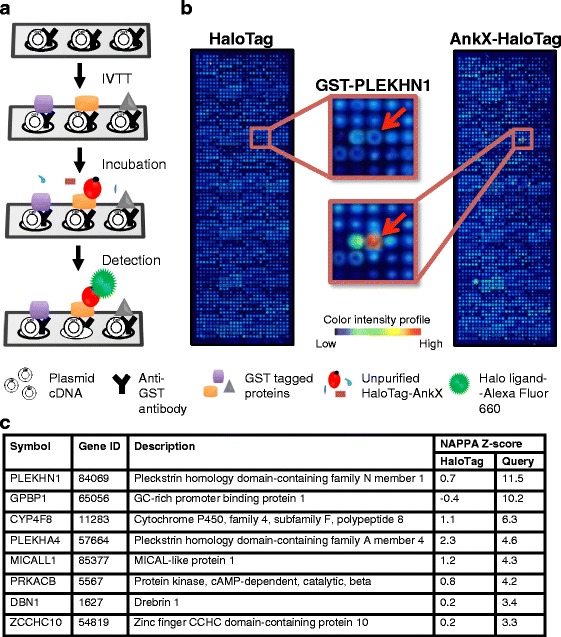
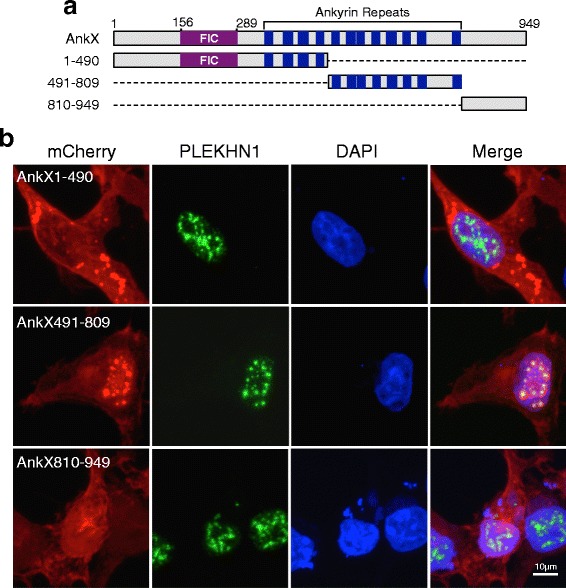
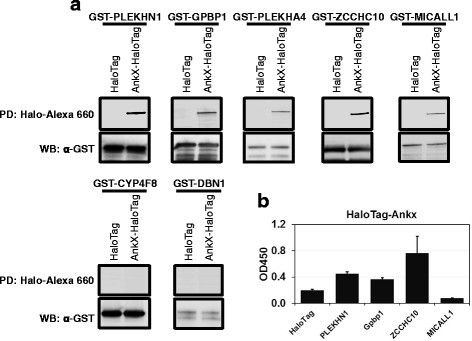
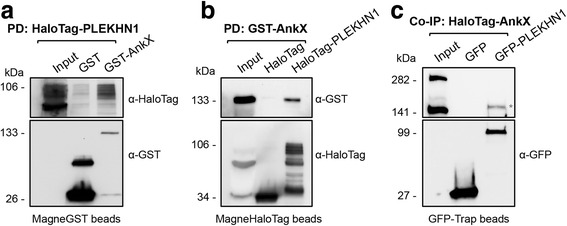
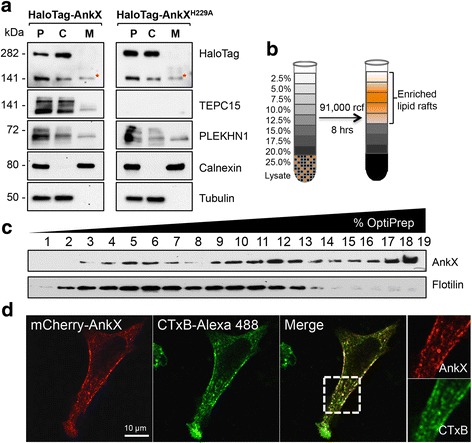
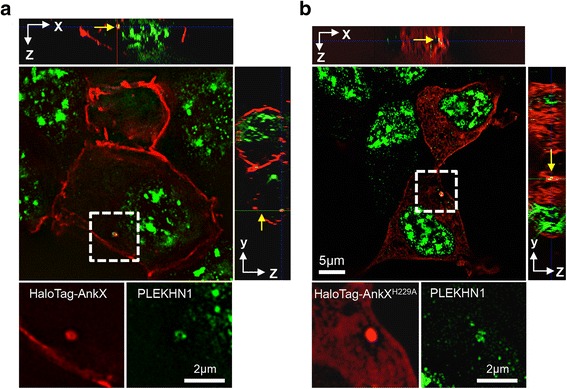
Here, we investigated the protein interaction network of AnkX by using the nucleic acid programmable protein array (NAPPA), a high-density platform comprising 10,000 unique human ORFs. This approach facilitated the discovery of PLEKHN1 as a novel interaction partner of AnkX. We confirmed this interaction through multiple independent in vitro pull-down, co-immunoprecipitation, and cell-based assays. Structured illumination microscopy revealed that endogenous PLEKHN1 is found in the nucleus and on vesicular compartments, whereas ectopically produced AnkX co-localized with lipid rafts at the plasma membrane. In mammalian cells, HaloTag-AnkX co-localized with endogenous PLEKHN1 on vesicular compartments. A central fragment of AnkX (amino acids 491-809), containing eight ankyrin repeats, extensively co-localized with endogenous PLEKHN1, indicating that this region may harbor a new function. Further, we found that PLEKHN1 associated with multiple proteins involved in the inflammatory response.
Altogether, our study provides evidence that in addition to Rab GTPases, the L. pneumophila effector AnkX targets nuclear host proteins and suggests that AnkX may have novel functions related to manipulating the inflammatory response.
细胞内细菌病原体嗜肺军团菌在人类肺泡巨噬细胞中增殖,导致一种严重的肺炎,称为军团病。在整个感染过程中,嗜肺军团菌仍然被封闭在一个特殊的膜隔室中,逃避与溶酶体融合。病原体将超过 300 种效应蛋白输送到宿主细胞中,以改变宿主途径的方式为有效病原体复制奠定基础。嗜肺军团菌效应蛋白 AnkX 靶向宿主 Rab GTPases,并在防止含军团菌的空泡与溶酶体融合中发挥作用。然而,目前对 AnkX 与宿主蛋白的相互作用以及它发挥其细胞功能的方式的理解是有限的。
在这里,我们通过使用核酸可编程蛋白阵列(NAPPA)研究了 AnkX 的蛋白质相互作用网络,NAPPA 是一个包含 10000 个独特人类 ORF 的高密度平台。这种方法促进了 PLEKHN1 作为 AnkX 的一种新的相互作用伙伴的发现。我们通过多种独立的体外下拉、共免疫沉淀和基于细胞的测定证实了这种相互作用。结构照明显微镜显示,内源性 PLEKHN1 存在于核中和囊泡区室中,而异位产生的 AnkX 与质膜上的脂筏共定位。在哺乳动物细胞中,HaloTag-AnkX 与内源性 PLEKHN1 共定位在囊泡区室上。AnkX 的中央片段(氨基酸 491-809),包含八个锚蛋白重复序列,与内源性 PLEKHN1 广泛共定位,表明该区域可能具有新的功能。此外,我们发现 PLEKHN1 与参与炎症反应的多种蛋白质相关。
总之,我们的研究提供了证据表明,除了 Rab GTPases 之外,嗜肺军团菌效应蛋白 AnkX 还靶向宿主的核蛋白,并表明 AnkX 可能具有与操纵炎症反应相关的新功能。