Université Paris-Saclay, INRAE, AgroParisTech, Micalis Institute, Epigenetics and Cellular Microbiology team, F-78350 Jouy-en-Josas, France.
Toxins (Basel). 2020 Mar 31;12(4):220. doi: 10.3390/toxins12040220.
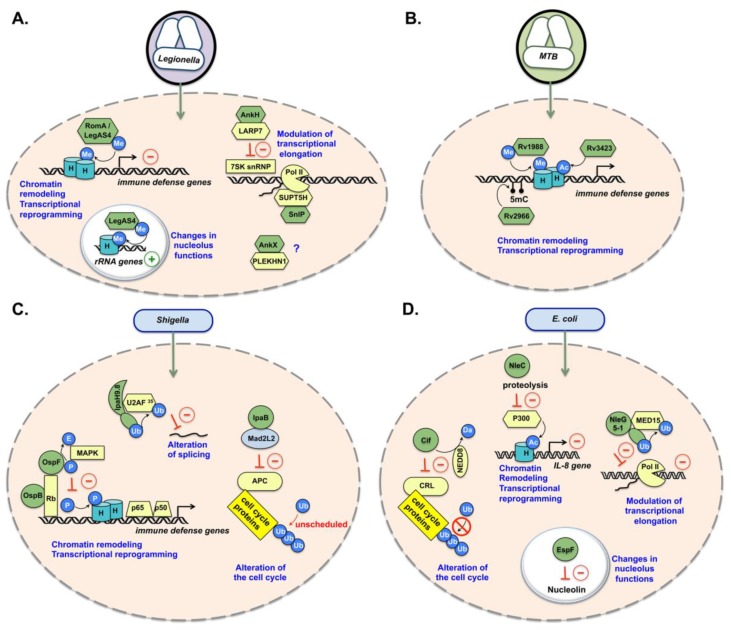
Pathogenic bacteria secrete a variety of proteins that manipulate host cell function by targeting components of the plasma membrane, cytosol, or organelles. In the last decade, several studies identified bacterial factors acting within the nucleus on gene expression or other nuclear processes, which has led to the emergence of a new family of effectors called "nucleomodulins". In human and animal pathogens, for Gram-positive bacteria and , , , and for Gram-negative bacteria, have led to pioneering discoveries. In this review, we present these paradigms and detail various mechanisms and core elements (e.g., DNA, histones, epigenetic regulators, transcription or splicing factors, signaling proteins) targeted by nucleomodulins. We particularly focus on nucleomodulins interacting with epifactors, such as LntA of and ankyrin repeat- or tandem repeat-containing effectors of Rickettsiales, and nucleomodulins from various bacterial species acting as post-translational modification enzymes. The study of bacterial nucleomodulins not only generates important knowledge about the control of host responses by microbes but also creates new tools to decipher the dynamic regulations that occur in the nucleus. This research also has potential applications in the field of biotechnology. Finally, this raises questions about the epigenetic effects of infectious diseases.
病原菌通过靶向质膜、细胞质或细胞器的成分来分泌各种蛋白质,从而操纵宿主细胞的功能。在过去的十年中,有几项研究鉴定了在细胞核内作用于基因表达或其他核过程的细菌因子,这导致了一类新的效应物家族的出现,称为“核调节因子”。在人类和动物病原体中,革兰氏阳性菌的 LntA 和 ,革兰氏阴性菌的 SaeS、HigA、YopJ 和 YopT,都促成了开创性的发现。在这篇综述中,我们介绍了这些范例,并详细描述了核调节因子靶向的各种机制和核心元件(例如 DNA、组蛋白、表观遗传调节剂、转录或剪接因子、信号蛋白)。我们特别关注与 epifactors 相互作用的核调节因子,如 中的 LntA 和 Rickettssiales 的含锚重复或串联重复效应物,以及来自各种细菌物种的核调节因子,它们作为翻译后修饰酶发挥作用。对细菌核调节因子的研究不仅产生了关于微生物控制宿主反应的重要知识,而且还为破译核内发生的动态调控提供了新的工具。这项研究在生物技术领域也有潜在的应用。最后,这引发了关于传染病的表观遗传效应的问题。