Adachi Sayaka, Yuki Kenya, Awano-Tanabe Sachiko, Ono Takeshi, Shiba Daisuke, Murata Hiroshi, Asaoka Ryo, Tsubota Kazuo
Department of Ophthalmology, Keio University School of Medicine, Shinanomachi 35, Shinjuku-ku, Tokyo, Japan.
Department of Ophthalmology, the University of Tokyo, Graduate School of Medicine, 7-3-1 Hongo, Bunkyo-ku, Tokyo, Japan.
BMC Ophthalmol. 2018 Feb 13;18(1):39. doi: 10.1186/s12886-018-0706-5.
To investigate the relationship between clinical risk factors, including visual field (VF) defects and visual acuity, and a fear of falling, among patients with primary open-angle glaucoma (POAG).
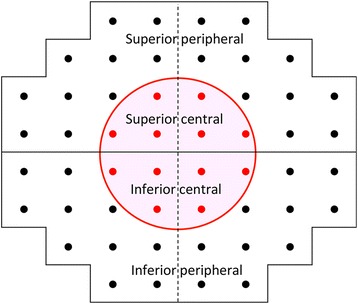
All participants answered the following question at a baseline ophthalmic examination: Are you afraid of falling? The same question was then answered every 12 months for 3 years. A binocular integrated visual field was calculated by merging a patient's monocular Humphrey field analyzer VFs, using the 'best sensitivity' method. The means of total deviation values in the whole, superior peripheral, superior central, inferior central, and inferior peripheral VFs were calculated. The relationship between these mean VF measurements, and various clinical factors, against patients' baseline fear of falling and future fear of falling was analyzed using multiple logistic regression.
Among 392 POAG subjects, 342 patients (87.2%) responded to the fear of falling question at least twice in the 3 years study period. The optimal regression model for patients' baseline fear of falling included age, gender, mean of total deviation values in the inferior peripheral VF and number of previous falls. The optimal regression equation for future fear of falling included age, gender, mean of total deviation values in the inferior peripheral VF and number of previous falls.
Defects in the inferior peripheral VF area are significantly related to the development of a fear of falling.
探讨原发性开角型青光眼(POAG)患者的临床风险因素(包括视野(VF)缺损和视力)与跌倒恐惧之间的关系。
所有参与者在基线眼科检查时回答以下问题:您是否害怕跌倒?然后在3年的时间里,每12个月回答一次相同的问题。通过使用“最佳敏感度”方法合并患者的单眼Humphrey视野分析仪视野,计算双眼综合视野。计算整个视野、上半周边视野、上半中央视野、下半中央视野和下半周边视野中总偏差值的平均值。使用多元逻辑回归分析这些平均视野测量值与各种临床因素与患者基线跌倒恐惧和未来跌倒恐惧之间的关系。
在392名POAG受试者中,342名患者(87.2%)在3年的研究期间至少两次回答了跌倒恐惧问题。患者基线跌倒恐惧的最佳回归模型包括年龄、性别、下半周边视野总偏差值的平均值和既往跌倒次数。未来跌倒恐惧的最佳回归方程包括年龄、性别、下半周边视野总偏差值的平均值和既往跌倒次数。
下半周边视野区域的缺损与跌倒恐惧的发生显著相关。