Department of Dermatology, Seventh People's Hospital of Shanghai University of Traditional Chinese Medicine, Shanghai, China (mainland).
Department of Traditional Chinese Medicine, Shanghai Changzheng Hospital, Shanghai, China (mainland).
Med Sci Monit. 2018 Feb 13;24:891-896. doi: 10.12659/msm.906098.
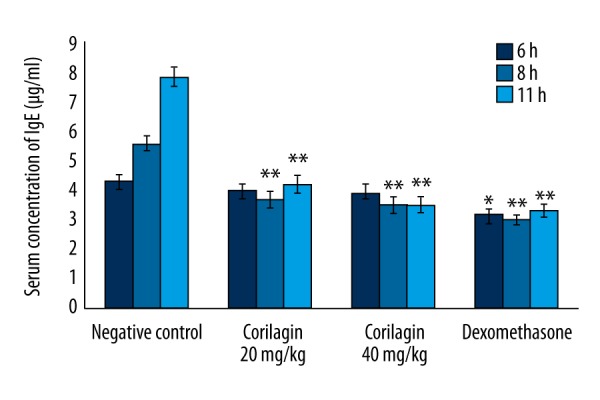
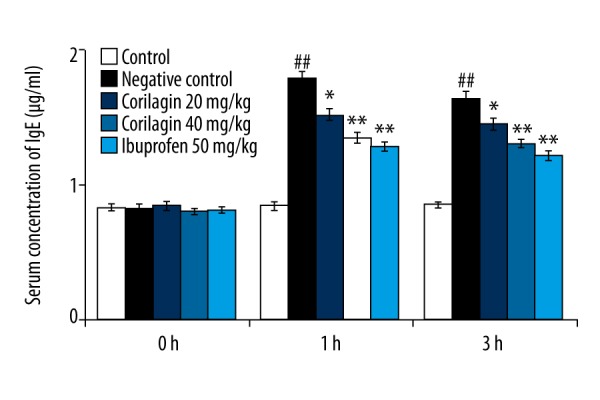
BACKGROUND This study evaluated the anti-allergic activity of corilagin and also postulates the possible mechanism of its action. MATERIAL AND METHODS Corilagin was given orally at dose of 10, 20, and 40 mg/kg/day. All the animals (guinea pigs, rats, and mice) were sensitized for allergy such as eosinophilia and leukocytosis induced by milk; degranulation of mast cell by compound 48/80; and passive and active anaphylaxis. Moreover, the antagonistic effect was determined by estimating the effect of corilagin on contraction of guinea pig tracheal chain and ileum induced by Ach and histamine, respectively. RESULTS There was a significant decrease in the leukocyte and eosinophil counts in the corilagin-treated group compared to the negative control group. Treatment with corilagin significantly protects the degranulation of mast cells, and it also has significant anti-muscarinic and antihistaminic activity by reducing the muscle contraction induced by Acetylcholine (Ach) and histamine in guinea pig tracheal chain and ileum. CONCLUSIONS Corilagin possess anti-anaphylactic and anti-allergic activity by inhibiting the release of mediators from mast cells and by decreasing the serum concentration of immunoglobulin E (IgE).
本研究评估了柯里拉京的抗过敏活性,并提出了其作用的可能机制。
柯里拉京以 10、20 和 40mg/kg/天的剂量口服给予。所有动物(豚鼠、大鼠和小鼠)均对过敏进行致敏,如牛奶引起的嗜酸性粒细胞增多和白细胞增多;肥大细胞脱颗粒由化合物 48/80 引起;以及被动和主动过敏反应。此外,通过估计柯里拉京对乙酰胆碱(Ach)和组胺分别诱导的豚鼠气管链和回肠收缩的影响来确定拮抗作用。
与阴性对照组相比,柯里拉京治疗组的白细胞和嗜酸性粒细胞计数明显减少。柯里拉京治疗显著保护肥大细胞脱颗粒,通过减少乙酰胆碱(Ach)和组胺诱导的豚鼠气管链和回肠肌肉收缩,具有显著的抗毒蕈碱和抗组胺活性。
柯里拉京通过抑制肥大细胞释放介质和降低血清免疫球蛋白 E(IgE)浓度来发挥抗过敏性和抗过敏活性。