Motta Benedetta M, Pramstaller Peter P, Hicks Andrew A, Rossini Alessandra
Institute for Biomedicine, Eurac Research, Affiliated Institute of the University of Lübeck, Bolzano, Italy.
Stem Cells Int. 2017;2017:8960236. doi: 10.1155/2017/8960236. Epub 2017 Dec 25.
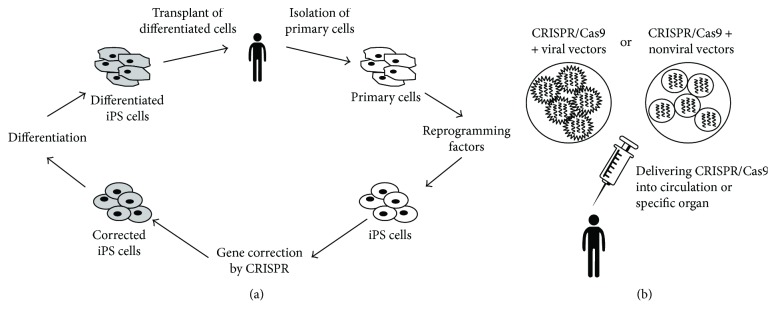
Genome-editing technology has emerged as a powerful method that enables the generation of genetically modified cells and organisms necessary to elucidate gene function and mechanisms of human diseases. The clustered regularly interspaced short palindromic repeats- (CRISPR-) associated 9 (Cas9) system has rapidly become one of the most popular approaches for genome editing in basic biomedical research over recent years because of its simplicity and adaptability. CRISPR/Cas9 genome editing has been used to correct DNA mutations ranging from a single base pair to large deletions in both and model systems. CRISPR/Cas9 has been used to increase the understanding of many aspects of cardiovascular disorders, including lipid metabolism, electrophysiology and genetic inheritance. The CRISPR/Cas9 technology has been proven to be effective in creating gene knockout (KO) or knockin in human cells and is particularly useful for editing induced pluripotent stem cells (iPSCs). Despite these progresses, some biological, technical, and ethical issues are limiting the therapeutic potential of genome editing in cardiovascular diseases. This review will focus on various applications of CRISPR/Cas9 genome editing in the cardiovascular field, for both disease research and the prospect of genome-editing therapies in the future.
基因组编辑技术已成为一种强大的方法,能够生成阐明基因功能和人类疾病机制所需的基因修饰细胞和生物体。近年来,成簇规律间隔短回文重复序列(CRISPR)相关蛋白9(Cas9)系统因其简单性和适应性,迅速成为基础生物医学研究中最受欢迎的基因组编辑方法之一。CRISPR/Cas9基因组编辑已被用于纠正从单个碱基对到大片段缺失的DNA突变,在细胞和动物模型系统中均有应用。CRISPR/Cas9已被用于增进对心血管疾病诸多方面的理解,包括脂质代谢、电生理学和遗传遗传。CRISPR/Cas9技术已被证明在人类细胞中创建基因敲除(KO)或敲入有效,尤其适用于编辑诱导多能干细胞(iPSC)。尽管取得了这些进展,但一些生物学、技术和伦理问题限制了基因组编辑在心血管疾病中的治疗潜力。本综述将聚焦CRISPR/Cas9基因组编辑在心血管领域的各种应用,包括疾病研究以及未来基因组编辑疗法的前景。