Thompson Nicole A, Cords Marina
Department of Ecology, Evolution, and Environmental Biology Columbia University New York NY USA.
New York Consortium in Evolutionary Primatology New York NY USA.
Ecol Evol. 2018 Jan 3;8(3):1604-1614. doi: 10.1002/ece3.3781. eCollection 2018 Feb.
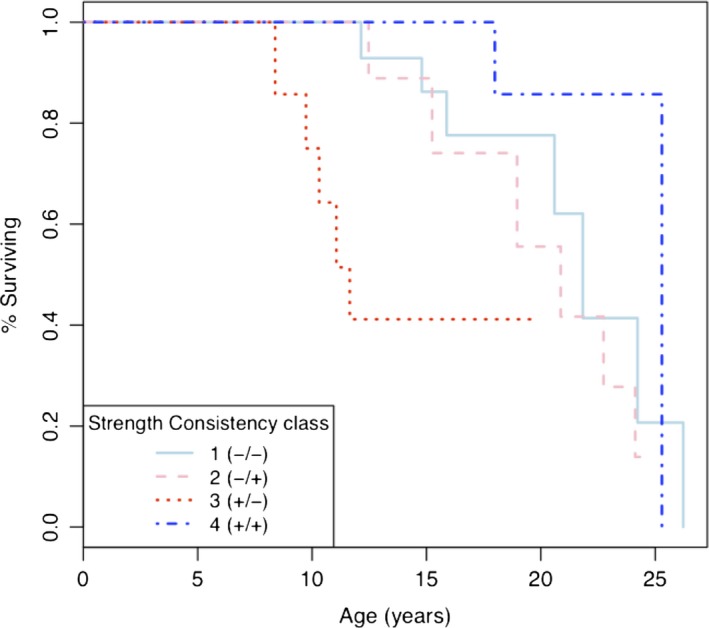
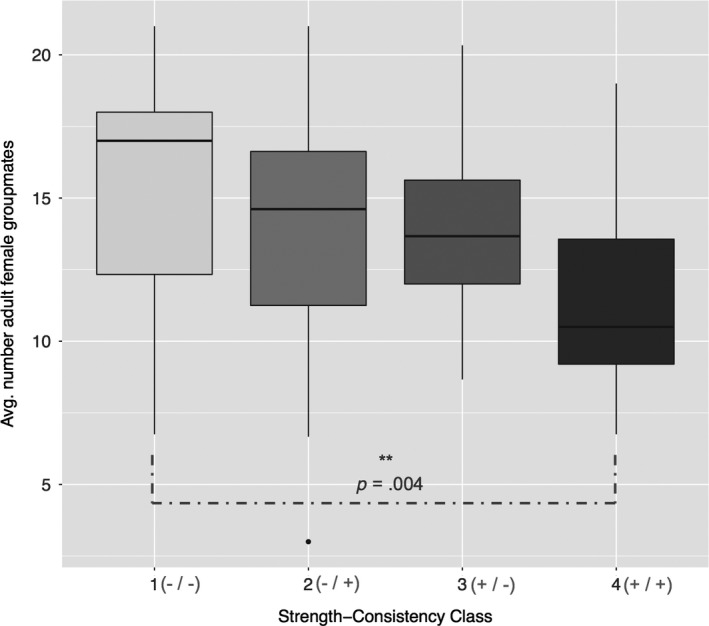
In group-living species, individuals often have preferred affiliative social partners, with whom ties or bonds can confer advantages that correspond with greater fitness. For example, in adult female baboons and juvenile horses, individuals with stronger or more social ties experience greater survival. We used detailed behavioral and life history records to explore the relationship between tie quality and survival in a gregarious monkey (), while controlling for dominance rank, group size, and life history strategy. We used Cox proportional hazards regressions to model the cumulative (multi-year) and current (single-year) relationships of social ties and the hazard of mortality in 83 wild adult females of known age, observed 2-8 years each (437 subject-years) in eight social groups. The strength of bonds with close partners was associated with increased mortality risk under certain conditions: Females that had strong bonds with close partners that were inconsistent over multiple years had a higher risk of mortality than females adopting any other social strategy. Within a given year, females had a higher risk of death if they were strongly bonded with partners that changed from the previous year versus with partners that remained consistent. Dominance rank, number of adult female groupmates, and age at first reproduction did not predict the risk of death. This study demonstrates that costs and benefits of strong social bonds can be context-dependent, relating to the consistency of social partners over time.
在群居物种中,个体通常有偏好的亲密社会伙伴,与这些伙伴的关系或纽带能带来与更高适应性相对应的优势。例如,在成年雌性狒狒和幼年马中,拥有更强或更多社会关系的个体存活率更高。我们利用详细的行为和生活史记录,在控制优势等级、群体规模和生活史策略的同时,探究一种群居猴子的关系质量与存活率之间的关系。我们使用Cox比例风险回归模型,对83只已知年龄的野生成年雌性猴子的社会关系与死亡风险的累积(多年)和当前(单年)关系进行建模,这些猴子在八个社会群体中被观察了2至8年(共437个个体年)。在某些情况下,与亲密伙伴的关系强度与死亡风险增加有关:与亲密伙伴的关系在多年间不稳定的雌性,其死亡风险高于采取任何其他社会策略的雌性。在特定年份内,如果雌性与前一年相比伙伴发生了变化,那么与伙伴保持不变的雌性相比,前者的死亡风险更高。优势等级、成年雌性群体成员数量和首次繁殖年龄并不能预测死亡风险。这项研究表明,牢固社会关系的成本和收益可能取决于具体情境,与社会伙伴随时间的一致性有关。