a Cancer Epigenetics Laboratory, INGEMM , La Paz University Hospital , Madrid , Spain.
b Biomarkers and Experimental Therapeutics in Cancer , IdiPAZ , Madrid , Spain.
Epigenetics. 2018;13(3):251-263. doi: 10.1080/15592294.2018.1436364. Epub 2018 Apr 2.
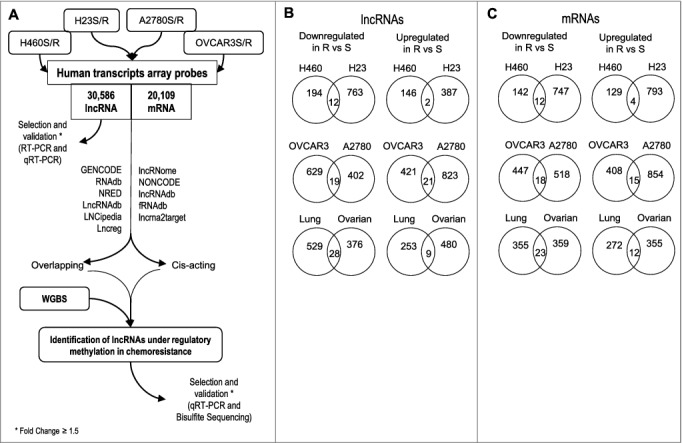
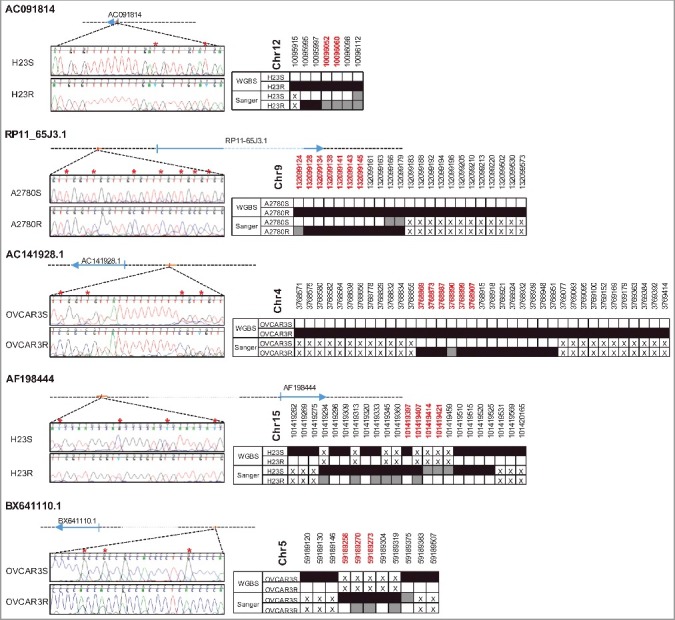
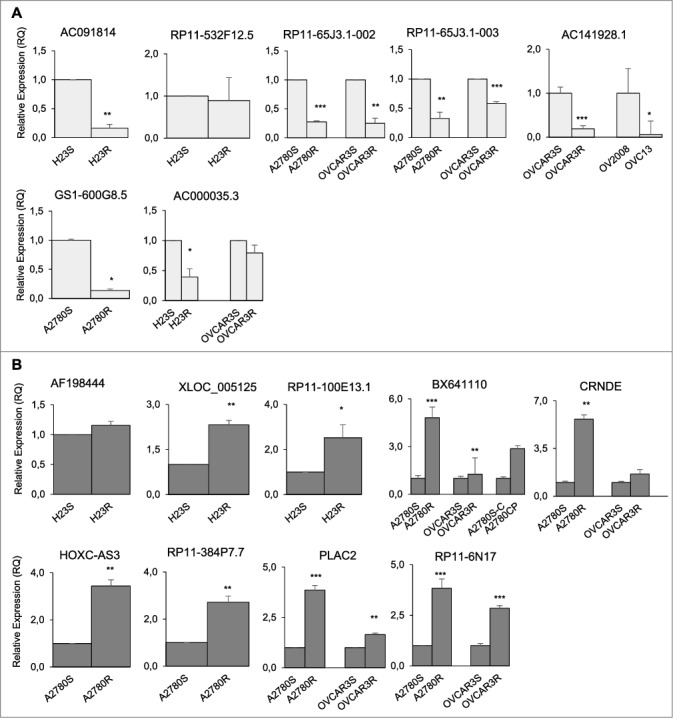
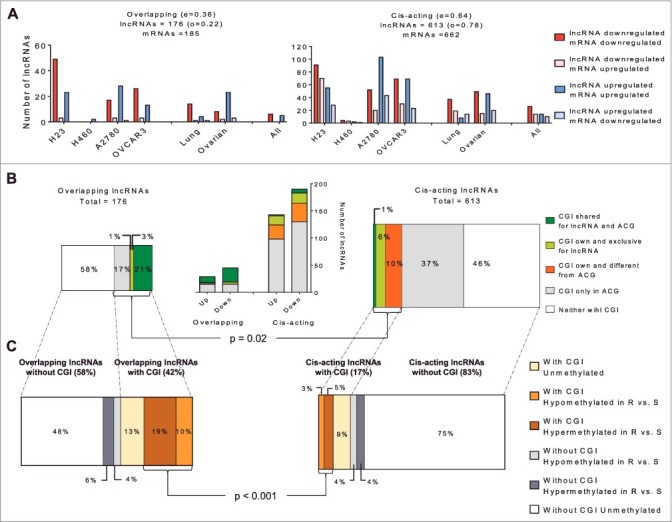
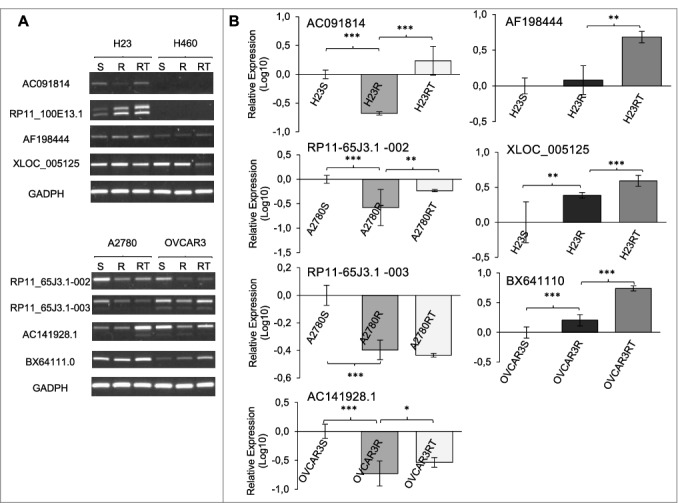
Long noncoding RNAs (lncRNAs) are critical regulators of cell biology whose alteration can lead to the development of diseases such as cancer. The potential role of lncRNAs and their epigenetic regulation in response to platinum treatment are largely unknown. We analyzed four paired cisplatin-sensitive/resistant non-small cell lung cancer and ovarian cancer cell lines. The epigenetic landscape of overlapping and cis-acting lncRNAs was determined by combining human microarray data on 30,586 lncRNAs and 20,109 protein coding mRNAs with whole-genome bisulfite sequencing. Selected candidate lncRNAs were further characterized by PCR, gene-ontology analysis, and targeted bisulfite sequencing. Differential expression in response to therapy was observed more frequently in cis-acting than in overlapping lncRNAs (78% vs. 22%, fold change ≥1.5), while significantly altered methylation profiles were more commonly associated with overlapping lncRNAs (29% vs. 8%; P value <0.001). Moreover, overlapping lncRNAs contain more CpG islands (CGIs) (25% vs. 17%) and the majority of CGI-containing overlapping lncRNAs share these CGIs with their associated coding genes (84%). The differences in expression between sensitive and resistant cell lines were replicated in 87% of the selected candidates (P<0.05), while our bioinformatics approach identifying differential methylation was confirmed in all of the selected lncRNAs (100%). Five lncRNAs under epigenetic regulation appear to be involved in cisplatin resistance (AC091814.2, AC141928.1, RP11-65J3.1-002, BX641110, and AF198444). These novel findings provide new insights into epigenetic mechanisms and acquired resistance to cisplatin that highlight specific lncRNAs, some with unknown function, that may signal strategies in epigenetic therapies.
长链非编码 RNA(lncRNA)是细胞生物学的关键调节因子,其改变可导致癌症等疾病的发生。lncRNA 及其对铂类治疗的表观遗传调节的潜在作用在很大程度上尚不清楚。我们分析了四对顺铂敏感/耐药的非小细胞肺癌和卵巢癌细胞系。通过将 30586 个 lncRNA 和 20109 个蛋白质编码 mRNA 的人类微阵列数据与全基因组亚硫酸氢盐测序相结合,确定了重叠和顺式作用 lncRNA 的表观遗传景观。通过 PCR、基因本体分析和靶向亚硫酸氢盐测序进一步对选定的候选 lncRNA 进行了表征。与重叠 lncRNA 相比,顺式作用 lncRNA 中观察到更多的治疗反应差异表达(78%对 22%,倍数变化≥1.5),而重叠 lncRNA 中更常见的是显著改变的甲基化谱(29%对 8%;P 值<0.001)。此外,重叠 lncRNA 含有更多的 CpG 岛(CGI)(25%对 17%),并且大多数包含 CGI 的重叠 lncRNA 与其相关的编码基因共享这些 CGI(84%)。敏感和耐药细胞系之间的差异表达在选定的候选者中 87%得到了复制(P<0.05),而我们的生物信息学方法识别差异甲基化在所有选定的 lncRNA 中得到了确认(100%)。五个受表观遗传调控的 lncRNA 似乎参与了顺铂耐药(AC091814.2、AC141928.1、RP11-65J3.1-002、BX641110 和 AF198444)。这些新发现为顺铂的表观遗传机制和获得性耐药提供了新的见解,突出了一些具有未知功能的特定 lncRNA,它们可能在表观遗传治疗中发出信号策略。