Department of Chemistry, University of Miami, 1301 Memorial Drive, Coral Gables, FL 33146, USA.
College of Pharmacy and Chemistry, Dali University, Dali 671000, Yunnan, China.
Molecules. 2018 Feb 10;23(2):378. doi: 10.3390/molecules23020378.
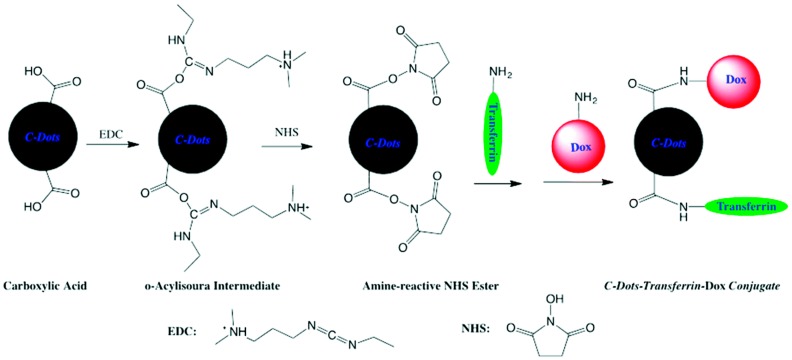
Currently cancer treatment is in large part non-specific with respect to treatment. Medication is often harsh on patients, whereby they suffer several undesired side effects as a result. Carbon-based nanoparticles have attracted attention in recent years due to their ability to act as a platform for the attachment of several drugs and/or ligands. Relatively simple models are often used in cancer research, wherein carbon nanoparticles are conjugated to a ligand that is specific to an overexpressed receptor for imaging and drug delivery in cancer treatment. These carbon nanoparticles confer unique properties to the imaging or delivery vehicle due to their nontoxic nature and their high fluorescence qualities. Chief among the ongoing research within carbon-based nanoparticles emerge carbon dots (C-dots) and carbon nanotubes (CNTs). In this review, the aforementioned carbon nanoparticles will be discussed in their use within doxorubicin and gemcitabine based drug delivery vehicles, as well as the ligand-mediated receptor specific targeted therapy. Further directions of research in current field are also discussed.
目前,癌症治疗在很大程度上是非特异性的,药物治疗对患者往往很苛刻,因此会产生多种不良副作用。近年来,由于碳纳米粒子能够作为附着多种药物和/或配体的平台,因此受到了关注。在癌症研究中,通常使用相对简单的模型,其中将碳纳米粒子与针对过表达受体的配体偶联,用于癌症治疗的成像和药物输送。由于这些碳纳米粒子的无毒性质和高荧光特性,它们为成像或输送载体赋予了独特的性质。在基于碳的纳米粒子的正在进行的研究中,碳点(C-dots)和碳纳米管(CNTs)尤为突出。在这篇综述中,将讨论上述碳纳米粒子在阿霉素和吉西他滨为基础的药物输送载体中的应用,以及配体介导的受体特异性靶向治疗。还讨论了当前领域的进一步研究方向。