Key Laboratory of Bio-Resource and Eco-Environment of Ministry of Education, College of life sciences, Sichuan University, No. 24 South Section 1, Yihuan Road, Chengdu, 610065, China.
Tibet Academy of Agriculture and Animal Husbandry Sciences, Lhasa, 850002, China.
BMC Microbiol. 2018 Feb 13;18(1):11. doi: 10.1186/s12866-018-1152-5.
Soil contaminated with the heavy metal Cadmium (Cd) is a widespread problem in many parts of the world. Based on metagenomic analysis, we investigated the functional potential and structural diversity of the microbial community in Cd-contaminated and non-contaminated soil samples and we explored the associated metabolic pathway network in cluster of orthologous groups (COG) and Kyoto Encyclopedia of Genes and Genomes (KEGG).
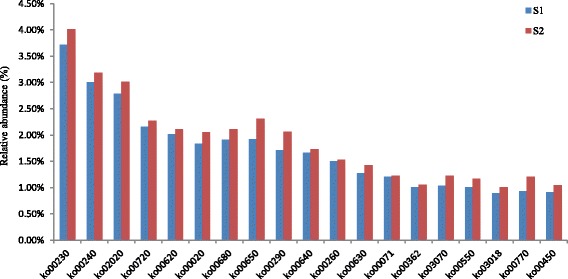
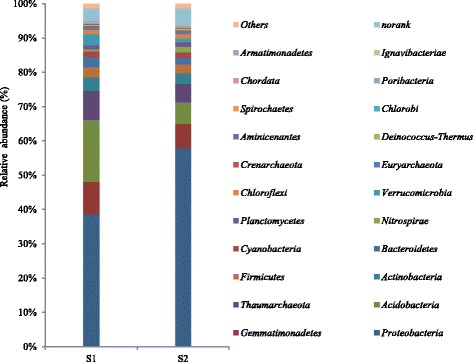
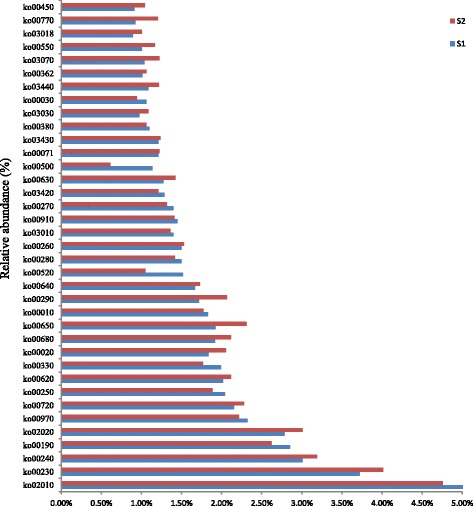
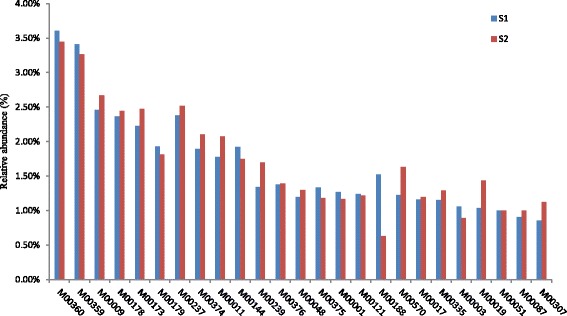
The results showed that microorganisms in these soils were quite abundant, and many of them possessed numerous physiological functions. However, Cd-contamination has the potential to reduce the microbial diversity and further alter the community structure in the soil. Notably, function analysis of the crucial microorganisms (e. g. Proteobacteria, Sulfuricella and Thiobacillus) indicated that these bacteria and their corresponding physiological functions were important for the community to cope with Cd pollution. The COG annotation demonstrated that the predominant category was the microbial metabolism cluster in both soil samples, while the relative abundance of metabolic genes was increased in the Cd-contaminated soil. The KEGG annotation results exhibited that the non-contaminated soil had more genes, pathways, modules, orthologies and enzymes involved in metabolic pathways of microbial communities than the Cd-contaminated soil. The relative abundance of some dominant KEGG pathways increased in the Cd contaminated soil, and they were mostly enriched to the metabolism, biosynthesis and degradation of amino acids, fatty acids and nucleotides, which was related to Cd tolerance of the microorganisms.
Cd-contamination can decrease the taxonomic species of microbes in soil and change the soil microbial composition. The functional pathways involved in the soil change with microbial structure variation, many of which are related to the heavy metal tolerance of soil microbes. The Cd-contaminated soil microbes is a potential resource for exploring cadmium resistant or tolerant bacteria.
受重金属镉(Cd)污染的土壤是世界许多地区普遍存在的问题。基于宏基因组分析,我们研究了受 Cd 污染和未污染土壤样本中微生物群落的功能潜力和结构多样性,并在同源基因簇(COG)和京都基因与基因组百科全书(KEGG)中探索了相关的代谢途径网络。
结果表明,这些土壤中的微生物相当丰富,其中许多具有多种生理功能。然而,Cd 污染有可能降低微生物多样性,并进一步改变土壤中的群落结构。值得注意的是,关键微生物(如 Proteobacteria、Sulfuricella 和 Thiobacillus)的功能分析表明,这些细菌及其相应的生理功能对于群落应对 Cd 污染至关重要。COG 注释表明,在两种土壤样本中,主要类别都是微生物代谢群,而代谢基因的相对丰度在受 Cd 污染的土壤中增加。KEGG 注释结果表明,未受污染的土壤具有更多的基因、途径、模块、同源物和参与微生物群落代谢途径的酶,而受 Cd 污染的土壤则较少。一些主要 KEGG 途径的相对丰度在 Cd 污染土壤中增加,它们主要富集在氨基酸、脂肪酸和核苷酸的代谢、生物合成和降解途径,这与微生物对 Cd 的耐受性有关。
Cd 污染会减少土壤中微生物的分类物种,并改变土壤微生物组成。涉及土壤变化的功能途径随着微生物结构的变化而变化,其中许多与土壤微生物对重金属的耐受性有关。受 Cd 污染的土壤微生物是探索镉抗性或耐受细菌的潜在资源。