Conca Antoinette, Gabele Angela, Reutlinger Barbara, Schuetz Philipp, Kutz Alexander, Haubitz Sebastian, Faessler Lukas, Batschwaroff Marcus, Schild Ursula, Caldara Zeljka, Regez Katharina, Schirlo Susanne, Vossler Gabi, Kahles Timo, Nedeltchev Krassen, Keller Anja, Huber Andreas, De Geest Sabina, Buergi Ulrich, Tobias Petra, Louis Simonet Martine, Mueller Beat, Schäfer-Keller Petra
Department of Clinical Nursing Science, Kantonsspital Aarau, Aarau, Switzerland.
Pflege & MTTD, Fachabteilung Pflegeentwicklung. Kantonsspital Aarau, Tellstrasse 25, 5001, Aarau, CH, Switzerland.
BMC Health Serv Res. 2018 Feb 13;18(1):111. doi: 10.1186/s12913-018-2897-0.
Early identification of patients requiring transfer to post-acute care (PAC) facilities shortens hospital stays. With a focus on interprofessional assessment of biopsychosocial risk, this study's aim was to assess medical and neurological patients' post-acute care discharge (PACD) scores on days 1 and 3 after hospital admission regarding diagnostic accuracy and effectiveness as an early screening tool. The transfer to PAC facilities served as the outcome ("gold standard").
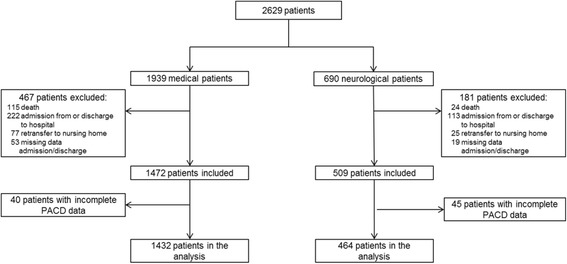
In this prospective cohort study, registered at ClinicalTrial.gov (NCT01768494) on January 2013, 1432 medical and 464 neurological patients (total n = 1896) were included consecutively between February and October 2013. PACD scores and other relevant data were extracted from electronic records of patient admissions, hospital stays, and interviews at day 30 post-hospital admission. To gauge the scores' accuracy, we plotted receiver operating characteristic (ROC) curves, calculated area under the curve (AUC), and determined sensitivity and specificity at various cut-off levels.
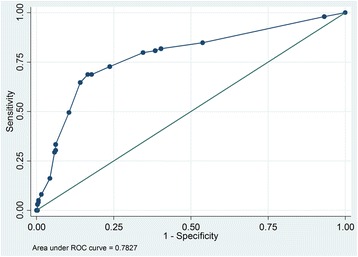
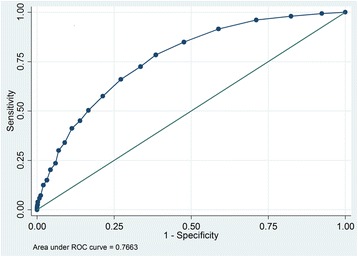
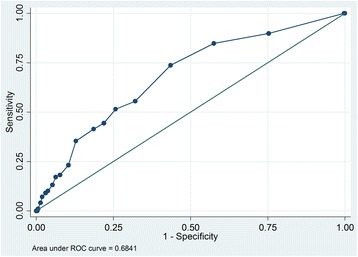
Medical patients' day 1 and day 3 PACD scores accurately predicted discharge to PAC facilities, with respective discriminating powers (AUC) of 0.77 and 0.82. With a PACD cut-off of ≥8 points, day 1 and 3 sensitivities were respectively 72.6% and 83.6%, with respective specificities of 66.5% and 70.0%. Neurological patients' scores showed lower accuracy both days: using the same cut-off, respective day 1 and day 3 AUCs were 0.68 and 0.78, sensitivities 41.4% and 68.7% and specificities 81.4% and 83.4%.
PACD scores at days 1 and 3 accurately predicted transfer to PAC facilities, especially in medical patients on day 3. To confirm and refine these results, PACD scores' value to guide discharge planning interventions and subsequent impact on hospital stay warrants further investigation.
ClinialTrials.gov Identifier, NCT01768494 .
早期识别需要转至急性后护理(PAC)机构的患者可缩短住院时间。本研究以跨专业的生物心理社会风险评估为重点,旨在评估内科和神经科患者在入院后第1天和第3天的急性后护理出院(PACD)评分作为早期筛查工具的诊断准确性和有效性。转至PAC机构作为研究结果(“金标准”)。
在这项前瞻性队列研究中,于2013年1月在ClinicalTrial.gov(NCT01768494)注册,2013年2月至10月连续纳入1432例内科患者和464例神经科患者(共n = 1896例)。PACD评分和其他相关数据从患者入院、住院期间的电子记录以及入院后30天的访谈中提取。为评估评分的准确性,我们绘制了受试者操作特征(ROC)曲线,计算曲线下面积(AUC),并确定不同截断水平下的敏感性和特异性。
内科患者第1天和第3天的PACD评分准确预测了转至PAC机构的情况,其鉴别能力(AUC)分别为0.77和0.82。当PACD截断值≥8分时,第1天和第3天的敏感性分别为72.6%和83.6%,特异性分别为66.5%和70.0%。神经科患者这两天的评分准确性较低:使用相同截断值时,第1天和第3天的AUC分别为0.68和0.78,敏感性分别为41.4%和68.7%,特异性分别为81.4%和83.4%。
第1天和第3天的PACD评分准确预测了转至PAC机构的情况,尤其是第3天的内科患者。为证实和完善这些结果,PACD评分在指导出院计划干预措施方面的价值以及对住院时间的后续影响值得进一步研究。
ClinicalTrials.gov标识符,NCT01768494 。