Department of Bioengineering, University of Illinois at Chicago, Chicago, 60607, IL, USA.
Department of Medicine, University of Illinois at Chicago, Chicago, 60612, IL, USA.
Microbiome. 2018 Feb 13;6(1):32. doi: 10.1186/s40168-018-0402-y.
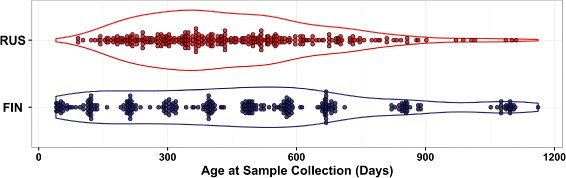
Microbial longitudinal studies are powerful experimental designs utilized to classify diseases, determine prognosis, and analyze microbial systems dynamics. In longitudinal studies, only identifying differential features between two phenotypes does not provide sufficient information to determine whether a change in the relative abundance is short-term or continuous. Furthermore, sample collection in longitudinal studies suffers from all forms of variability such as a different number of subjects per phenotypic group, a different number of samples per subject, and samples not collected at consistent time points. These inconsistencies are common in studies that collect samples from human subjects.
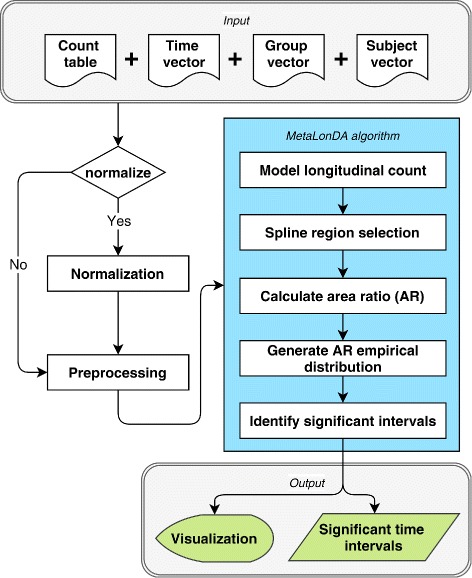
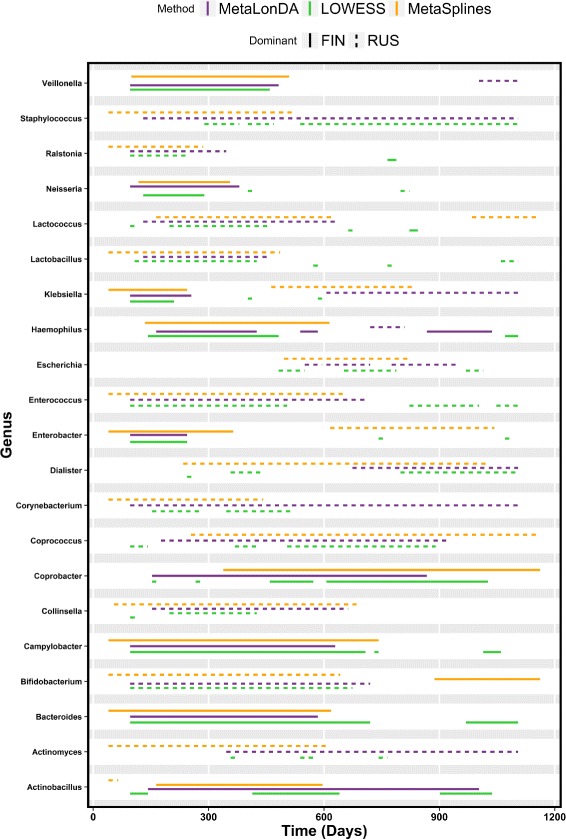
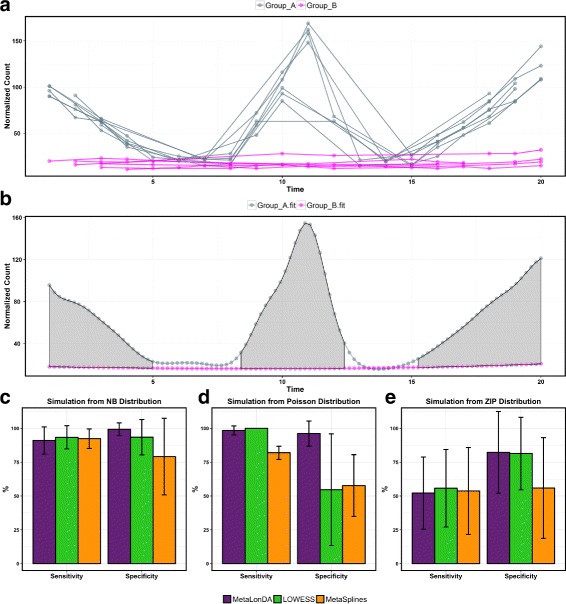
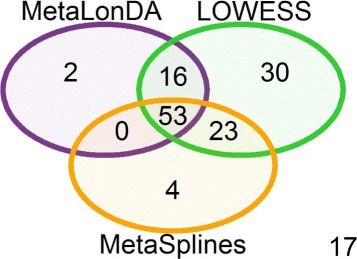
We present MetaLonDA, an R package that is capable of identifying significant time intervals of differentially abundant microbial features. MetaLonDA is flexible such that it can perform differential abundance tests despite inconsistencies associated with sample collection. Extensive experiments on simulated datasets quantitatively demonstrate the effectiveness of MetaLonDA with significant improvement over alternative methods. We applied MetaLonDA to the DIABIMMUNE cohort ( https://pubs.broadinstitute.org/diabimmune ) substantiating significant early lifetime intervals of exposure to Bacteroides and Bifidobacterium in Finnish and Russian infants. Additionally, we established significant time intervals during which novel differentially relative abundant microbial genera may contribute to aberrant immunogenicity and development of autoimmune disease.
MetaLonDA is computationally efficient and can be run on desktop machines. The identified differentially abundant features and their time intervals have the potential to distinguish microbial biomarkers that may be used for microbial reconstitution through bacteriotherapy, probiotics, or antibiotics. Moreover, MetaLonDA can be applied to any longitudinal count data such as metagenomic sequencing, 16S rRNA gene sequencing, or RNAseq. MetaLonDA is publicly available on CRAN ( https://CRAN.R-project.org/package=MetaLonDA ).
微生物纵向研究是一种强大的实验设计,可用于对疾病进行分类、确定预后,并分析微生物系统的动态。在纵向研究中,仅识别两种表型之间的差异特征并不能提供足够的信息来确定相对丰度的变化是短期的还是连续的。此外,纵向研究中的样本采集会受到各种形式的变异性的影响,例如每个表型组的受试者数量不同、每个受试者的样本数量不同以及样本不是在一致的时间点采集。这些不一致在从人体受试者收集样本的研究中很常见。
我们提出了 MetaLonDA,这是一个 R 包,能够识别差异丰度微生物特征的显著时间间隔。MetaLonDA 具有灵活性,即使在与样本采集相关的不一致情况下,它也可以执行差异丰度测试。在模拟数据集上进行的广泛实验定量证明了 MetaLonDA 的有效性,与替代方法相比有显著的改进。我们将 MetaLonDA 应用于 DIABIMMUNE 队列(https://pubs.broadinstitute.org/diabimmune),证实了芬兰和俄罗斯婴儿早期生命中暴露于拟杆菌属和双歧杆菌属的显著时间间隔。此外,我们确定了在这些时间间隔内,新的相对丰度差异的微生物属可能会导致异常免疫原性和自身免疫性疾病的发展。
MetaLonDA 计算效率高,可在台式机上运行。鉴定的差异丰度特征及其时间间隔有可能区分可能通过细菌治疗、益生菌或抗生素进行微生物重建的微生物生物标志物。此外,MetaLonDA 可以应用于任何纵向计数数据,如宏基因组测序、16S rRNA 基因测序或 RNAseq。MetaLonDA 可在 CRAN(https://CRAN.R-project.org/package=MetaLonDA)上公开获得。