Fang Haolin, Li Xianzhou, Shen Haiming, Sun Buwei, Teng Haijun, Li Pei
Department of Emergency Trauma Surgery, Jining No.1 People's Hospital, Jining 272011, P. R. China, Jining, China.
Department of Spinal Surgery, Jining No.1 People's Hospital, Jining 272011, P. R. China, Jining, China.
Biosci Rep. 2018 Feb 13;38(2). doi: 10.1042/BSR20180018.
Disc degeneration is correlated with mechanical load. Osteogenic protein-1 (OP-1) is potential to regenerate degenerative disc.
To investigate whether OP-1 can protect against high magitude compression-induced nucleus pulposus (NP) cell apoptosis and NP matrix catabolism, and its potential mechanism.
Porcine discs were cultured in a bioreactor and compressed at a relatively high-magnitude mechanical compression (1.3 MPa at a frequency of 1.0 Hz for 2 hours once per day) for 7 days. OP-1 was added along with the culture medium to investigate the protective effects of OP-1. NP cell apoptosis and matrix biosynthesis were evaluated. Additionally, activity of the p38 MAPK pathway is also analyzed.
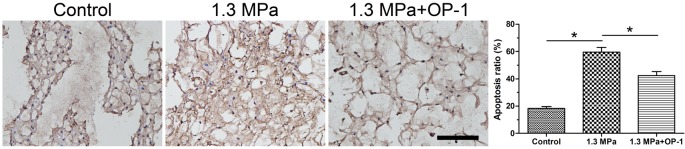
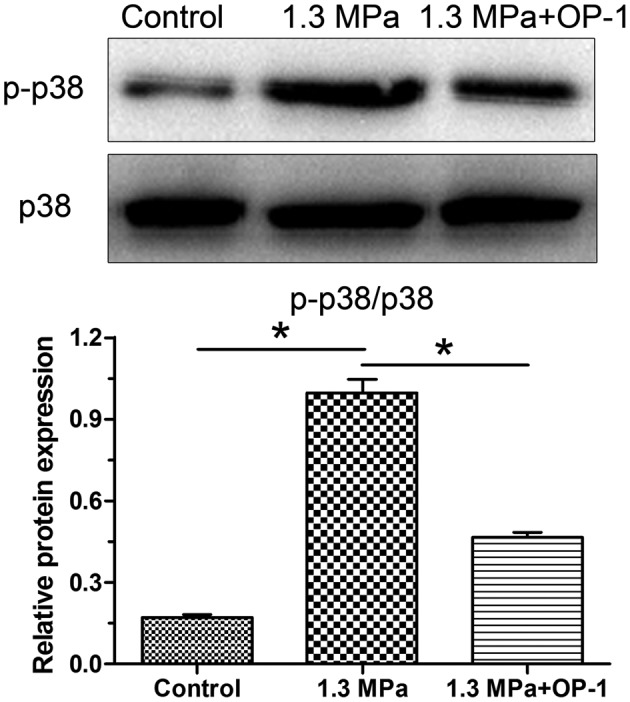
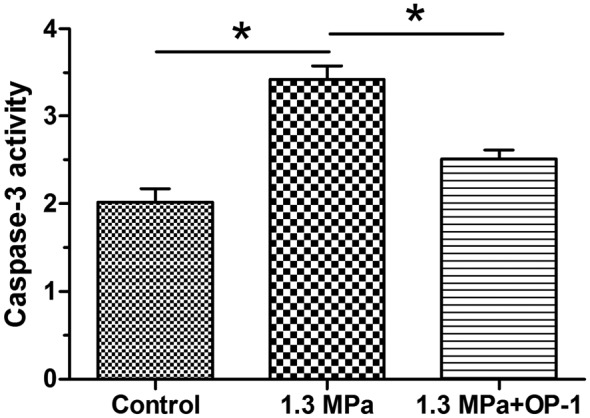
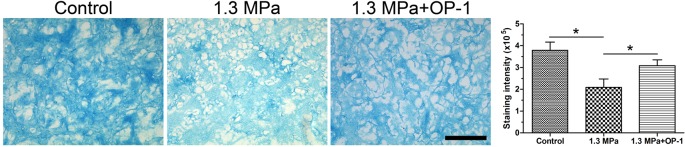
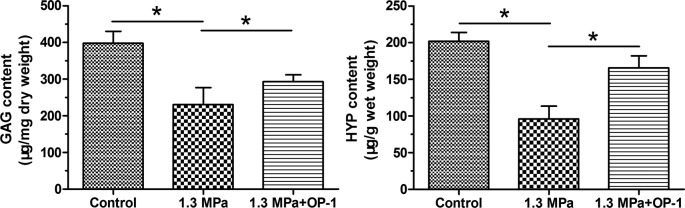
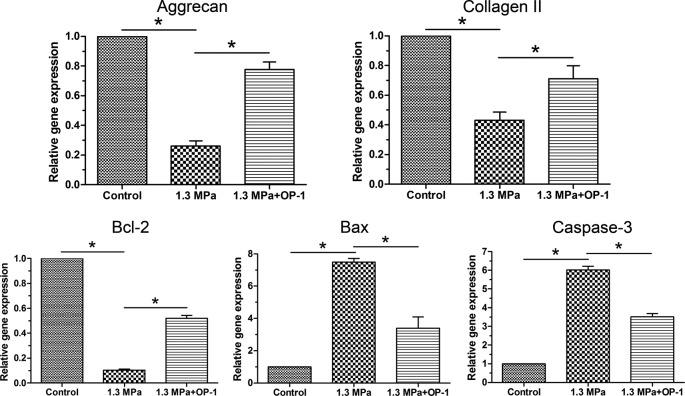
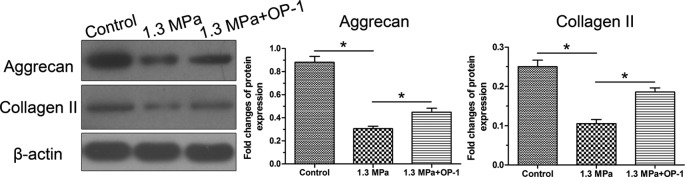
Compared with the control group, high magnitude compression significantly promoted NP cell apoptosis and decreased NP matrix biosynthesis, reflected by the increase in the number of TUNEL-positive cells and caspase-3 activity, the up-regulated expression of Bax and caspase-3 mRNA and down-regulated expression of Bcl-2 mRNA, and the decreased alcian blue staining intensity and expression of matrix proteins (aggrecan and collagen II). However, OP-1 addition partly attenuated the effects of high magnitude compression on NP cell apoptosis and NP matrix biosynthesis. Further analysis showed that inhibition of the p38 MAPK pathway partly participated in this process.
OP-1 can attenuate high magnitude compression-induced NP cell apoptosis and promoted NP matrix biosynthesis, and inhibition of the p38 MAPK pathway may participate in this regulatory process. This study provides that OP-1 may be efficacy in retarding mechanical overloading-exacerbated disc degeneration.
椎间盘退变与机械负荷相关。成骨蛋白-1(OP-1)具有修复退变椎间盘的潜力。
探讨OP-1是否能预防高幅度压缩诱导的髓核(NP)细胞凋亡和NP基质分解代谢及其潜在机制。
将猪椎间盘置于生物反应器中,以相对高幅度的机械压缩(1.3MPa,频率1.0Hz,每天一次,每次2小时)处理7天。将OP-1与培养基一起添加,以研究OP-1的保护作用。评估NP细胞凋亡和基质生物合成。此外,还分析了p38丝裂原活化蛋白激酶(MAPK)途径的活性。
与对照组相比,高幅度压缩显著促进NP细胞凋亡并降低NP基质生物合成,表现为TUNEL阳性细胞数量和半胱天冬酶-3活性增加、Bax和半胱天冬酶-3 mRNA表达上调、Bcl-2 mRNA表达下调,以及阿尔新蓝染色强度和基质蛋白(聚集蛋白聚糖和胶原蛋白II)表达降低。然而,添加OP-1部分减弱了高幅度压缩对NP细胞凋亡和NP基质生物合成的影响。进一步分析表明,抑制p38 MAPK途径部分参与了这一过程。
OP-1可减轻高幅度压缩诱导的NP细胞凋亡并促进NP基质生物合成,抑制p38 MAPK途径可能参与这一调节过程。本研究表明,OP-1可能对延缓机械过载加剧的椎间盘退变有效。