Department of Spine Surgery, Xiangya Hospital, Central South University, Changsha 410008, Hunan, People's Republic of China.
Hunan Engineering Laboratory of Advanced Artificial Osteo-Materials, Xiangya Hospital, Central South University, Changsha 410008, Hunan, People's Republic of China.
Biosci Rep. 2018 Dec 14;38(6). doi: 10.1042/BSR20181708. Print 2018 Dec 21.
Previous studies have indicated that osteogenic protein-1 has protective effects on the biological functions of intervertebral disc cells. Hyperosmolarity is an important physicochemical factor within the disc nucleus pulposus (NP) region, which obviously promotes NP cell apoptosis.
To study the effects of osteogenic protein-1 (OP-1) on NP cell apoptosis induced by hyperosmolarity and the potential signaling transduction pathway.
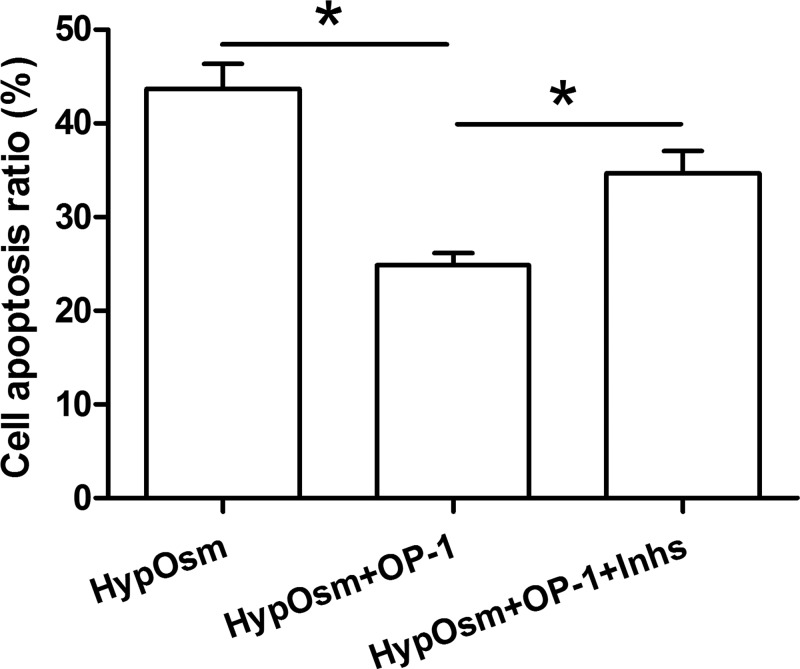
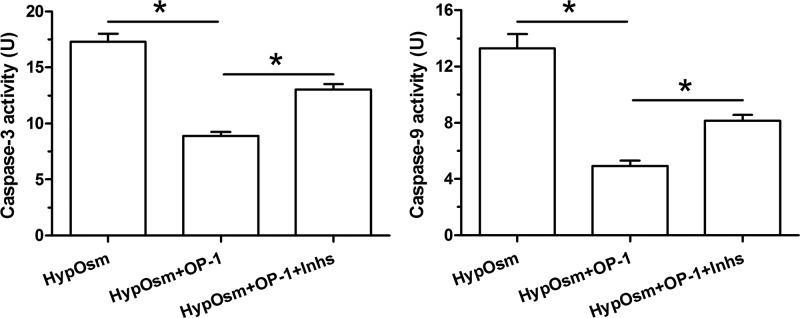
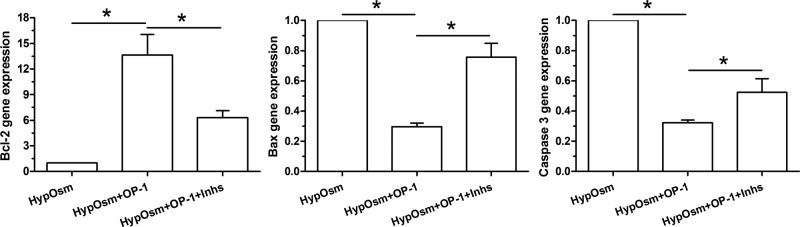
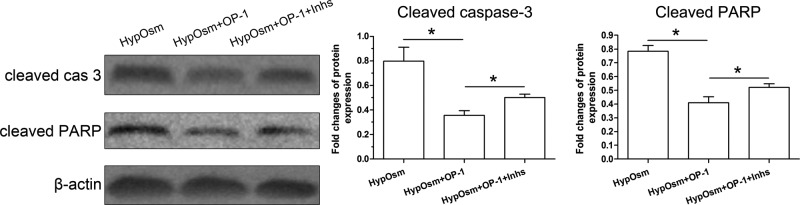
Rat NP cells were cultured in a hyperosmotic medium with or without OP-1 addition for 7 days. Inhibitor 294002 and inhibitor FK-506 were used to investigate the role of the PI3K/Akt/mTOR pathway in this process. NP cell apoptosis were evaluated by cell apoptosis ratio, activity of caspase-3/9 and gene/protein expression of apoptosis-related molecules (Bax, Bcl-2, caspase-3/cleaved caspase-3 and cleaved PARP).
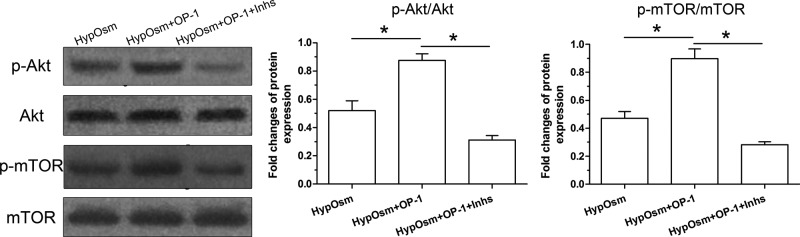
OP-1 addition obviously decreased cell apoptosis ratio and caspase-3/9 activity, down-regulated gene/protein expression of pro-apoptosis molecules (Bax, caspase-3/cleaved casepase-3 and cleaved PARP), up-regulated gene/protein expression of anti-apoptosis molecule (Bcl-2) in a hyperosmotic culture. Moreover, OP-1 addition significantly increased protein expression of p-Akt and p-mTOR. Further analysis showed that addition of LY294002 and FK-506 partly attenuated these protective effects of OP-1 against NP cell apoptosis and activation of the PI3K/Akt/mTOR pathway in a hyperosmotic culture.
OP-1 can attenuate NP cell apoptosis through activating the PI3K/Akt/mTOR pathway in a hyperosmotic culture. The present study sheds a new light on the protective role of OP-1 in regulating disc cell biology and provides some theoretical basis for the application of OP-1 in retarding/regenerating disc degeneration.
先前的研究表明,骨形成蛋白-1 对椎间盘细胞的生物学功能具有保护作用。高渗性是椎间盘核(NP)区域内的一个重要理化因素,它明显促进 NP 细胞凋亡。
研究骨形成蛋白-1(OP-1)对高渗诱导的 NP 细胞凋亡的影响及其潜在的信号转导途径。
将大鼠 NP 细胞在高渗培养基中培养,或在高渗培养基中添加 OP-1 培养 7 天。用抑制剂 294002 和抑制剂 FK-506 来研究 PI3K/Akt/mTOR 途径在这一过程中的作用。通过细胞凋亡率、半胱氨酸天冬氨酸蛋白酶-3/9 的活性以及凋亡相关分子(Bax、Bcl-2、caspase-3/cleaved caspase-3 和 cleaved PARP)的基因/蛋白表达来评估 NP 细胞凋亡。
OP-1 的添加明显降低了细胞凋亡率和 caspase-3/9 的活性,下调了促凋亡分子(Bax、caspase-3/cleaved caspase-3 和 cleaved PARP)的基因/蛋白表达,上调了抗凋亡分子(Bcl-2)的基因/蛋白表达在高渗培养中。此外,OP-1 的添加明显增加了 p-Akt 和 p-mTOR 的蛋白表达。进一步分析表明,添加 LY294002 和 FK-506 部分削弱了 OP-1 在高渗培养中对 NP 细胞凋亡和 PI3K/Akt/mTOR 途径激活的这种保护作用。
OP-1 可以通过在高渗培养中激活 PI3K/Akt/mTOR 途径来减轻 NP 细胞凋亡。本研究为 OP-1 调节椎间盘细胞生物学的保护作用提供了新的视角,并为 OP-1 在延缓/再生椎间盘退变中的应用提供了一定的理论依据。