Krefft Olivia, Jabali Ammar, Iefremova Vira, Koch Philipp, Ladewig Julia
Institute of Reconstructive Neurobiology, University of Bonn.
Institute of Reconstructive Neurobiology, University of Bonn; Central Institute of Mental Health, University of Heidelberg/Medical Faculty Mannheim; Hector Institute for Translational Brain Research (HITBR gGmbH).
J Vis Exp. 2018 Jan 23(131):56768. doi: 10.3791/56768.
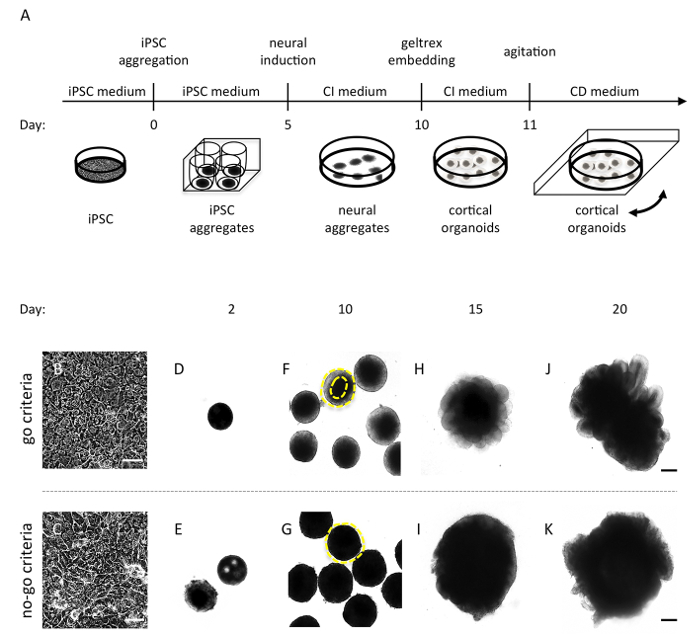
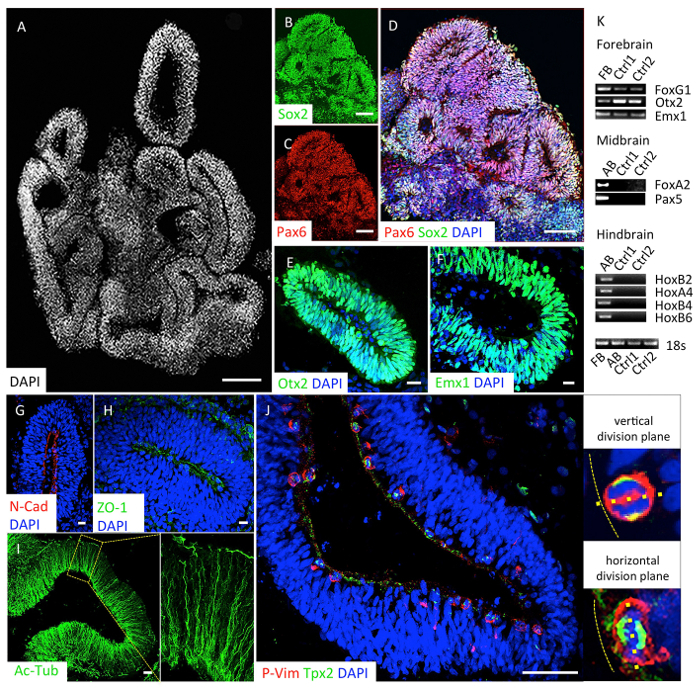
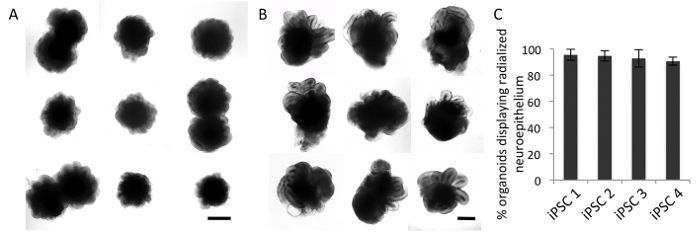
The human cortex is highly expanded and exhibits a complex structure with specific functional areas, providing higher brain function, such as cognition. Efforts to study human cerebral cortex development have been limited by the availability of model systems. Translating results from rodent studies to the human system is restricted by species differences and studies on human primary tissues are hampered by a lack of tissue availability as well as ethical concerns. Recent development in human pluripotent stem cell (PSC) technology include the generation of three-dimensional (3D) self-organizing organotypic culture systems, which mimic to a certain extent human-specific brain development in vitro. Currently, various protocols are available for the generation of either whole brain or brain-region specific organoids. The method for the generation of homogeneous and reproducible forebrain-type organoids from induced PSC (iPSC), which we previously established and describe here, combines the intrinsic ability of PSC to self-organize with guided differentiation towards the anterior neuroectodermal lineage and matrix embedding to support the formation of a continuous neuroepithelium. More specifically, this protocol involves: (1) the generation of iPSC aggregates, including the conversion of iPSC colonies to a confluent monolayer culture; (2) the induction of anterior neuroectoderm; (3) the embedding of neuroectodermal aggregates in a matrix scaffold; (4) the generation of forebrain-type organoids from neuroectodermal aggregates; and (5) the fixation and validation of forebrain-type organoids. As such, this protocol provides an easily applicable system for the generation of standardized and reproducible iPSC-derived cortical tissue structures in vitro.
人类大脑皮层高度扩展,呈现出具有特定功能区域的复杂结构,具备如认知等高级脑功能。对人类大脑皮层发育的研究一直受到模型系统可用性的限制。将啮齿动物研究结果转化到人类系统受到物种差异的制约,而对人类原代组织的研究则因组织可用性不足以及伦理问题而受阻。人类多能干细胞(PSC)技术的最新进展包括三维(3D)自组织类器官培养系统的产生,该系统在一定程度上模拟了人类特异性的体外脑发育。目前,有多种方案可用于生成全脑或脑区特异性类器官。我们之前建立并在此描述的从诱导多能干细胞(iPSC)生成均匀且可重复的前脑型类器官的方法,将PSC的自组织内在能力与向前神经外胚层谱系的定向分化以及基质包埋相结合,以支持连续神经上皮的形成。更具体地说,该方案包括:(1)iPSC聚集体的生成,包括将iPSC集落转化为汇合的单层培养物;(2)前神经外胚层的诱导;(3)将神经外胚层聚集体包埋在基质支架中;(4)从神经外胚层聚集体生成前脑型类器官;以及(5)前脑型类器官的固定和验证。因此,该方案提供了一个易于应用的系统,用于在体外生成标准化且可重复的iPSC衍生的皮质组织结构。