Schregel Katharina, Behme Daniel, Tsogkas Ioannis, Knauth Michael, Maier Ilko, Karch André, Mikolajczyk Rafael, Bähr Mathias, Schäper Jörn, Hinz José, Liman Jan, Psychogios Marios-Nikos
Institute of Neuroradiology, University Medical Center Goettingen; Department of Radiology, Brigham and Women's Hospital and Harvard Medical School;
Institute of Neuroradiology, University Medical Center Goettingen.
J Vis Exp. 2018 Jan 18(131):56397. doi: 10.3791/56397.
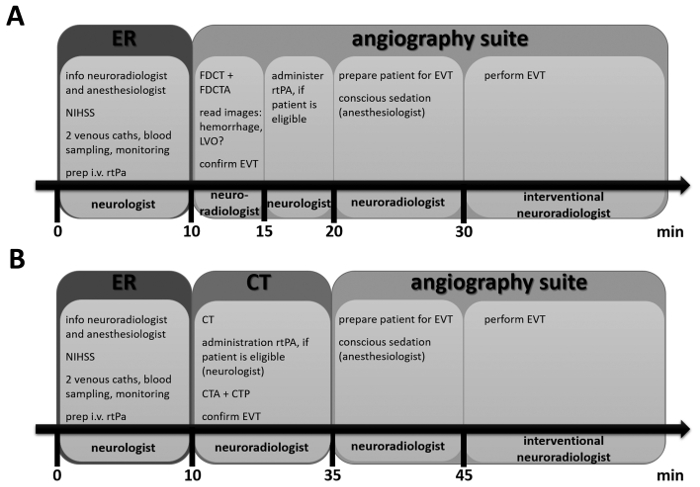
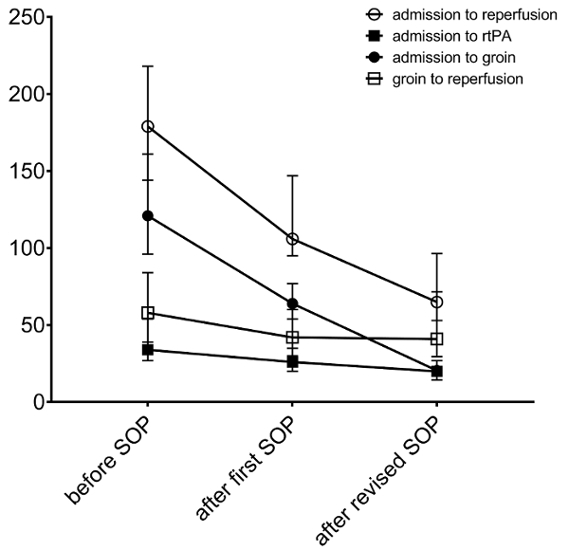
This manuscript describes a streamlined protocol for the management of patients with acute ischemic stroke, which aims at the minimization of time from hospital admission to reperfusion. Rapid restoration of cerebral blood flow is essential for the outcomes of patients with acute ischemic stroke. Endovascular treatment (EVT) has become the standard of care to accomplish this in patients with acute stroke due to large vessel occlusion (LVO). To achieve reperfusion of ischemic brain regions as fast as possible, all in-hospital time delays have to be carefully avoided. Therefore, management of patients with acute ischemic stroke was optimized with an interdisciplinary standard operating procedure (SOP). Stroke neurologists, diagnostic as well as interventional neuroradiologists, and anesthesiologists streamlined all necessary processes from patient admission and diagnosis to EVT of eligible patients. Target times for every step were established. Actually achieved times were prospectively recorded along with clinical data and imaging scores for all endovascularly treated stroke patients. These data were regularly analyzed and discussed in interdisciplinary team meetings. Potential issues were evaluated and all staff involved was trained to adhere to the SOP. This streamlined patient management approach and enhanced interdisciplinary collaboration reduced time from patient admission to reperfusion significantly and was accompanied by a beneficial effect on clinical outcomes.
本手稿描述了一种针对急性缺血性中风患者的简化治疗方案,其目的是尽量缩短从入院到再灌注的时间。迅速恢复脑血流对急性缺血性中风患者的预后至关重要。血管内治疗(EVT)已成为因大血管闭塞(LVO)导致急性中风患者实现这一目标的标准治疗方法。为了尽快实现缺血脑区的再灌注,必须仔细避免所有院内时间延误。因此,采用跨学科标准操作程序(SOP)对急性缺血性中风患者的治疗进行了优化。中风神经科医生、诊断及介入神经放射科医生以及麻醉医生简化了从患者入院、诊断到符合条件患者的EVT的所有必要流程。确定了每个步骤的目标时间。前瞻性记录了所有接受血管内治疗的中风患者实际达到的时间以及临床数据和影像评分。这些数据在跨学科团队会议上定期进行分析和讨论。对潜在问题进行了评估,并对所有相关工作人员进行培训以遵守SOP。这种简化的患者管理方法和加强的跨学科协作显著缩短了从患者入院到再灌注的时间,并对临床结果产生了有益影响。