Lemke Sandra B, Schnorrer Frank
Muscle Dynamics Group, Max Planck Institute of Biochemistry;
Muscle Dynamics Group, Max Planck Institute of Biochemistry; Aix Marseille University, CNRS, IBDM;
J Vis Exp. 2018 Feb 6(132):57312. doi: 10.3791/57312.
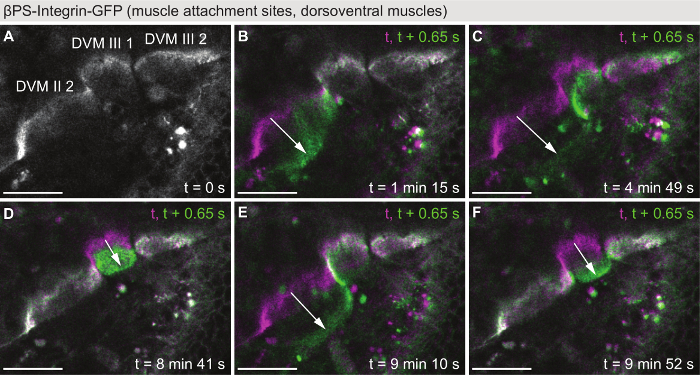
Muscles together with tendons and the skeleton enable animals including humans to move their body parts. Muscle morphogenesis is highly conserved from animals to humans. Therefore, the powerful Drosophila model system can be used to study concepts of muscle-tendon development that can also be applied to human muscle biology. Here, we describe in detail how morphogenesis of the adult muscle-tendon system can be easily imaged in living, developing Drosophila pupae. Hence, the method allows investigating proteins, cells and tissues in their physiological environment. In addition to a step-by-step protocol with helpful tips, we provide a comprehensive overview of fluorescently tagged marker proteins that are suitable for studying the muscle-tendon system. To highlight the versatile applications of the protocol, we show example movies ranging from visualization of long-term morphogenetic events - occurring on the time scale of hours and days - to visualization of short-term dynamic processes like muscle twitching occurring on time scale of seconds. Taken together, this protocol should enable the reader to design and perform live-imaging experiments for investigating muscle-tendon morphogenesis in the intact organism.
肌肉与肌腱和骨骼共同作用,使包括人类在内的动物能够移动身体部位。从动物到人类,肌肉形态发生高度保守。因此,强大的果蝇模型系统可用于研究肌肉 - 肌腱发育的概念,这些概念也可应用于人类肌肉生物学。在这里,我们详细描述了如何在发育中的活体果蝇蛹中轻松成像成年肌肉 - 肌腱系统的形态发生。因此,该方法允许在其生理环境中研究蛋白质、细胞和组织。除了带有有用提示的分步方案外,我们还提供了适用于研究肌肉 - 肌腱系统的荧光标记标记蛋白的全面概述。为了突出该方案的广泛应用,我们展示了示例视频,范围从数小时和数天时间尺度上发生的长期形态发生事件的可视化,到秒时间尺度上发生的肌肉抽搐等短期动态过程的可视化。总之,该方案应使读者能够设计和进行活体成像实验,以研究完整生物体中的肌肉 - 肌腱形态发生。