Laboratoire d'Ingénierie des Biomolécules (LIBio), ENSAIA-Université de Lorraine, 2 Avenue de la Forêt de Haye, TSA 40602, 54518 Vandœuvre-lès-Nancy CEDEX, France.
Institut Jean Lamour (UMR CNRS 7198), Université de Lorraine, Parc de Saurupt, 54011 Nancy CEDEX, France.
Int J Mol Sci. 2018 Feb 14;19(2):574. doi: 10.3390/ijms19020574.
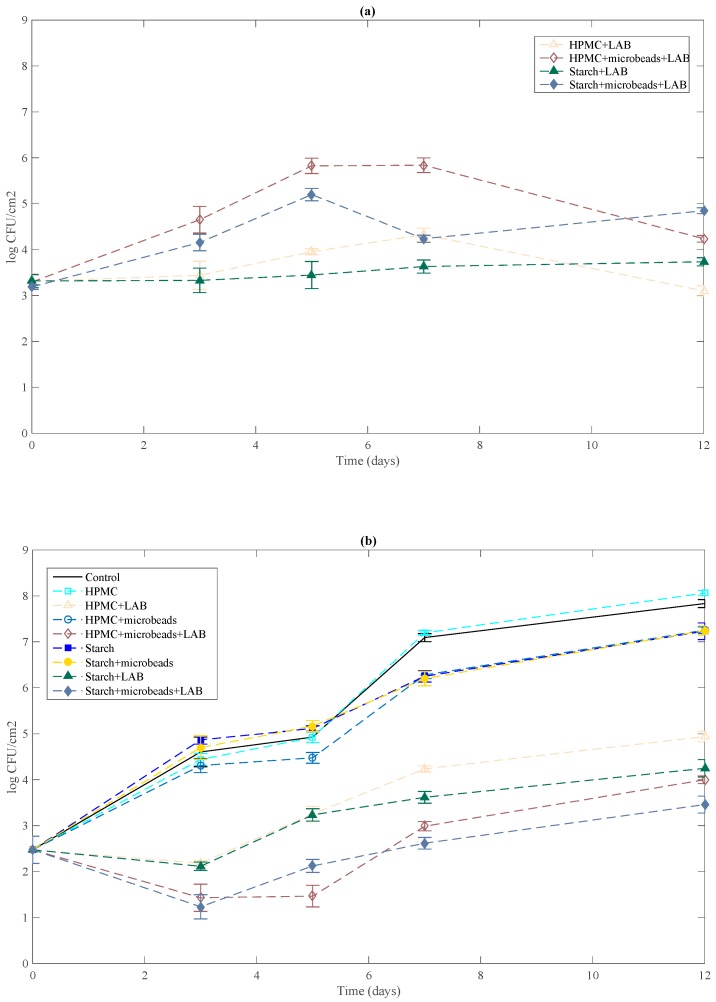
Novel bioactive films were developed from the incorporation of into polysaccharide films. Two different biopolymers were tested: cellulose derivative (hydroxylpropylmethylcellulose (HPMC)) and corn starch. Lactic acid bacteria (LAB) free or previously encapsulated in alginate-pectin composite hydrogel microbeads were added directly to the film forming solution and films were obtained by casting. In order to study the impact of the incorporation of the protective culture into the biopolymer matrix, the water vapour permeability, oxygen permeability, optical and mechanical properties of the dry films were evaluated. Furthermore, the antimicrobial effect of bioactive films against was studied in synthetic medium. Results showed that the addition of LAB or alginate-pectin microbeads modified slightly films optical properties. In comparison with HPMC films, starch matrix proves to be more sensitive to the addition of bacterial cells or beads. Indeed, mechanical resistance of corn starch films was lower but barrier properties were improved, certainly related to the possible establishment of interactions between alginate-pectin beads and starch. HPMC and starch films containing encapsulated bioactive culture showed a complete inhibition of listerial growth during the first five days of storage at 5 °C and a reduction of 5 logs after 12 days.
新型生物活性薄膜是通过将[物质名称]掺入多糖薄膜中开发的。测试了两种不同的生物聚合物:纤维素衍生物(羟丙基甲基纤维素(HPMC))和玉米淀粉。将乳酸菌(LAB)游离或预先包封在藻酸盐-果胶复合水凝胶微球中直接添加到成膜溶液中,并通过浇铸获得薄膜。为了研究将保护培养物掺入生物聚合物基质的影响,评估了干燥薄膜的水蒸气透过率、氧气透过率、光学和机械性能。此外,还研究了生物活性薄膜对[病原体名称]的抑菌作用。结果表明,LAB 或藻酸盐-果胶微球的添加略微改变了薄膜的光学性质。与 HPMC 薄膜相比,淀粉基质对细菌细胞或珠粒的添加更为敏感。事实上,玉米淀粉薄膜的机械强度较低,但阻隔性能得到了提高,这肯定与藻酸盐-果胶珠粒和淀粉之间可能建立的相互作用有关。含有包封生物活性培养物的 HPMC 和淀粉薄膜在 5°C 下储存的头五天内完全抑制了李斯特菌的生长,在 12 天后减少了 5 个对数级。