Chiou Shin-Yi, Koutsos Ermis, Georgiou Pantelis, Strutton Paul H
The Nick Davey Laboratory, Human Performance Group, Division of Surgery, Department of Surgery and Cancer, Faculty of Medicine, Imperial College London, Charing Cross Hospital, London, UK.
Department of Electrical and Electronic Engineering, Centre for Bio-inspired Technology, Imperial College London, London, UK.
BMJ Open. 2018 Feb 14;8(2):e017091. doi: 10.1136/bmjopen-2017-017091.
Characteristics of muscle activity, represented by surface electromyography (EMG), have revealed differences between patients with low back pain (LBP) and healthy adults; how they relate to functional and clinical parameters remains unclear. The purpose of the current study was to examine the correlation between frequency characteristics of EMG (analysed using continuous wavelet transform (CWT) analysis) and patients' self-rated score of disability.
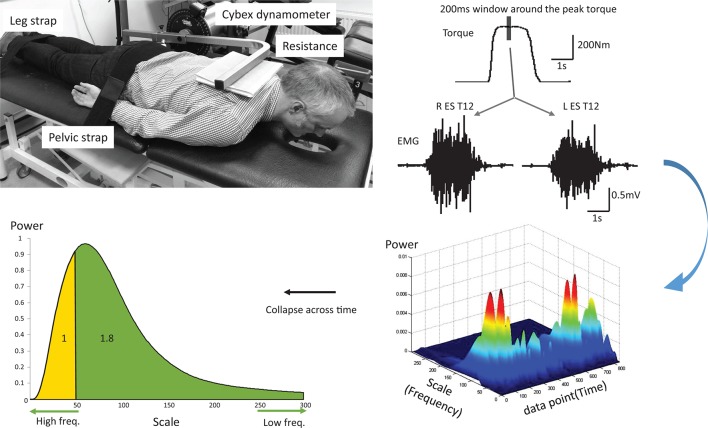
This is a case-control study with 15 patients with mechanical LBP without radicular symptoms. Patients were recruited from the orthopaedic clinic at Charing Cross Hospital. Ten healthy adults were recruited from the staff working in the hospital and associated university. Patients completed the Roland-Morris Disability Questionnaire (RMDQ) and bilateral EMG activity was obtained from erector spinae at vertebral levels L4 and T12. Subjects performed three brief maximal voluntary isometric contractions (MVICs) of the back extensors and the torque was measured using a dynamometer. CWT was applied to the EMG signals of each muscle in a 200 ms window centred around the peak torque obtained during the MVICs. The ratio (low/high frequencies) of the energy, the peak power and the frequency of the peak power were calculated for each recording site, averaged and correlated with the individual's RMDQ score.
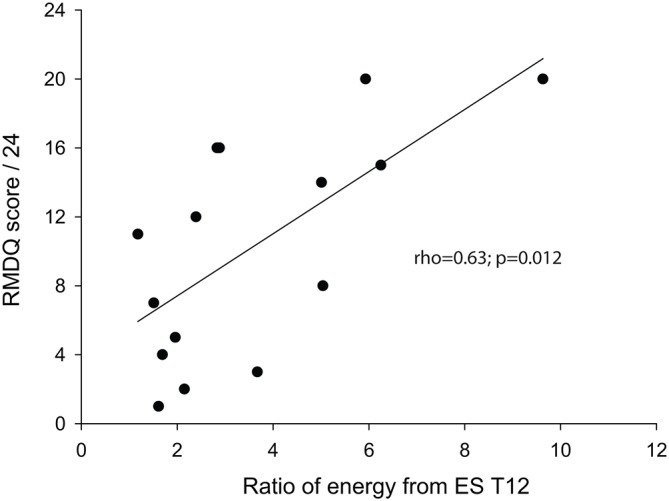
Patients had lower peak power (T12 and L4) and lower frequency of the peak power (at T12) than the healthy adults. Additionally, RMDQ positively correlated to the average ratio of energy at T12 (r=0.63; p=0.012), that is, greater self-rated disability corresponded to a dominant distribution of energy in the lower frequencies.
The current findings reveal alterations in EMG profile and its association with self-related back pain disability, suggesting that spectral characteristics of EMG reflect muscle function.
以表面肌电图(EMG)为代表的肌肉活动特征已揭示出腰痛(LBP)患者与健康成年人之间的差异;但其与功能和临床参数之间的关系仍不明确。本研究的目的是探讨肌电图频率特征(使用连续小波变换(CWT)分析)与患者自评残疾评分之间的相关性。
这是一项病例对照研究,纳入了15例无神经根症状的机械性腰痛患者。患者从查令十字医院的骨科门诊招募。10名健康成年人从医院及相关大学的工作人员中招募。患者完成罗兰-莫里斯残疾问卷(RMDQ),并从L4和T12椎体水平的竖脊肌获取双侧肌电图活动。受试者对背部伸肌进行三次短暂的最大自主等长收缩(MVIC),并使用测力计测量扭矩。将CWT应用于以MVIC期间获得的峰值扭矩为中心的200毫秒窗口内每块肌肉的肌电图信号。计算每个记录部位的能量比(低频/高频)、峰值功率和峰值功率频率,进行平均并与个体的RMDQ评分相关联。
与健康成年人相比,患者的峰值功率(T12和L4)较低,峰值功率频率(T12处)较低。此外,RMDQ与T12处的平均能量比呈正相关(r = 0.63;p = 0.012),即自评残疾程度越高,能量在低频中的分布越占主导。
当前研究结果揭示了肌电图特征的改变及其与自我相关的背痛残疾的关联,表明肌电图的频谱特征反映了肌肉功能。