Kumwenda Ben, Cleland Jennifer, Greatrix Rachel, MacKenzie Rhoda Katharine, Prescott Gordon
Centre for Healthcare Education Research and Innovation, Institute of Education for Medical and Dental Sciences, School of Medicine, Medical Sciences and Nutrition, University of Aberdeen, Aberdeen, UK.
UKCAT Consortium, Nottingham, UK.
BMJ Open. 2018 Feb 14;8(2):e018946. doi: 10.1136/bmjopen-2017-018946.
Attracting graduates was recommended as a means of diversifying the UK medical student population. Graduates now make up nearly a quarter of the total medical student population. Research to date has focused on comparing the sociodemographic characteristics of applicants to and/or students on traditional and graduate entry programmes (GEMs), yet GEMs account for only 40% of the graduate medical student population. Thus, we aimed to compare the sociodemographic characteristic and outcomes of graduates and non-graduate applicants across a range of programmes.
This was an observational study of 117 214 applicants to medicine who took the UK Clinical Aptitude Test (UKCAT) from 2006 to 2014 and who applied to medical school through Universities and Colleges Admissions Service (UCAS). We included applicant demographics, UKCAT total score and offers in our analysis. Applicants were assigned as graduates or non-graduates on the basis of their highest qualification. Multiple logistic regression was used to predict the odds of receiving an offer, after adjusting for confounders.
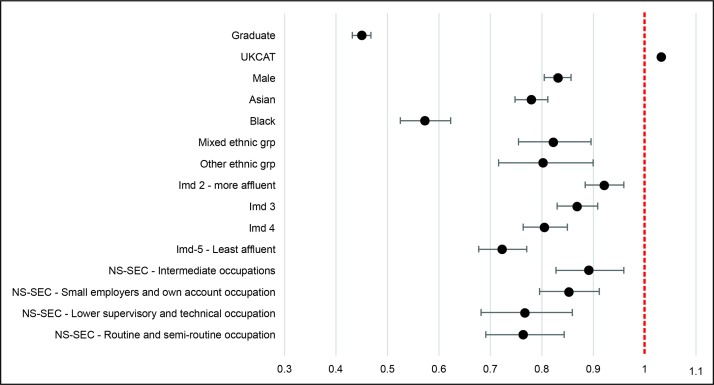
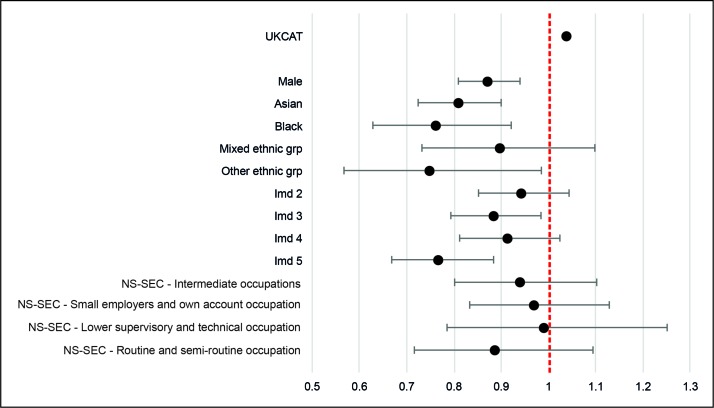
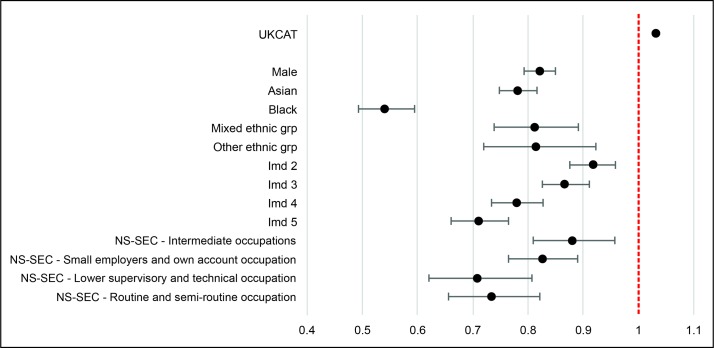
Irrespective of graduate or non-graduate status, most applicants were from the highest socioeconomic groups and were from a white ethnic background. Receiving an offer was related to gender and ethnicity in both graduates and non-graduates. After adjusting for UKCAT score, the OR of an offer for graduates versus non-graduates was approximately 0.5 (OR=0.48, 95% CI 0.46 to 0.49).
Our findings indicate that the aim of diversifying the medical student population on socioeconomic grounds by attracting graduates has been only marginally successful. Graduate applicants from widening access backgrounds are less likely than others to be offered a place at medical school. Different approaches must be considered if medicine is to attract and select more socially diverse applicants.
吸引毕业生被认为是使英国医学生群体多样化的一种方式。如今,毕业生占医学生总数的近四分之一。迄今为止的研究主要集中在比较传统入学项目和毕业生入学项目(GEMs)的申请者及/或学生的社会人口学特征,然而GEMs仅占研究生医学生群体的40%。因此,我们旨在比较一系列项目中毕业生和非毕业生申请者的社会人口学特征及结果。
这是一项对117214名医学申请者的观察性研究,这些申请者在2006年至2014年期间参加了英国临床能力倾向测试(UKCAT),并通过大学和学院招生服务中心(UCAS)申请医学院。我们的分析包括申请者的人口统计学信息、UKCAT总分及录取情况。申请者根据其最高学历被分为毕业生或非毕业生。在调整混杂因素后,使用多因素逻辑回归来预测获得录取的几率。
无论毕业生或非毕业生身份如何,大多数申请者来自社会经济地位最高的群体,且为白人种族背景。毕业生和非毕业生获得录取都与性别和种族有关。在调整UKCAT分数后,毕业生获得录取的比值比(OR)与非毕业生相比约为0.5(OR = 0.48,95%可信区间0.46至0.49)。
我们的研究结果表明,通过吸引毕业生以实现医学生群体社会经济背景多样化的目标仅取得了些许成功。来自拓宽入学机会背景的毕业生申请者比其他申请者获得医学院录取名额的可能性更小。如果医学要吸引和选拔更多社会背景多样化的申请者,就必须考虑不同的方法。