MRC Laboratory of Molecular Biology, Francis Crick Ave., Cambridge CB1 0QH, U.K.
Biochem J. 2018 Feb 14;475(3):643-648. doi: 10.1042/BCJ20170785.
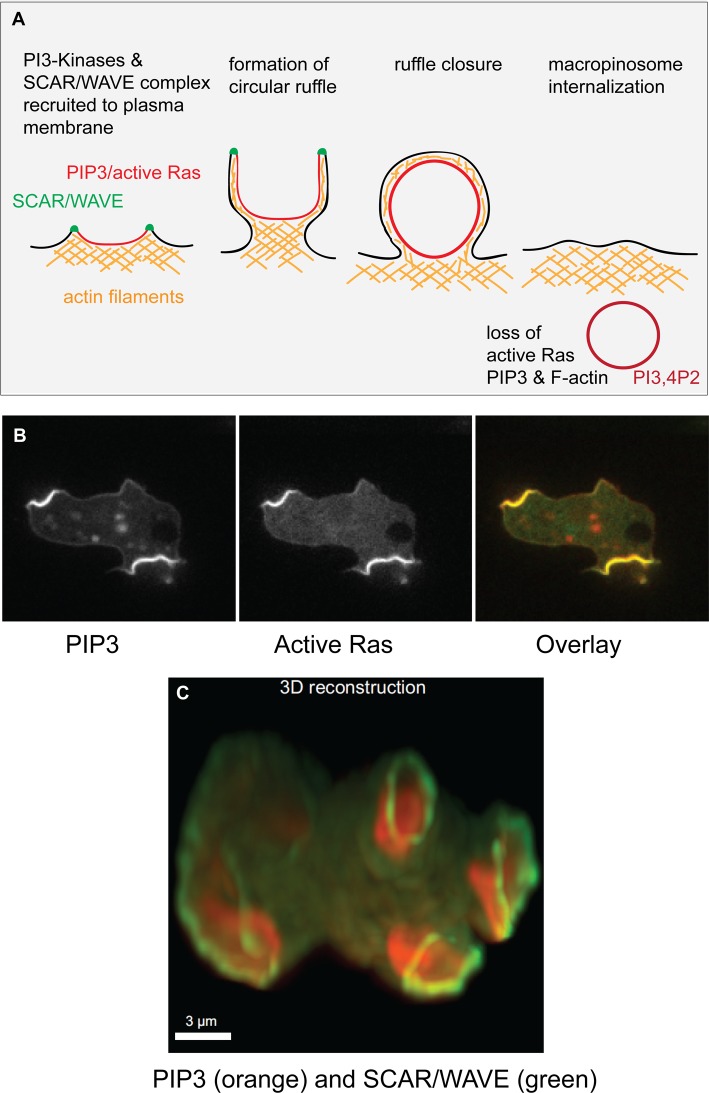
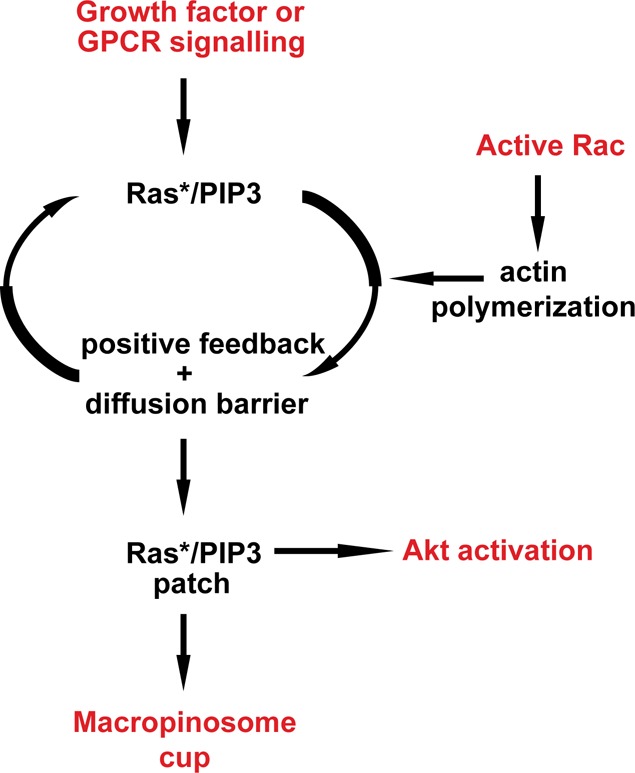
In a role distinct from and perhaps more ancient than that in signal transduction, PIP3 and Ras help to spatially organize the actin cytoskeleton into macropinocytic cups. These large endocytic structures are extended by actin polymerization from the cell surface and have at their core an intense patch of active Ras and PIP3, around which actin polymerizes, creating cup-shaped projections. We hypothesize that active Ras and PIP3 self-amplify within macropinocytic cups, in a way that depends on the structural integrity of the cup. Signalling that triggers macropinocytosis may therefore be amplified downstream in a way that depends on macropinocytosis. This argument provides a context for recent findings that signalling to Akt (an effector of PIP3) is sensitive to cytoskeletal and macropinocytic inhibitors.
在一个与信号转导不同的角色中,可能比信号转导更古老的角色中,PIP3 和 Ras 帮助将肌动球蛋白细胞骨架空间组织成大胞饮杯。这些大的内吞结构通过肌动蛋白聚合从细胞膜表面延伸,其核心是一个强烈的活性 Ras 和 PIP3 斑点,周围聚合肌动蛋白,形成杯状突起。我们假设活性 Ras 和 PIP3 在大胞饮杯中自我放大,这种方式依赖于杯的结构完整性。因此,触发大胞饮作用的信号可能在依赖大胞饮作用的下游被放大。这个论点为最近的发现提供了一个背景,即 Akt(PIP3 的效应物)的信号对细胞骨架和大胞饮抑制剂敏感。